
Here's why voters are sticking with Trump as party leaders abandon him

GOP voters have seen too many conservatives transformed from monster to moderate hero in the media's eyes.

October 10, 2017 at 5:03PM
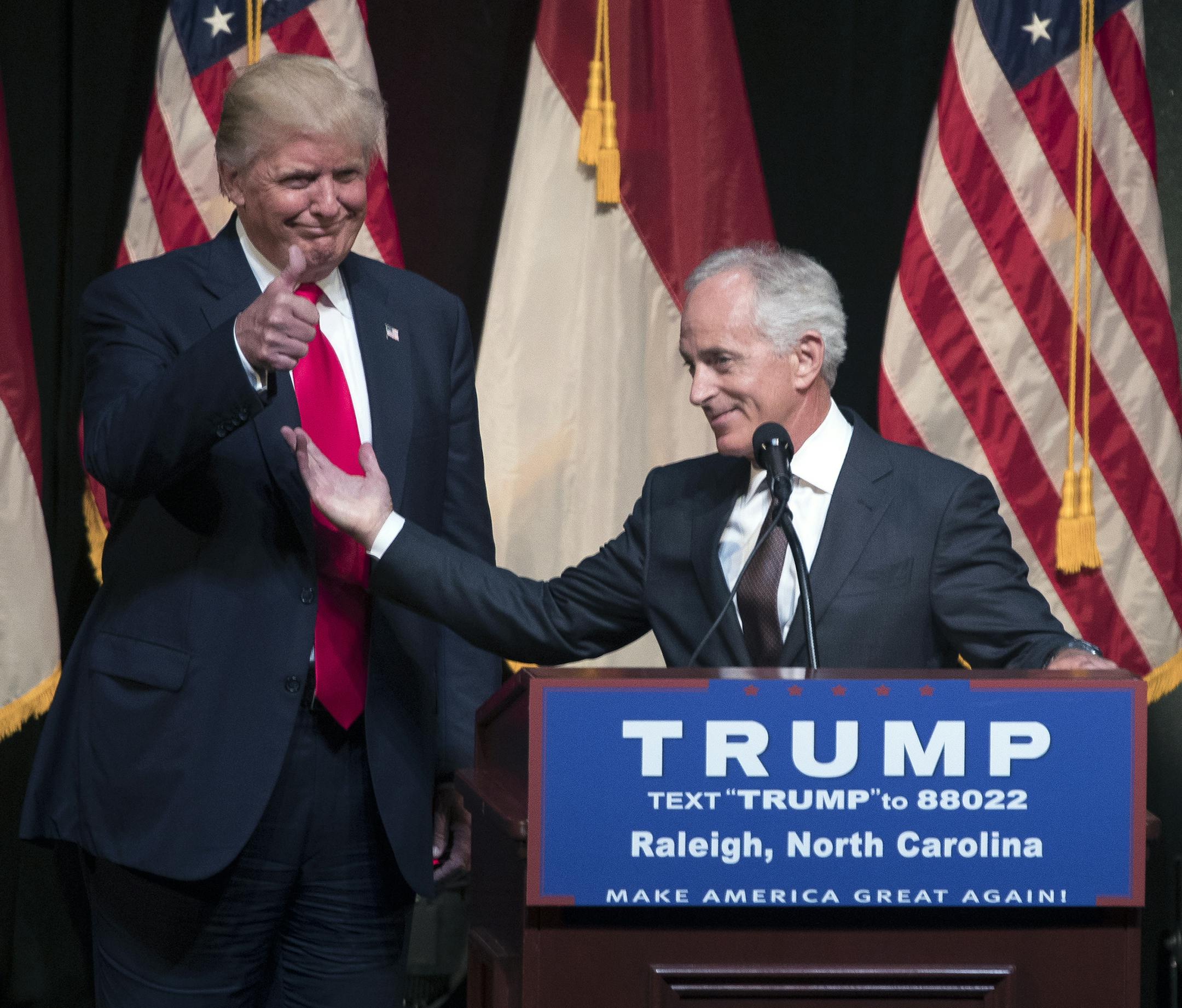
FILE -- Sen. Bob Corker (R-Tenn.), right, introduces Donald Trump, then a candidate for president, at a campaign rally in Raleigh, N.C., on July 5, 2016. Corker, the chairman of the Senate Foreign Relations Committee, charged in an interview on Sunday, Oct. 8, 2017, that President Trump was treating his office like “a reality show,” with reckless threats toward other countries that could set the nation “on the path to World War III.” (Stephen Crowley/The New York Time
FILE -- Sen. Bob Corker (R-Tenn.), right, introduces Donald Trump, then a candidate for president, at a campaign rally in Raleigh, N.C., on July 5, 2016. Corker, the chairman of the Senate Foreign Relations Committee, charged in an interview on Sunday, Oct. 8, 2017, that President Trump was treating his office like “a reality show,” with reckless threats toward other countries that could set the nation “on the path to World War III.” (Stephen Crowley/The New York Times) (The Minnesota Star Tribune)

Bloomberg View.

One of the stranger aspects of the Donald Trump presidency is how many Republican voters still support him. According to the latest Gallup poll, 81 percent of party voters approve of his job performance, down just 10 points since the inauguration.

It's strange because so many Republican members of Congress, not to mention conservative journalists and intellectuals, find the president so dangerous. The latest example is Sen. Bob Corker, R-Tenn., chairman of the Senate Foreign Relations Committee, who announced last month that he would not be seeking re-election.

As he told the New York Times on Sunday: "Look, except for a few people, the vast majority of our caucus understands what we're dealing with here. Of course they understand the volatility that we're dealing with and the tremendous amount of work that it takes by people around him to keep him in the middle of the road."

Corker was responding to one of Trump's latest tweetstorms. The president said Corker begged him for an endorsement, which Corker denies. Corker responded by observing that the White House had turned into an adult day-care center.

Now there are a few explanations why so many Republicans disagree with their representatives in Congress. For many on the left, this is evidence of a deep and racist rot within the party.

Conservative populists, meanwhile, argue that the disconnect is best explained by the failure of the Republican establishment to address illegal immigration and the downside of free trade agreements and their impact on the working class. Another explanation is the failure of the Republican Party to make good on its own promises to police the border or repeal Obamacare.

I favor a fourth explanation. I call it the media cycle of deplore and rehabilitate. Often a Republican, fresh on the national stage, will say or do something that earns not only the rebuke of liberals and Democrats, but also of another Republican who was once deplored by the same crowd.

It's an old pattern. In 1964, Sen. Barry Goldwater was to liberals the dangerous ideologue who quipped that he would leave it up to field commanders in Europe to determine when to launch nuclear weapons at the Soviet Union. He aligned himself with hardcore anticommunists and attacked his party's establishment. By the end of Goldwater's career, he was the conscientious conservative warning his fellow Republicans about the rise of the religious right.

Corker himself is an example of the deplore-and-rehabilitate cycle. This week he is the darling of thoughtful conservatives and liberals because he has the courage to speak plainly about the unique danger of the Trump presidency. But Corker himself was a key validator of Trump in 2016, praising the then-candidate's first major foreign policy speech and serving as an adviser to the candidate. As recently as mid-September, Corker downplayed rumors of a rift between himself and the president when he said, "For people to act as if there's daylight between us, that just is not true."

Indeed, when he first ran for the Senate in 2006, Corker was perceived as a political cynic willing to play on racial resentments against Democratic candidate Harold Ford Jr., an African-American. The Republican National Committee ran an ad for Corker that featured a white woman saying, "I met Harold Ford at the Playboy party," prompting a mini-scandal. William Cohen, a former Republican senator from Maine, took to CNN to denounce the ad as "a very serious appeal to a racist sentiment."

Of course, politicians are allowed to change their minds. But the voters are smarter than most of their representatives think. They've seen this cycle play out for decades and it almost always ends the same way. In 2008, presidential candidate John McCain was a dangerous, out-of-touch warmonger who wanted to bomb-bomb-bomb Iran. Today he is a statesman doing his best to save the republic from the leader of his party.

The sad truth is that Trump really is playing a dangerous game. His personal insults against North Korea's dictator, Kim Jong Un, risk an escalation and detract from a strategy aimed at pressuring China to rein in its client. His personal and public eruptions at senior advisers and cabinet secretaries undermine their ability to do their jobs. His failure to build coalitions in Congress has scuttled his party's legislative agenda.

More Republicans should disapprove of Trump's job performance. And perhaps they would — if his Republican critics were not so eager to collaborate with the liberals who once deplored them too.

about the writer

about the writer

Eli Lake

More from Commentaries

See More
card image
Alex Kormann/The Minnesota Star Tribune

About grand juries and trial juries and the need to uphold the standards of these bulwarks against tyranny.

card image
card image