

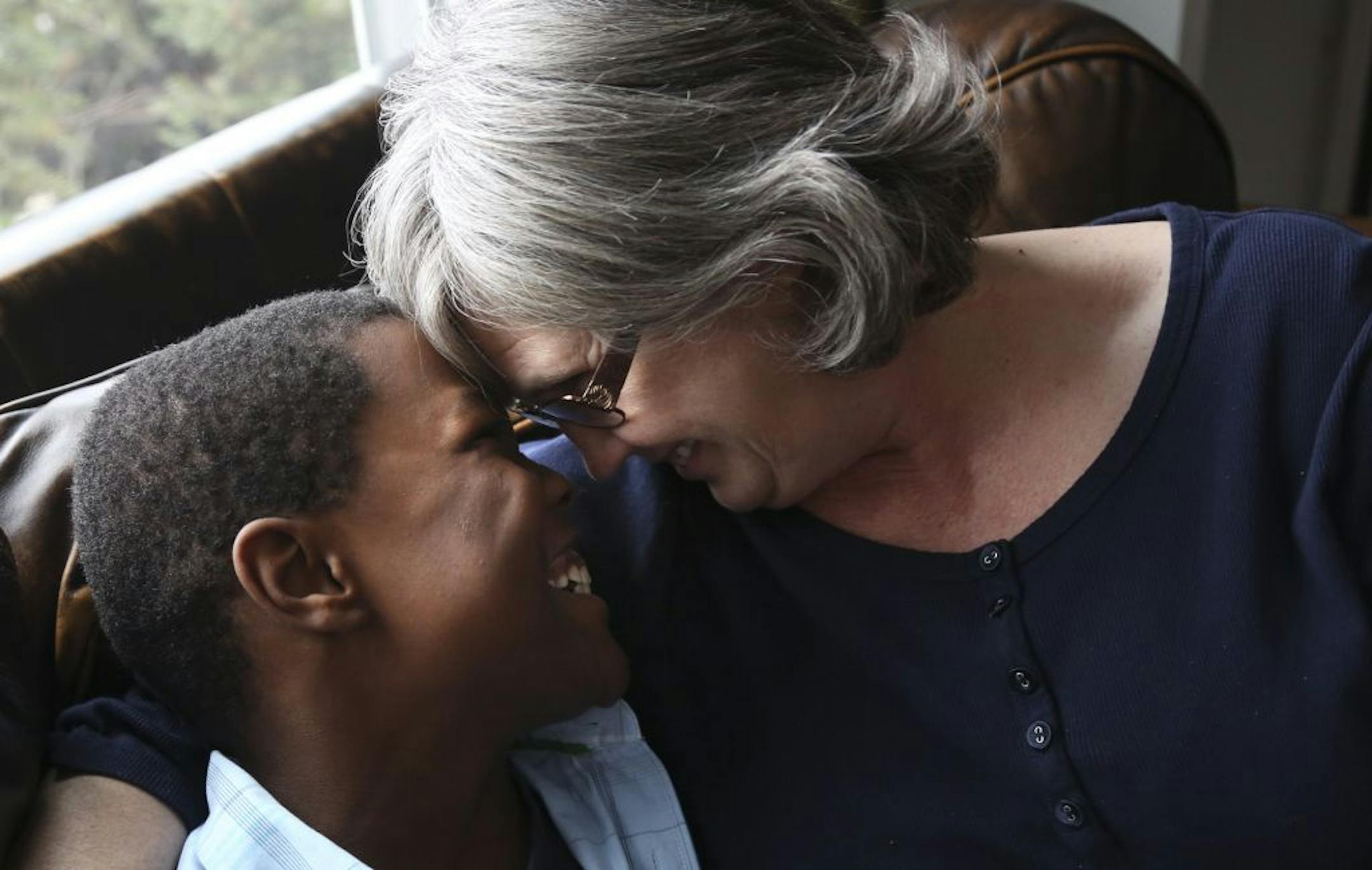
A drawing of a bright green rocket ship, complete with red flames, is proudly displayed on the refrigerator in the Hopkins home of Teresa and Brad Hassing. While at first glance it might seem like ordinary refrigerator-door fare, it is just one tiny example of how far the artist, their 10-year-old son Ezekiel, has come since being adopted by the Hassing family three years ago.
When and if Ezekiel would use crayons, everything was inexplicably black and blue. He was, in Teresa Hassing's words, "extremely hyper -- the fastest pingpong ball you'd ever seen going around the room." There were enormous temper tantrums, along with episodes at both home and school where Ezekiel would throw objects. Calls from school about his behavior became routine.
Ezekiel had been in foster care since age 5, with no contact from his birth parents. As his behavior problems worsened, he began participating in a day treatment program at Washburn Center for Children in Minneapolis, which offers half-day sessions for children ages 3 to 9 who suffer from social, emotional and behavioral issues.
Although Ezekiel had graduated from that program just before turning 7, his behavior reverted significantly when he came to live with the Hassings, so they once again began working with the staff at Washburn to help Ezekiel overcome the serious trauma that was affecting his social and emotional behavior.
"He was old enough to remember his mother, but he had blocked out everything about the trauma of being abandoned," said Hassing. "We did everything the Washburn staff suggested. My husband would pick him up to soothe him when he'd get out of control, but he just kept us at arm's length in many ways. He didn't want us to get too close -- he didn't want to hurt any more." Eventually, reactive attachment disorder (RAD) was diagnosed, defined by the American Academy of Child and Adolescent Psychiatry as "a complex psychiatric illness characterized by severe problems in emotional attachments to others."
Not long after his 10th birthday, Ezekiel experienced a major breakthrough during a play session at Washburn when he talked to his therapist about his birth mother and the last time he saw her. Hassing said she will never forget the smile on her son's face as he walked out of the room toward her.
"He was able to tell me everything he remembered," she said. "For about three weeks afterwards, he was very emotional, but we had definitely turned the corner."
A predictable place


