

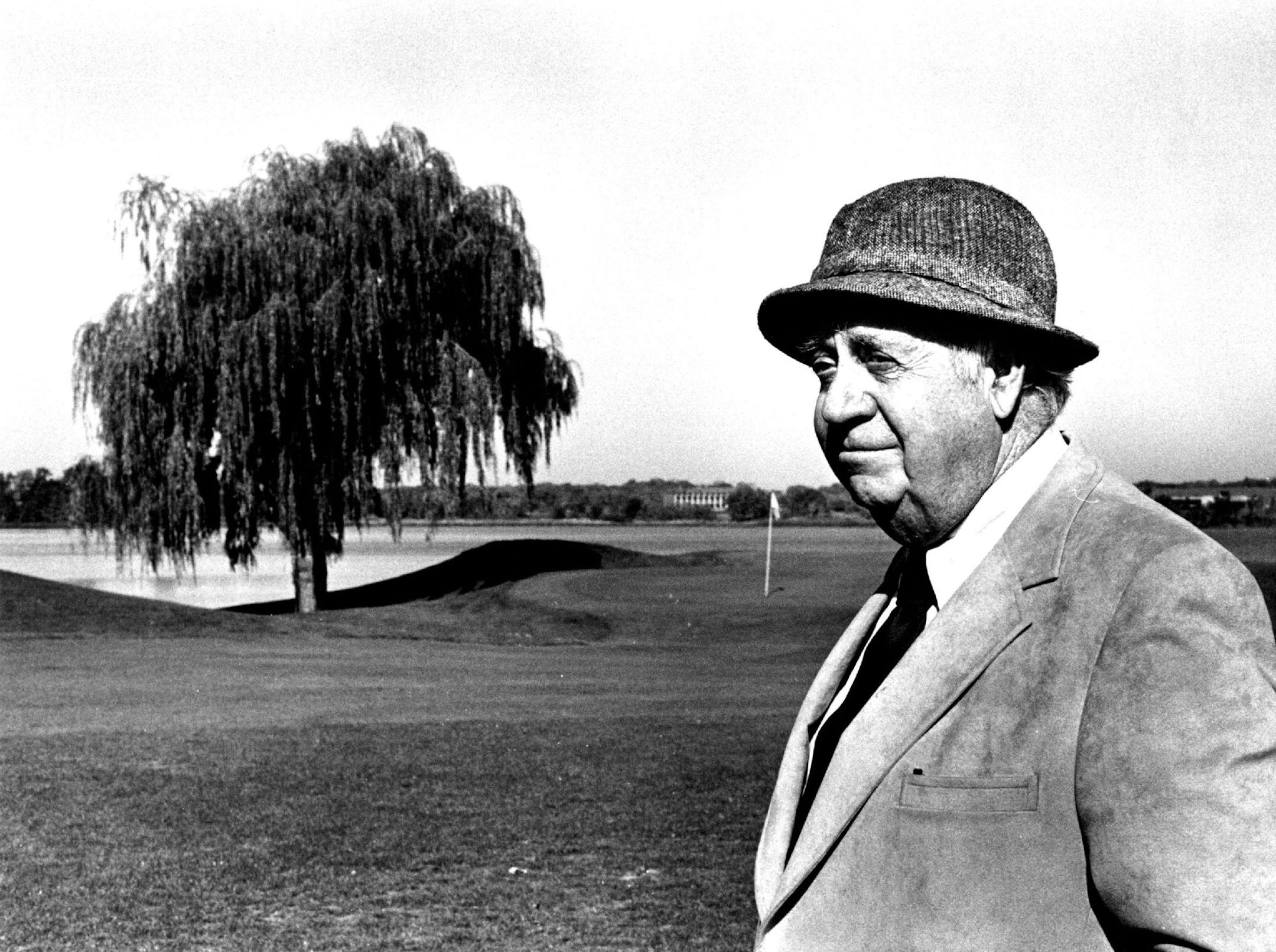
The Twin Cities were jostling toward Major League Baseball and professional football in the late 1950s. But local businessman Totton Peavey Heffelfinger had another grand sports vision. So one day, in 1958, he climbed aboard a small airplane to search for the piece of land that ultimately would carry Minnesota's standing as a big-league golf venue into the 21st century.
Seated next to Heffelfinger was Chicago golf course architect Robert Bruce Harris, who recently had designed Wayzata Country Club. Harris became a long-forgotten historical footnote, replaced by the legendary Robert Trent Jones in this golfing tale. But on this particular day, as the plane circled the cities, Harris looked down upon the tiny farming community of Chaska, turned to Heffelfinger and suggested his dream was nestled in the 725 acres around Hazeltine Lake.
The lake was named after a popular schoolteacher. Originally, the golf course that would sprout nearby for $1.1 million was to be called the Executive Golf Club of Minnesota, a name Jones suggested as part of a futuristic idea for a nationwide network of clubs with reciprocal memberships. When that idea failed, Hazeltine National Golf Club was born in 1962 with "a mission to build and maintain a golf course suitable for the conduct of national championships."
Now 54 years old and nearly 900 acres in size, Hazeltine has played host to two U.S. Opens, two PGA Championships, two U.S. Women's Opens, a U.S. Senior Open and more United States Golf Association (USGA) championships than any other golf club. But the best, members say, lies ahead when the 41st Ryder Cup moves Hazeltine onto the pre-eminent international golf stage from Friday to Sunday.
"The Ryder Cup is the ultimate prize in terms of worldwide interest and publicity for your course and your community," said Reed Mackenzie, a Hazeltine member since 1965 and a former USGA president. "It's like the PGA Championship or the U.S. Open on steroids."
Tot's dream
Frank Heffelfinger became an original member of the Minikahda Club when it opened in Minneapolis with nine holes in 1899, the year his son, Totton, was born. Minikahda played host to the 1916 U.S. Open and the 1927 U.S. Amateur. Three years later, Bobby Jones won the 1930 U.S. Open at Interlachen Country Club en route to his famous Grand Slam.
But 27 years passed and the Twin Cities still hadn't been awarded another U.S. Open. Even as USGA president in 1952-53, Totton Heffelfinger couldn't get the USGA to return. The U.S. Open had outgrown every course in town.
So in 1958, Heffelfinger asked his fellow members to build another course farther out of town. He had the foresight to know major championships would need courses with extra acreage for a malleable golf course and plenty of open land around it.


