

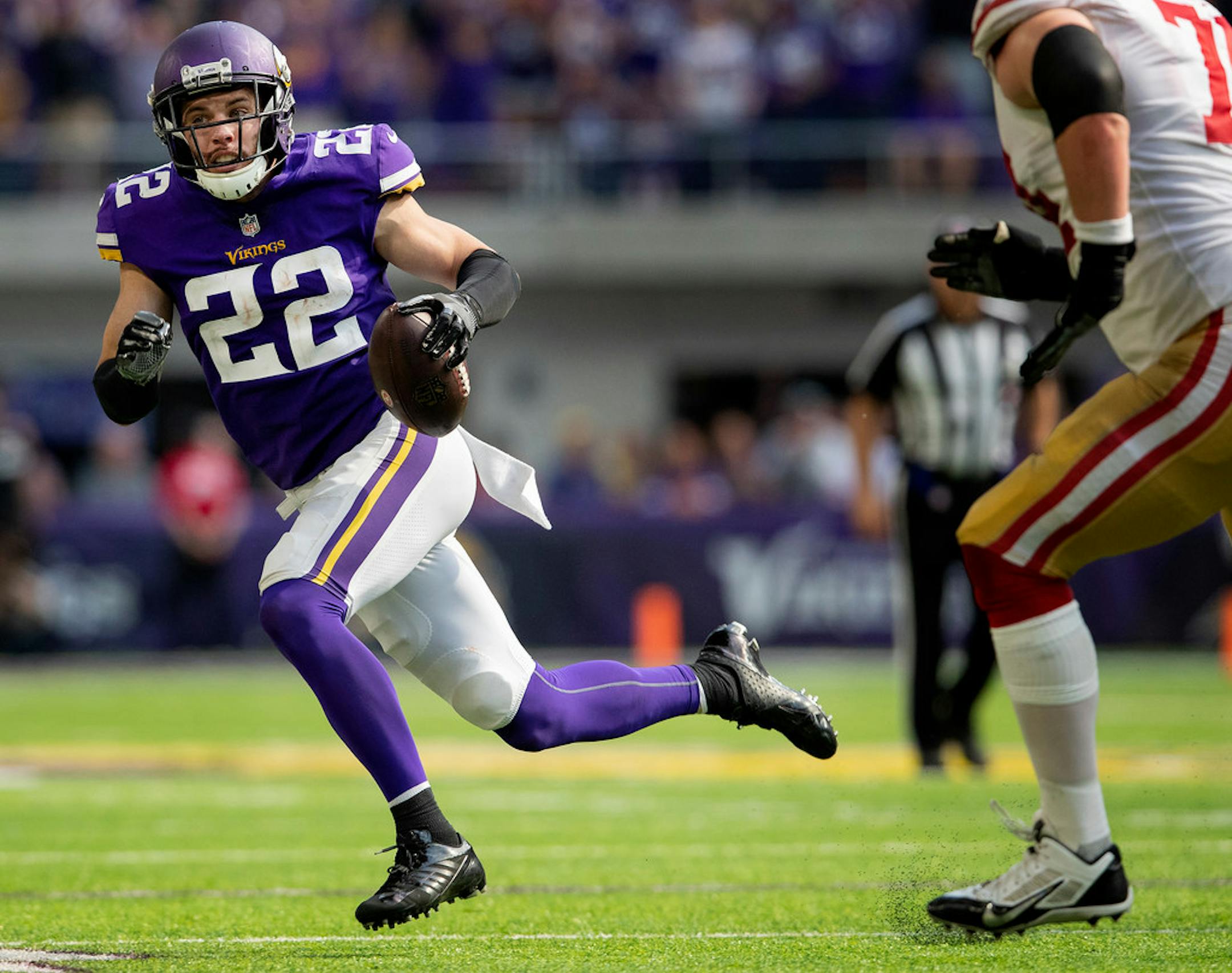
During the course of preparing for the story I wrote on Harrison Smith for Sunday's Star Tribune, the safety mentioned something about his preparation that I thought was worth discussing in more detail here.
In the meticulous process of studying an upcoming opponent, Smith said, one of the keys for him was learning what not to focus on.
"I know more how to prepare myself — how to actually take knowledge from practice and film study and things like that into a game," he said. "In your younger days, sometimes it feels like you're drinking out of a firehose, because you can try to do too much. It's hard to retain that and actually use it. … You can't always take everything that you might want to take with you. It's not always realistic, as far as in the game, in the moment, the play calls, down-and-distance situations. You have to learn how much you can take with you."
Smith said the process is ongoing for him — "It's not like I have it figured out yet," he said — but in his seventh year, he's got a better sense of how his preparatory time can be most useful. Players can inundate themselves with information, from an opponent's tendencies in certain personnel groups to something that might serve as a tell (the way a player aligns himself before the snap when he's going to run a certain route, for example), and the risk of information overload becomes ever greater as data and analytics become more prevalent. There's only so much, Smith said, that can be applicable during the four- or five-second lifespan of a play.
That was one of the big lessons Terence Newman said he tried to impart on young players while he was playing. Many players have to learn what to look for when studying film in the NFL, especially if they're from a college program that doesn't instill effective study skills in players, Newman said.
"There's guys that will come in, and you'll see they're moreso watching plays and players than actually watching for formations and splits and things of that nature," Newman said. "I think, honestly, it just depends on the player, and a lot of times, it depends on the program that they come from, and the people they've been around. When I was in college [at Kansas State], we watched film differently than a lot of guys that I saw when I first came into the league. They were watching, 'Oh, look at this guy get blown up!' If you're watching that, that's the wrong thing for a secondary guy. If you're looking at linemen and stuff, that's not what you're supposed to be looking at."
So how do players learn? For Smith, the process involved talking to older players, and some trial and error. Newman said he took some of his cues from what coaches emphasized in team meetings.
"You get a sense of, 'OK, maybe I'm looking at the wrong stuff, because they're talking about this [receiver] split, and this guy doing this and this guy doing that,'" Newman said. "You kind of get a sense of it. 'Zim' will watch film, and [defensive backs] coach [Jerry} Gray will watch film. You get a sense of what you're supposed to look at, once you hear them talk, and they're saying, 'Hey, [look for this] when this guy gets here, and this guy gets there.'"


