

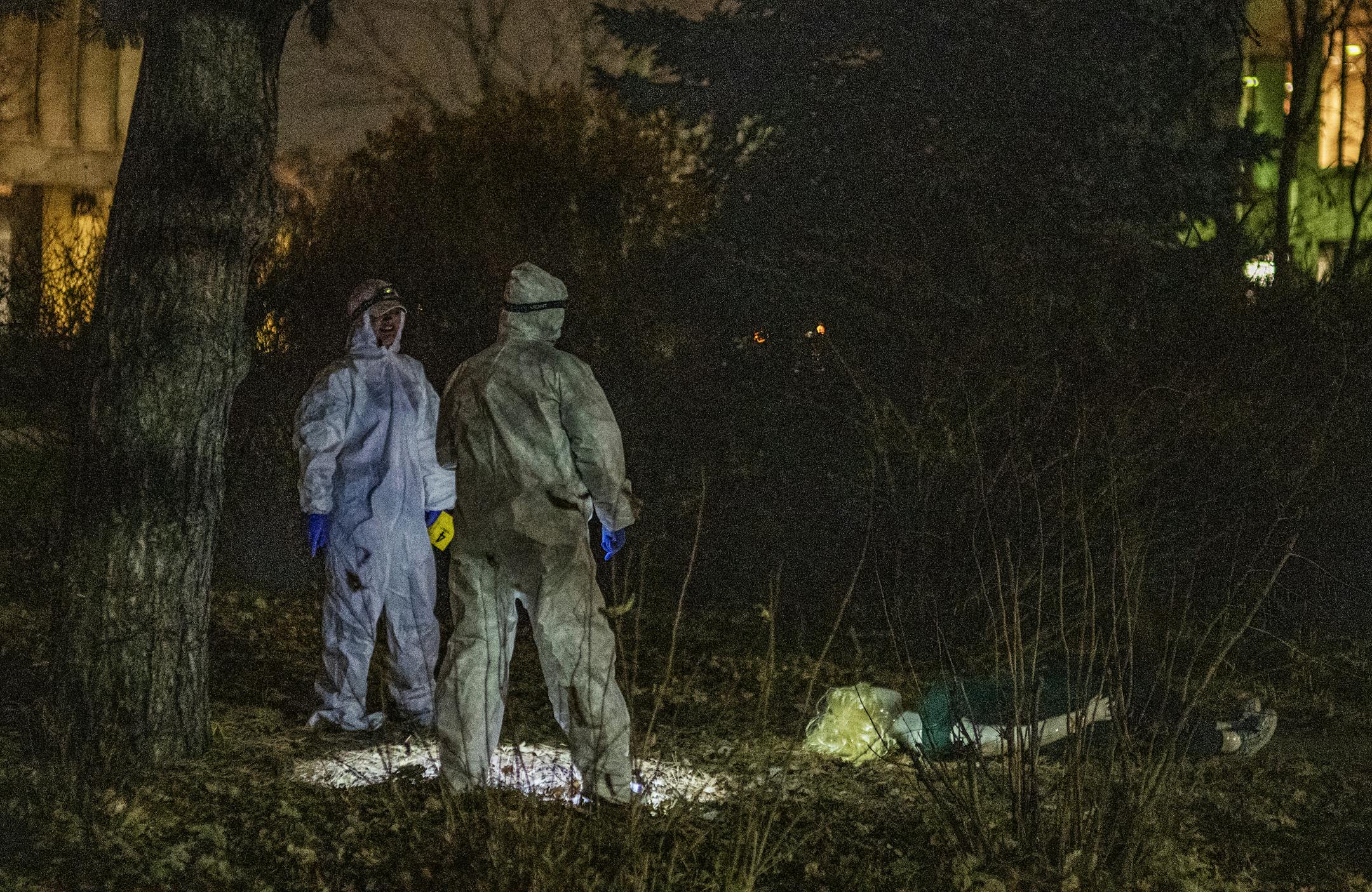
The calls come after midnight: "There has been an incident in the Blue Garden. I need you to respond."
Forensic science students at Hamline University rise from their sleep and trickle into the courtyard at the center of the St. Paul campus, where a crime scene awaits.
The victims are mannequins. Their wounds are prosthetics. Now the students must collect the evidence and figure out what happened to them.
"It's really a test of everything they've learned this semester," said assistant professor Jamie Spaulding. And it's a test of whether the students really want to become forensic investigators.
Hamline is one of the few colleges in the Midwest that offers a forensic science major, which aims to prepare students for careers as investigators. While some people still enter the field after studying criminal justice, biology or chemistry, Spaulding hopes that offering a forensic science major provides students with more hands-on experience and makes their credentials more appealing to potential employers.
The university has been offering the major for just a couple of years, and already roughly 60 students have signed up for it. Another 30 students are minoring in it. Demand for forensic science technicians is expected to grow this decade, and the median wage runs about $80,000 per year, according to data from the Minnesota Department of Employment and Economic Development.
The crime scene and death investigation course is one of the most popular electives in the program, which also includes classes on lifting fingerprints, testing firearms and giving court testimony.
By the time they arrive at the courtyard crime scene, students have learned to sketch out a crime scene and photograph it. They've learned to test blood and semen. They've learned how to catalog evidence.
![Students in protective suits including Brandon Taylor, far left, evaluate a mock crime scene in St. Paul, Minn., on Tuesday, Nov. 21, 2023. Every year Hamline University Professor Jamie Spaulding calls his students out in the middle of the night to investigate a staged crime scene as part of his forensic science class] RICHARD TSONG-TAATARII • richard.tsong-taatarii @startribune.com](https://arc.stimg.co/startribunemedia/7RVMTCNY6MH3YIKWKMTN5FPDT4.jpg?&w=1080)


