

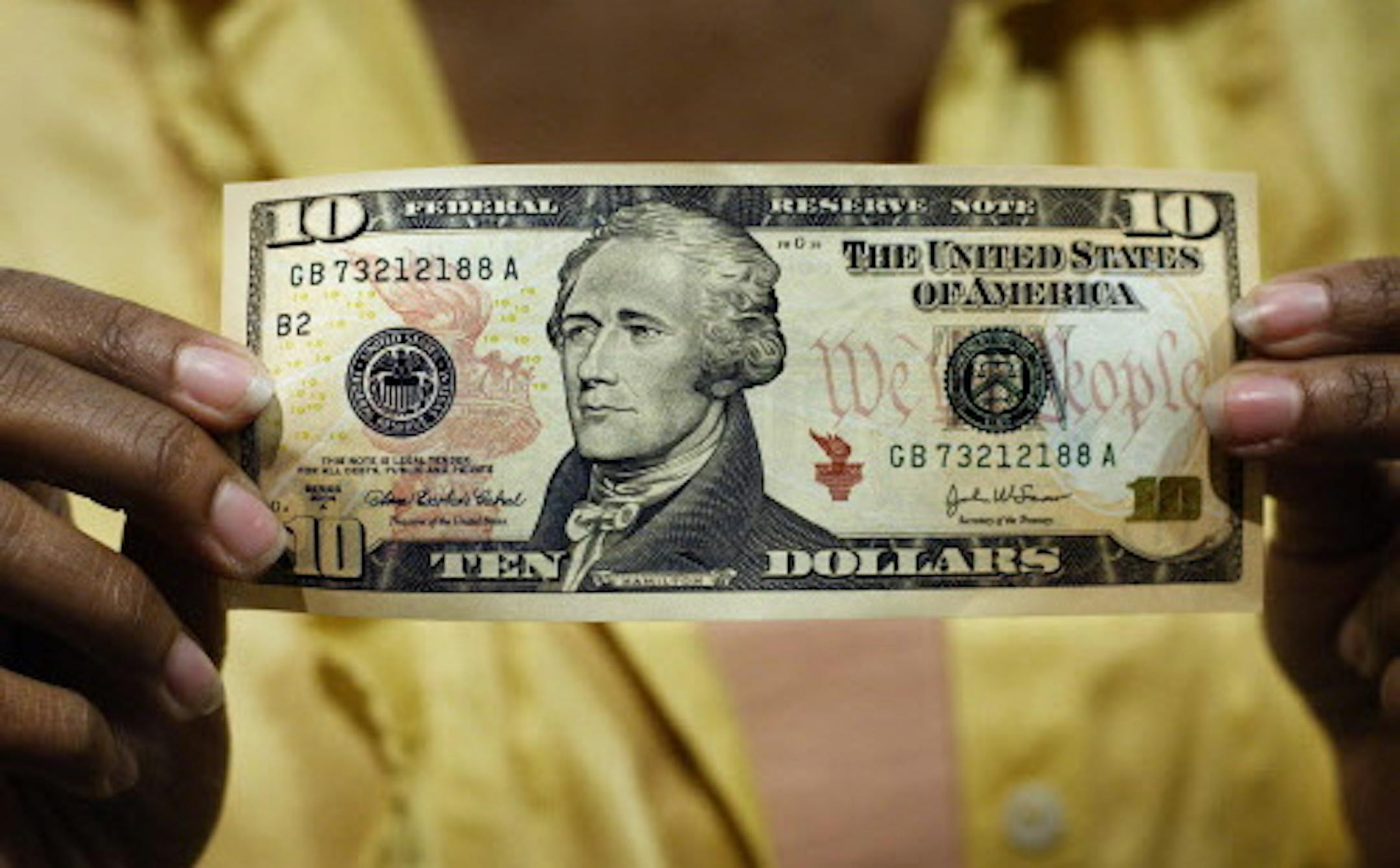
Having spoken contemptuously about "New York values," Texas Sen. Ted Cruz had a catastrophic election night in New York. So it's fitting that just one day after the primary, Treasury Secretary Jack Lew announced that Alexander Hamilton — the founder of New York values — will remain on the $10 bill. It's also fitting that in the same week Hamilton, the musical, a joyful celebration of New York values, won the Pulitzer Prize for drama.
Most politicians who run for national office develop a deep affection for the nation's diverse states, with all their unique quirks and histories. It's much worse than bad politics for a candidate to complain about "Vermont values," "Nebraska values," "Georgia values," "Ohio values," or the values of any of the states. In light of the nation's hard-won unity, it's a betrayal of the great motto of the United States, which can also be found on our currency: E pluribus unum (from many, one).
Which brings us to that guy on the $10 bill. An illegitimate child, Hamilton was born in the British West Indies, abandoned by his father, and orphaned as a teenager. When he was about 17, he made his way to New York.
It's there that he attended college (King's, which became Columbia University), began his career, joined the Revolutionary Army, founded the Bank of New York and wrote many of The Federalist Papers (addressed, by the way, "To the People of the State of New York"). It's in New York that he died and is buried. It's easy to visit the many places where he lived and worked.
Among the founders, Hamilton was probably the most passionate advocate of national unity. He wanted people to think of themselves as Americans, not as citizens of separate states.
In the Federalist Papers, he spoke of the union as a great barrier to the potentially destructive spirit of factions and hostility among the states: "Let the thirteen States, bound together in a strict and indissoluble Union, concur in erecting one great American system." He was alarmed by the dangers "from dissensions between the States themselves, and from domestic factions and convulsions."
During the Constitution's framing, a little-known revision of the preamble clarifies Hamilton's ultimate triumph. An early draft began this way: "We the People of the States of New Hampshire, Rhode-Island and Providence Plantations, Connecticut, New-York" and so forth "do ordain, declare and establish the following constitution for the government of ourselves and our posterity."
The start of the final preamble is in a far more Hamiltonian spirit, and it's much better: "We the People of the United States, in order to form a more perfect Union."


