

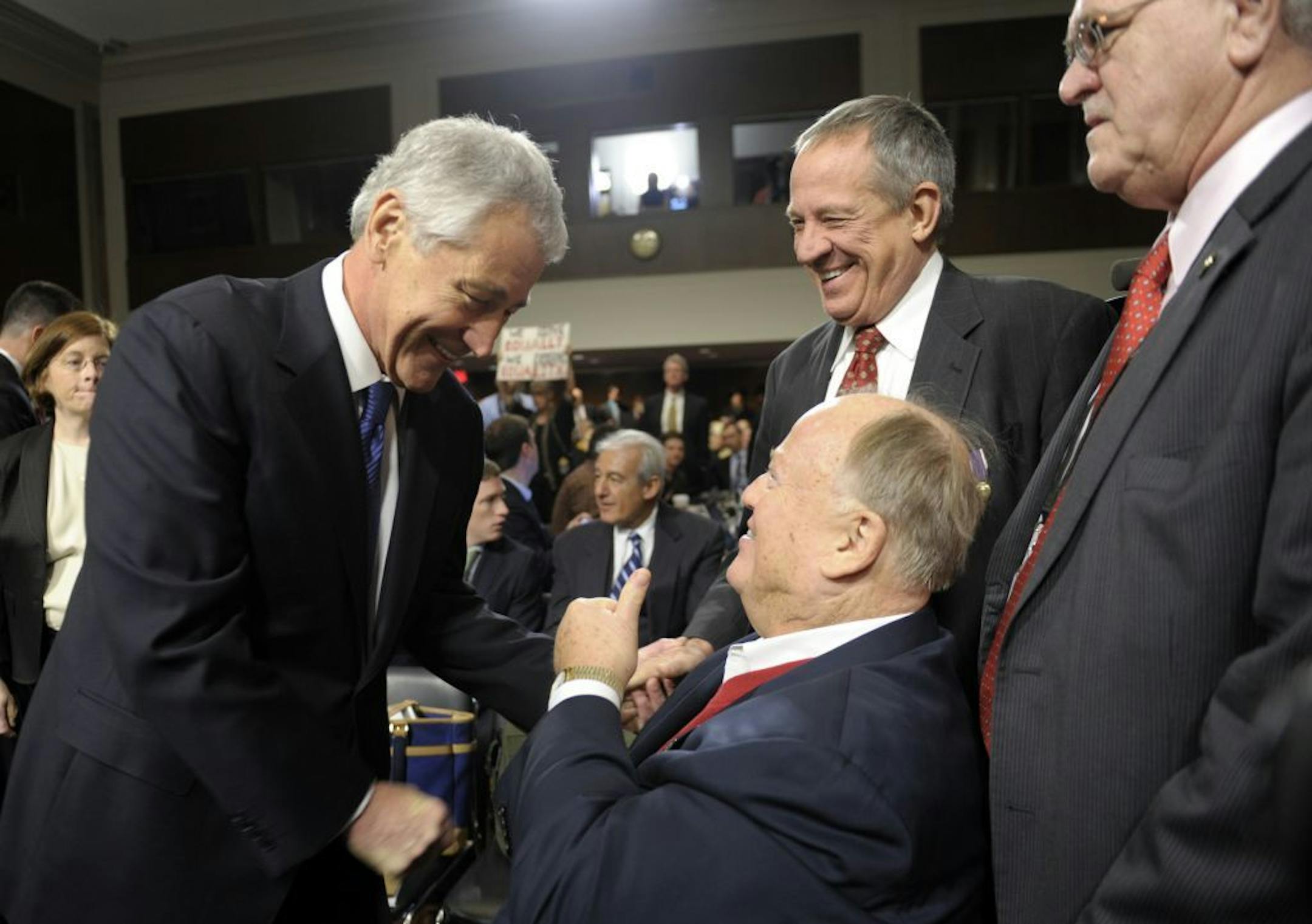
WASHINGTON - Bruised and battered, Chuck Hagel emerged from his grueling confirmation hearing with solid Democratic support for his nomination to be President Barack Obama's next defense secretary and relentless opposition from Republicans who repeatedly challenged their former GOP colleague.
Mathematically, Hagel has the edge as he looks to succeed Defense Secretary Leon Panetta as the nation's 24th Pentagon chief. Democrats hold a 14-12 advantage on the Senate Armed Services Committee, and Chairman Carl Levin, D-Mich., said the panel could vote as early as next Thursday, contingent on Hagel's prompt response on some lingering questions.
Levin expressed optimism about Hagel's prospects and praised his performance in nearly eight hours of testimony Thursday.
"I think his answers were honest and forthright and he did very well," Levin told reporters. "I hope that there will be some, who maybe were skeptical but who are undecided before this hearing, will maybe now look at him in a more favorable light. But I think there are a whole lot of folks who basically decided before the hearing that they were going to vote against him."
Unclear is whether Republicans will try to block the nomination of a Cabinet choice, especially when they have argued — when a Republican occupied the White House — that presidents should have their nominees.
Hagel struggled at times as GOP senators challenged him on issues ranging from Israel and Iran to his support for a group that advocates the elimination of nuclear weapons, repeatedly pressing him on past statements, votes and even letters he declined to sign. Refusing to show any frustration or anger, Hagel defended his record.
The former two-term Republican senator from Nebraska described his views as mainstream and closely aligned with those of Obama, the Democrat who nominated him. But several GOP members of the committee sought to portray him as radical and unsteady. Sen. Deb Fischer, R-Neb., called his ideas "extreme" and "far to the left" of Obama.
Hagel said he believes America "must engage — not retreat — in the world" and insisted that his record is consistent on that point.


