

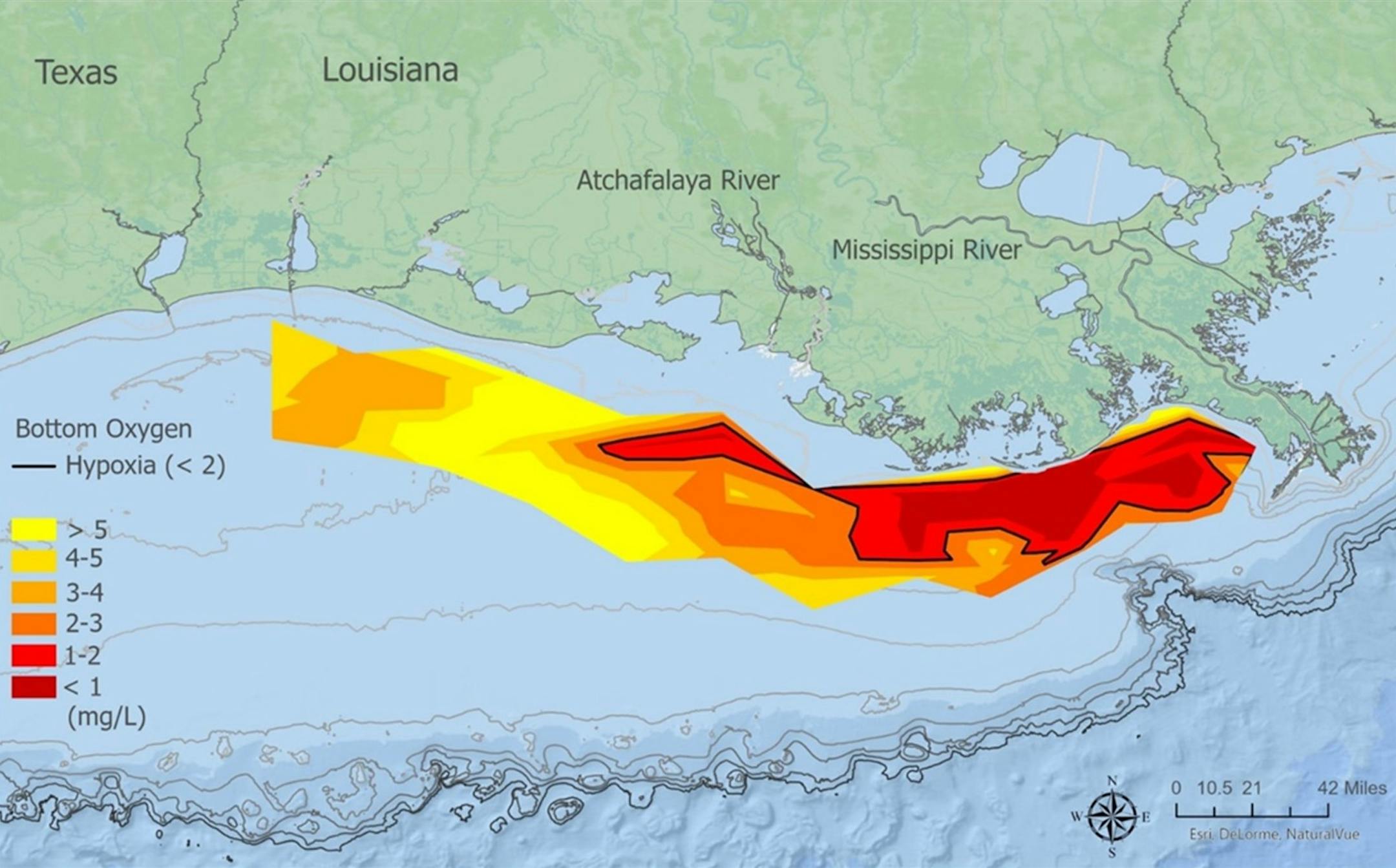
This year's oxygen-starved zone in the Gulf of Mexico is smaller than forecast, but still larger than the goal set by a coalition of upstream governments. The National Oceanic and Atmospheric Administration (NOAA) announced on Wednesday that this "dead zone" is approximately 3,058 square miles, about 25% smaller than what was predicted in June.
The Mississippi River/Gulf of Mexico Hypoxia Task Force, a partnership formed in 1997 between federal and state agencies and the National Tribal Water Council, aims to reduce the dead zone to 1,900 square miles by 2035.
Experts say this year's decrease is largely due to low water flow on the Mississippi River and fluctuating ocean temperatures, rather than ongoing efforts to reduce harmful runoff.
The "dead zone," known scientifically as a hypoxic area which is unable to sustain life, occurs every summer due primarily to excess nutrient pollution from human activities throughout the Mississippi River watershed.
The Mississippi and Atchafalaya Rivers carry nutrients from fertilizer runoff used in agriculture down to the Gulf of Mexico, which stimulates an overgrowth of algae. The area stretches from the mouth of the Mississippi River westward and can reach as far as the Texas border.
As this algae eventually dies and decomposes, it sinks to the bottom and depletes oxygen from the deeper areas of the Gulf. The low oxygen levels kill bottom-dwelling sea creatures, such as clams and burrowing crabs, that cannot escape. It also alters the distribution of commercially harvested species like shrimp.
This year's hypoxic zone is the seventh smallest area on record since scientists began measuring the phenomenon in 1985. The largest zone was measured at 8,776 square miles in 2017.
The measurements were made during an annual survey cruise led by a team of scientists from Louisiana State University and the Louisiana Universities Marine Consortium.

