

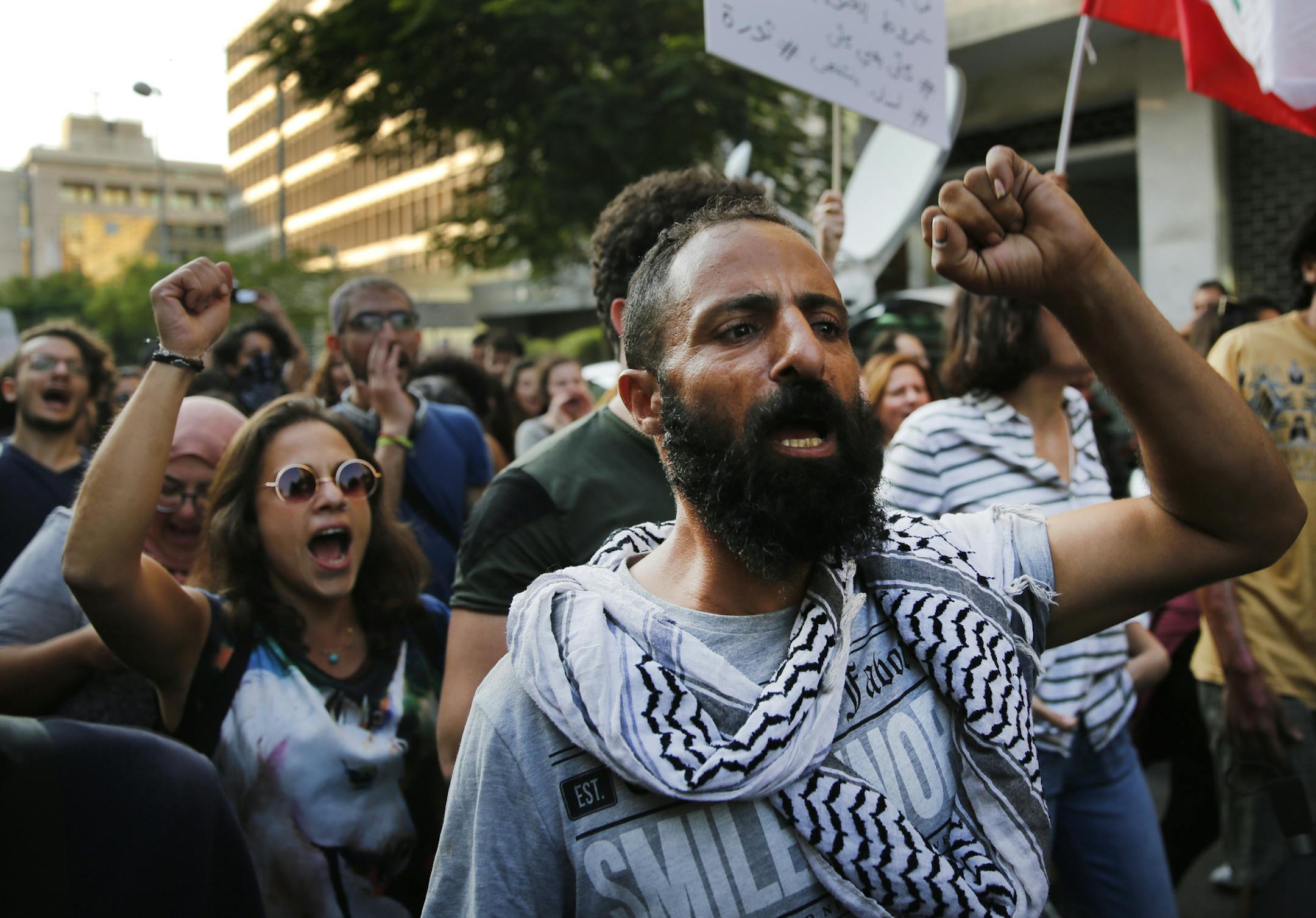
An unwieldy, unyielding global protest movement just claimed its first political victim — Lebanese Prime Minister Saad Hariri, who announced his resignation on Tuesday.
Given the movement's escalation, he likely won't be the last leader to leave.
And even if others survive, their legitimacy won't, unless they address the core corruption and governance issues that seem to be unifying themes in protests convulsing countries as disparate as Iraq, Egypt, Chile, Ecuador, Bolivia and Spain, as well as in the city of Hong Kong.
The spark that started the Lebanese protests was a proposed tax on online calls made via WhatsApp, the widely used social messenger service. After people took to the streets, the proposed tax was scrapped. But those already scraping by understandably weren't placated, and disgruntled crowds swelled to up to 1 million in a country of about 5 million people.
In his address to a nation in a deep fiscal crisis, Hariri said that his government had reached "a dead end." But it's not just his government. The governance of Lebanon — built on a sectarian spoils system that's ecumenical in its economic mismanagement and often unable to deliver basics like electricity, clean water and trash removal — has reached a dead end, too.
This failure united many in Lebanon's fractured society to reject the discredited system.
"The majority of people who are in the streets are the first Lebanese generation who actually did not live the Civil War, and this is major," Hanin Ghaddar, a visiting fellow at the Washington Institute of Near East Policy, told an editorial writer.
Ghaddar, an expert on her native Lebanon, added that, "It's a generation who just want to be Lebanese citizens. They have been hearing sectarian rhetoric, and they don't get it. This is a generation who have been westernized and globalized and grew up in the era of the internet and Xbox."


