

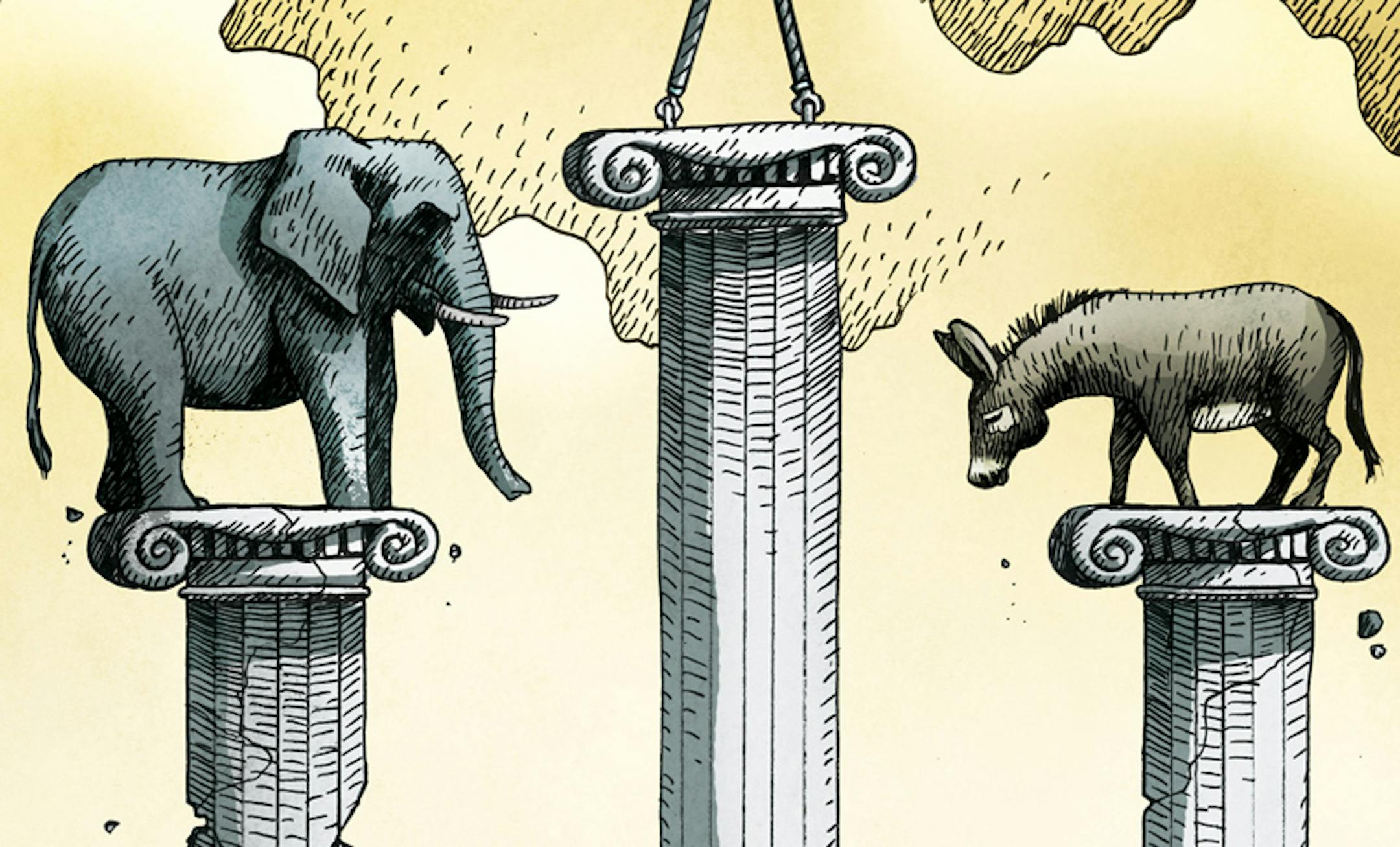
With the release of the president's budget, Washington again has descended into partisan squabbling. There is pervasive concern in the United States about the basic functioning of democracy. Revulsion runs deep at political figures seemingly unable to reach agreement, including on measures to reduce future budget deficits. Pundits and politicians alike condemn "gridlock."
Anyone who has worked in a political position in Washington has had ample experience with great frustration. Almost everyone in U.S. politics feels that much is essential yet infeasible in the current environment. Many yearn for a return to an imagined era when centrists in both parties negotiated bipartisan compromises that moved the country forward.
Yet fears about the functioning of the federal government have been a recurring feature of the political landscape ever since Patrick Henry's assertion in 1788 that the spirit of the revolution had been lost.
It is sobering to contrast today's concern about political paralysis with that which gripped Washington during the early 1960s. Then, the prevailing diagnosis was that a lack of cohesive and responsible parties for voters to choose from precluded clear mandates necessary for decisive action. While a flurry of legislation passed in 1964 to 1966 after a Democratic electoral landslide, Vietnam and Watergate followed, all leading to President Jimmy Carter's declaration of a crisis of the national spirit.
Despite today's rose-tinted view, there was hardly high rapport in Washington during Ronald Reagan's presidency.
In American history, division and slow change have been the norm rather than the exception. While often frustrating, this has not always been a bad thing.
There were probably too few checks and balances as the United States entered the Vietnam and Iraq wars. There should have been more checks and balances in place before the huge tax cuts of 1981, 2001 and 2003 — and to avert the many unfunded entitlement expansions of the past few decades. Most experts would agree that it is a good thing that politics thwarted the effort to establish a guaranteed annual income in the late 1960s and early 1970s, as well as the effort to establish a "single-payer" health care system during the 1970s.
The great mistake of the gridlock theorists is to suppose that progress comes from legislation, and that more legislation consistently represents more progress.


