

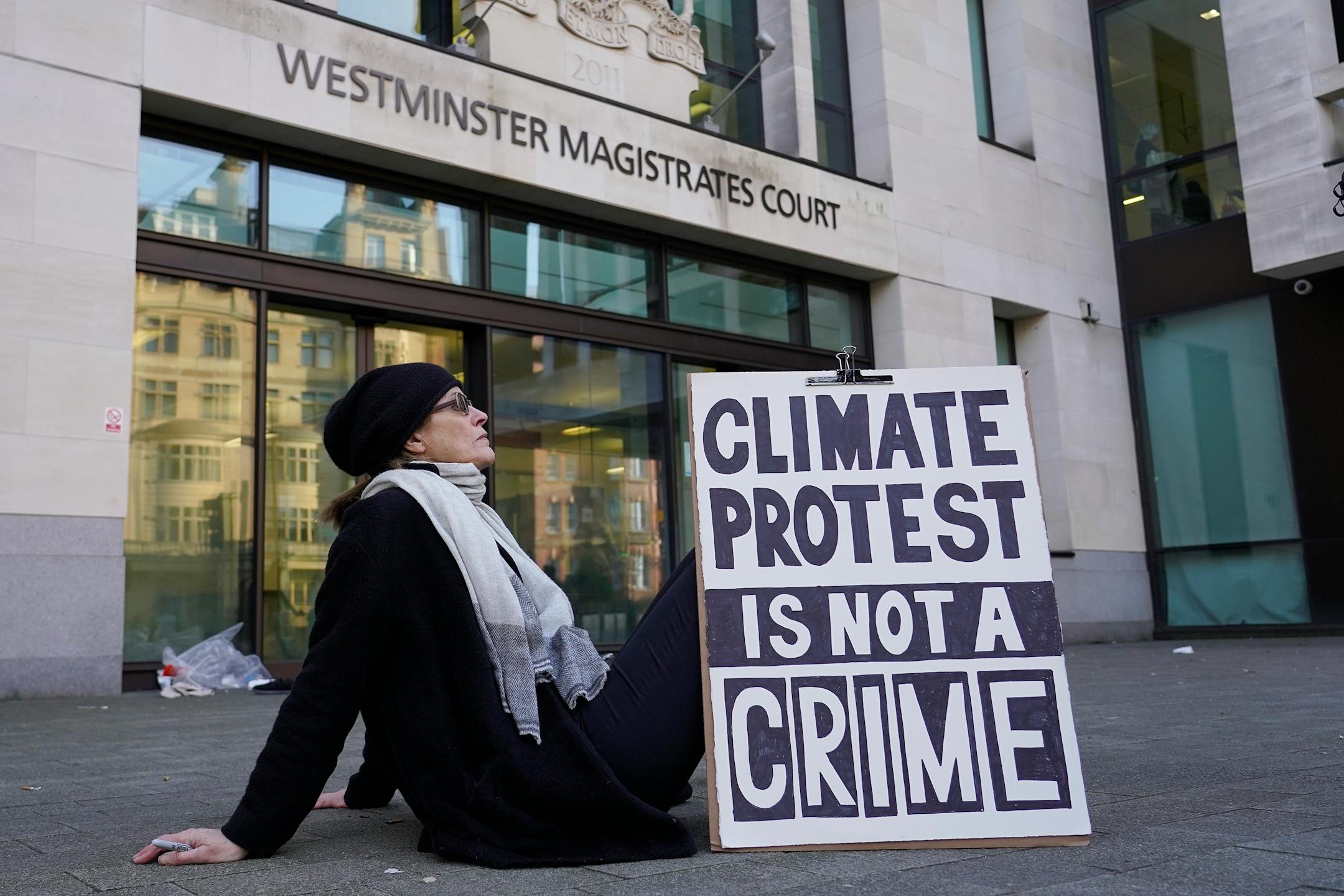
LONDON — Climate activist Greta Thunberg spoke defiantly about her mission outside court Thursday on the first day of her trial for refusing to leave a protest that blocked the entrance to a major oil and gas industry conference in London last year.
Thunberg, 21, was among more than two dozen protesters arrested on Oct. 17 after preventing access to a hotel during the Energy Intelligence Forum, attended by some of the industry's top executives.
''Even though we are the ones standing here ... climate, environmental and human rights activists all over the world are being prosecuted, sometimes convicted, and given legal penalties for acting in line with science," she said. ''We must remember who the real enemy is. What are we defending? Who are our laws meant to protect?''
The Swedish environmentalist, who inspired a global youth movement demanding stronger efforts to fight climate change, and four other protesters are in the middle of a two-day trial in Westminster Magistrates' Court on a charge of breaching a section of the Public Order Act that allows police to impose limits on public assemblies. She and four Fossil Free London protesters have pleaded not guilty.
Thunberg and other climate protesters have accused fossil fuel companies of deliberately slowing the global energy transition to renewables in order to make more profit. They also oppose the U.K. government's recent approval of drilling for oil in the North Sea, off the coast of Scotland.
Thunberg sat in court in a black T-shirt and black pants, taking notes as a police officer testified about efforts to disperse demonstrators who had blocked several exits and entrances for hours outside the luxury InterContinental Hotel in central London.
''It seemed like a very deliberate attempt ... to prevent access to the hotel for most delegates and the guests,'' Superintendent Matthew Cox said. ''People were really restricted from having access to the hotel.''
Cox said protesters were lighting colorful flares and drummers were creating a deafening din outside the hotel as some demonstrators sat on the ground and others rappelled from the roof of the hotel. When officers began arresting people, other protesters quickly took their places, leading to a ''perpetual cycle'' that found police running out of officers to make arrests.


