
Government shakes up funding for heart disease research

With many smaller heart studies going unpublished, NIH focuses on deeper trials.

The New York Times
October 24, 2015 at 4:30AM
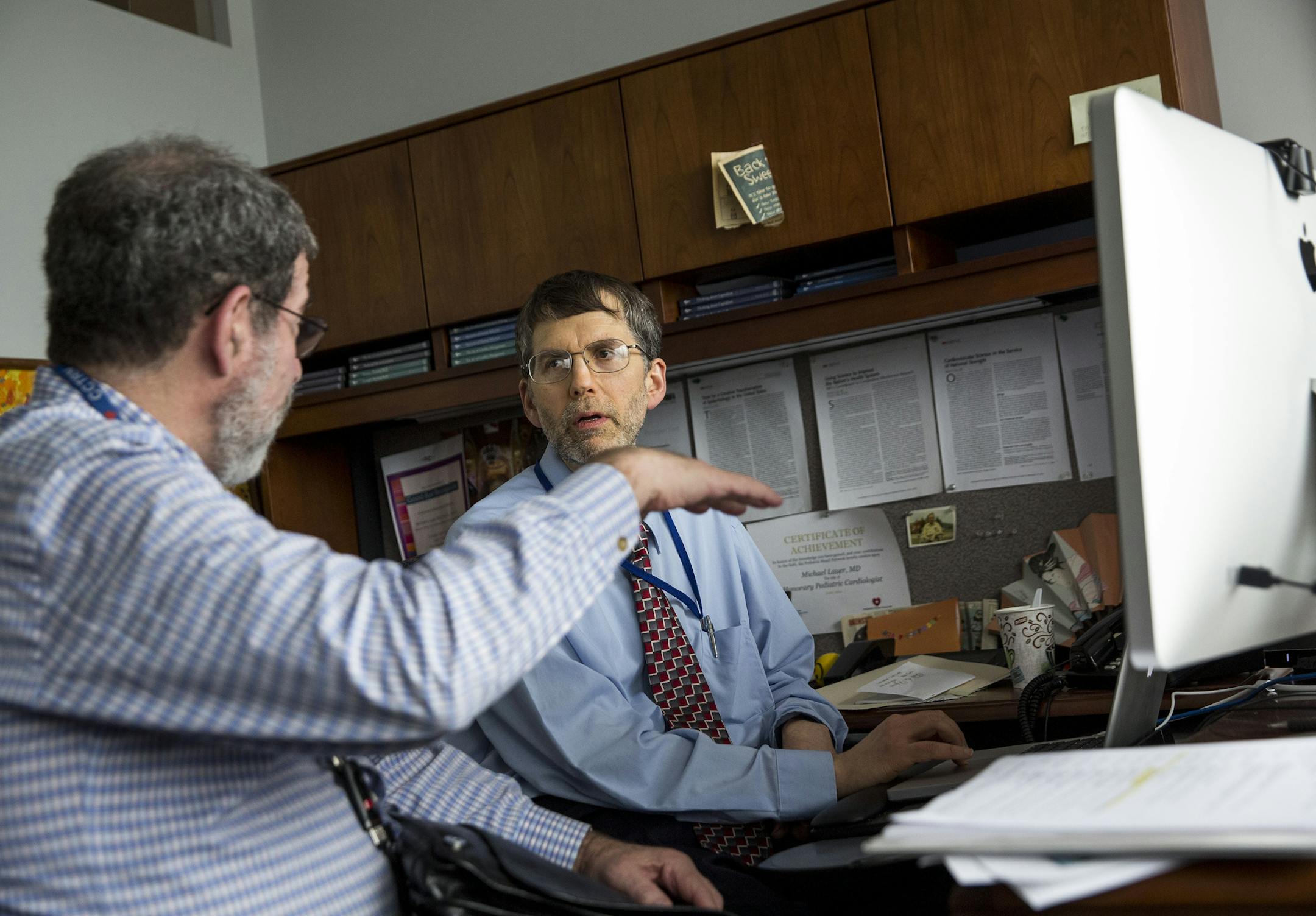
Dr. Michael Lauer, right, a cardiologist and deputy director for extramural research at the National Institutes of Health, talks with Dr. David Gordon of the National Heart, Lung and Blood Institute, in Bethesda, Md., June 17, 2015. Federal health officials acknowledge that money has been squandered on trials and studies that are too small or narrow to yield results with real-world impact. (Drew Angerer/The New York Times)
Dr. Michael Lauer, right, said, “If a research project is never published it is as if it never happened.” (The Minnesota Star Tribune)

Cardiologists recently hailed early results of a study suggesting that many lives might be saved if people with high blood pressure got it down far below levels now recommended. They predicted swift changes in treatment practices. Patients rushed to call their doctors.

But the intense interest in this big, rigorous clinical trial masked a startling truth about heart research: Many studies are never published at all, their findings consigned to oblivion.

It is an issue that is arising in other parts of medicine as well, but heart disease is one area where it has been especially well documented. Hundreds of millions of dollars have been going to heart studies that are too small and narrow to yield results meaningful enough to get into a journal. In an era of ever-tightening budgets, federal health officials acknowledge that money has been squandered on work that makes no difference to patients or even to research scientists.

Now, a few years after coming to that jolting realization, the influential federal agency that funds much of the nation's heart research is overhauling its practice, a change with far-reaching implications for the way medical research is funded in this country. The result will be the financing of fewer, but deeper, studies, to focus resources on efforts with real-world impact and life-or-death implications.

"We are much more willing to turn down proposed trials," said Dr. Michael Lauer, a cardiologist who is the newly appointed deputy director for extramural research of that agency, the National Institutes of Health. In fact, he added, "we are turning them down."

The pronounced shift is shaking up a field where change is usually measured in tiny increments. Some question this new direction.

"If you want to do things that are truly innovative and cutting edge, you sometimes have to do things that are high risk-high gain," said Dr. Steven A. Webber, a pediatric cardiologist at Vanderbilt, arguing for the need to continue funding small exploratory studies like one he conducted, which he could not complete because of unexpected technical issues.

This rethinking of how to study heart disease, which kills more than 600,000 Americans a year, began with an epiphany three years ago: Lauer and colleagues at the National Heart, Lung and Blood Institute discovered they had spent $2 billion on more than 200 clinical trials over the course of a decade. But the results of 2 out of 5 of the studies were either never made public or were published only after what to scientists were unconscionable delays.

"If a research project is never published it is as if it never happened," Lauer said.

So starting next year, the heart institute will require that all research results be reported in a federal database even if no journal will publish them. In addition to turning down smaller studies, it is insisting that the costs of large studies go way down.

Though some researchers are unsettled by the new practices, many agree that money was often wasted under the old system. Five small studies cost less than one large one, so the temptation, federal officials acknowledge, has been to stuff the clinical trials portfolio with small studies, especially given the reality of the federal budget. Funds for the NIH have fallen by 20 percent in inflation-adjusted dollars since 2006.

"It's worth understanding how perverse — and that's the right word — the environment has been for clinical trials," said Dr. Salim Yusuf, a cardiologist at McMaster University in Ontario.

A new Yale study under review at a medical journal found that a failure to publish afflicts researchers equally in prestigious medical centers and ones that are less well known. "The results are pretty scathing," said Dr. Nihar Desai, a Yale scientist. "If people really knew what was happening they would be outraged."

Lauer's study found that trials of treatments with an obvious life-or-death meaning for patients, like testing a way to cut heart attacks, almost always were published within two years of completion; 70 percent were published a year or less after the trial closed. Negative or equivocal results did not make any difference in publication rates.

But trials with so-called surrogate endpoints — Did cholesterol levels rise or fall? Did people walk more each day? — tended to languish.

Lauer called a few investigators who had not published their results and heard a variety of explanations. But excuses do not assuage the harm that is done, Lauer emphasized, including what he considers an unethical abandonment of participants in those studies.

"If you subject a person to the risks and hassles of being in a clinical trial, there is an implicit promise that they are giving to science," he said. "Giving to science means the results get published."


about the writer

about the writer

GINA KOLATA