

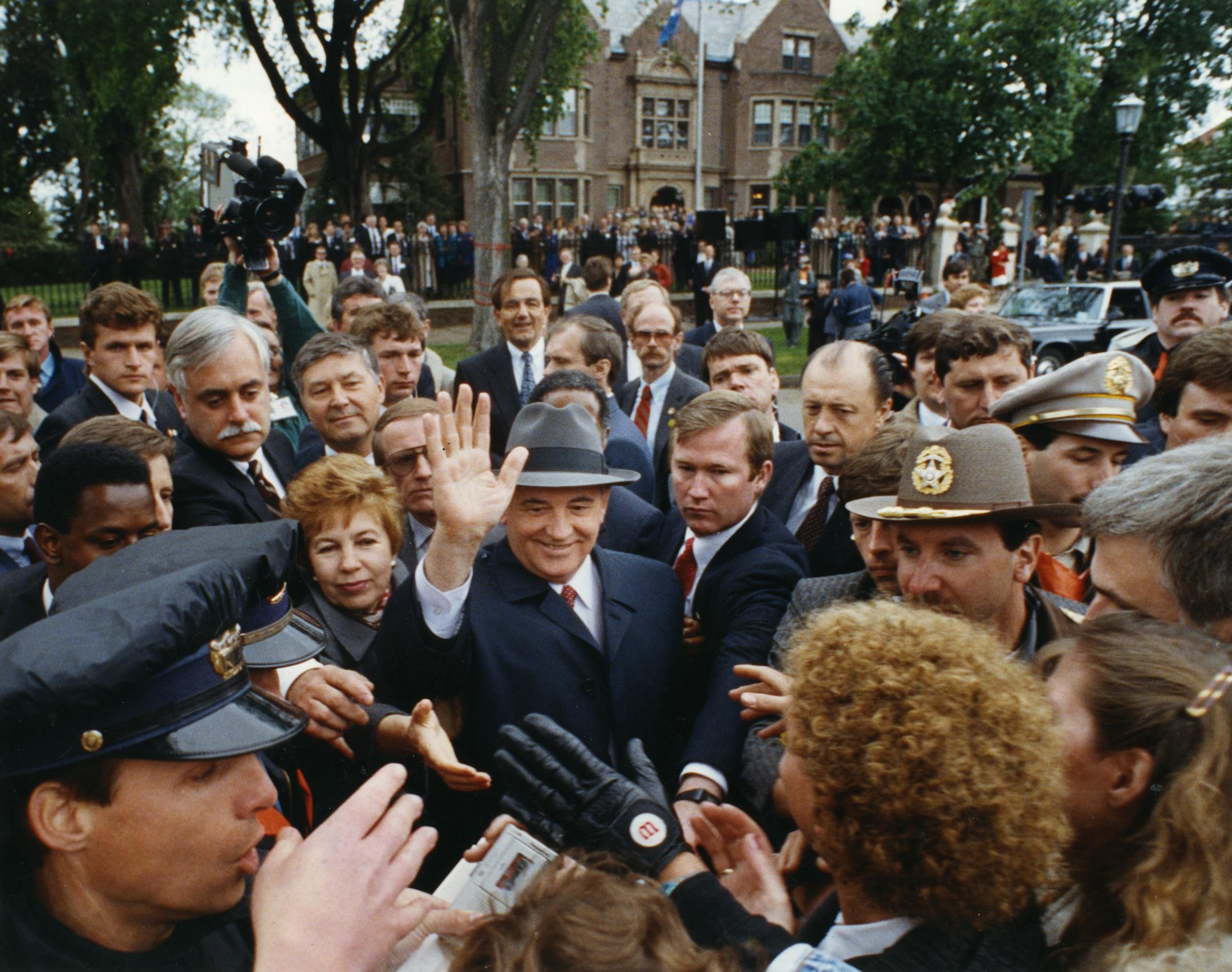
Opinion editor's note: Editorials represent the opinions of the Star Tribune Editorial Board, which operates independently from the newsroom.
•••
"I like Mr. Gorbachev," British Prime Minister Margaret Thatcher said in 1984. "We can do business together."
Many Westerners shared the sentiment, including, most consequentially, Thatcher's iron-willed contemporary, former President Ronald Reagan. Along with his vice president and eventual successor, George H.W. Bush, Reagan did business with former Soviet leader Mikhail Gorbachev on arms control and other issues that cooled, and eventually ended, the Cold War.
That Western success was seen differently by many Soviet citizens then and Russian citizens today. Many, maybe even most, revile Gorbachev, who died on Tuesday in Moscow at age 91, despite his actions that ultimately freed them from decades of Communist dictatorship when the Soviet Union dissolved in 1991.
That dissolution wasn't Gorbachev's plan or desire. He was a believer, albeit a realist, about the Soviet Union and thus sought to reform, not end, the U.S.S.R. But the forces unleashed through his policies of perestroika (reform) and glasnost (openness) revealed the rot, and contradictions, of the Soviet state, which led to its inevitable and welcome collapse.
While his stature at home is diminished, his place in history is secure.
Gorbachev "was enormously consequential — although not uncontroversial, particularly in his own country," Mitchel Wallerstein, a nonresident senior fellow at the Chicago Council on Global Affairs, told an editorial writer. Wallerstein, a former Department of Defense official, added that Gorbachev's ascension after generations of sclerotic Soviet leadership created a diplomatic aperture for Thatcher and Reagan. "When this younger, much more vital man succeeded to the [leadership] of the Soviet Union, then they began to engage with him and found him to be open to a variety of ideas that had been completely sacrosanct."


