

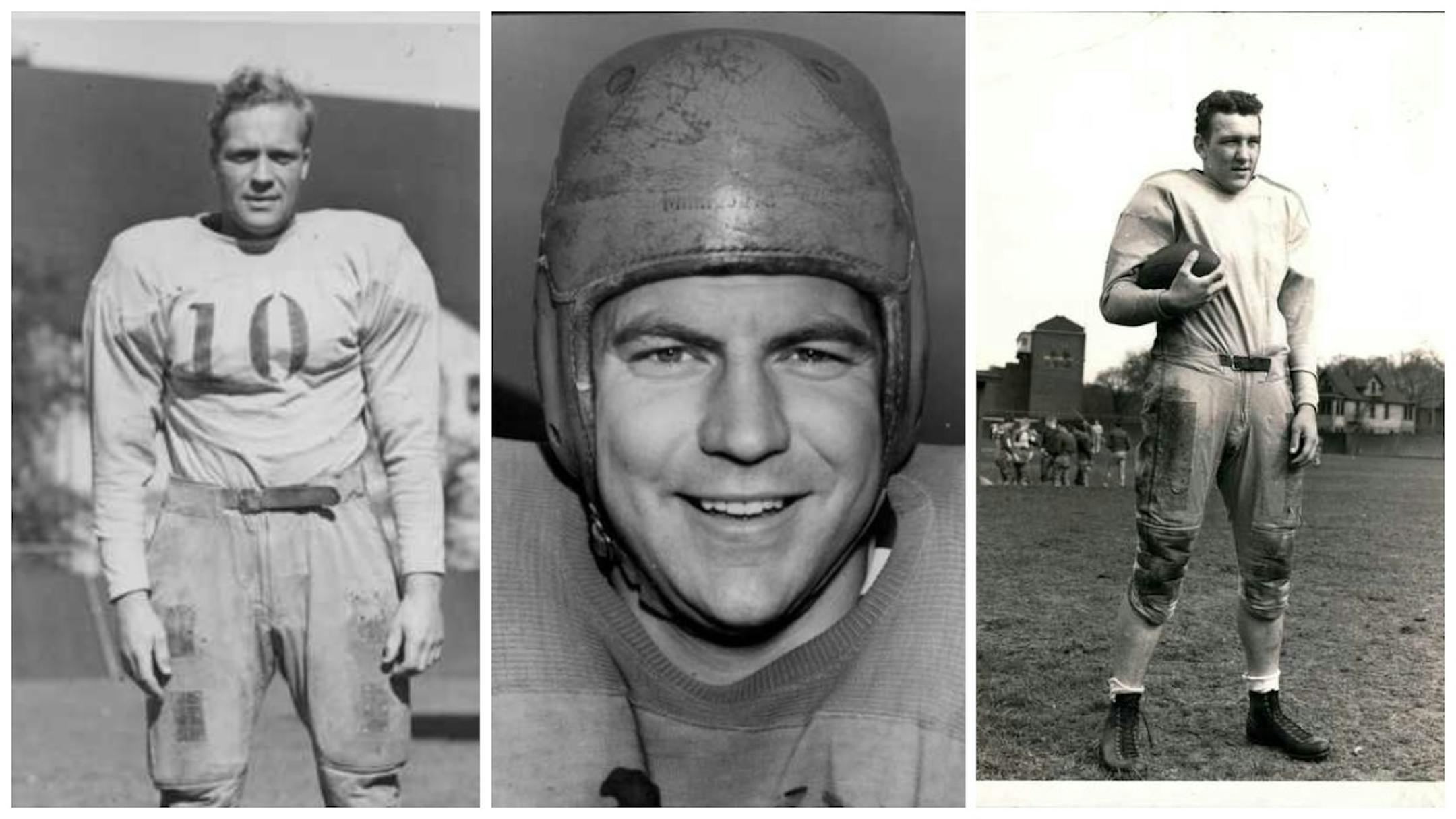
War rumbled in Europe 80 autumns ago, while in the Far East, the Japanese military was secretly mounting a sneak attack on Pearl Harbor. Back in Minnesota, Gophers football fans had an additional worry: Their beloved university team was limping into the 1941 season, hoping to defend its national title despite captain and star halfback Bruce Smith's bum knee, wrenched while working summertime construction on the viaduct in Faribault, his hometown.
Although that knee would find him on crutches later that fall, Smith scored two touchdowns against the University of Washington in a 14-6 season-opening victory on Sept. 27, 1941. Four weeks and four victories later, Smith was carried off the field on a stretcher when his knee snapped during an 8-7 squeaker against Northwestern in front of a season-high 64,464 home fans.
Smith watched practice the next week from crutches as his three backfield backups went through their drills. Like the injured starter from Faribault, the three juniors below him on the depth chart came from Minnesota towns: Mike Welch from St. James, Joe Lauterbach from Redwood Falls and Gene Bierhaus from Brainerd.
A new rule allowed free substitutions for the first time in 1941, meaning players didn't need to sit out the rest of the quarter if they came to the sideline for a break.
Welch, Lauterbach and Bierhaus were "three rural Minnesota prep stars aiming for their first college breakthrough in 1941 … [who] could only hope that unlimited substitutions would create more opportunities," writes KARE-TV reporter Danny Spewak, author of "From the Gridiron to the Battlefield" — a new book out this month that chronicles the 1941 Gophers (tinyurl.com/1941Gophersbook).
Spewak, 30, dedicates the book to his grandparents, Jack and Virginia Spewak. His grandfather, the son of Russian Jewish immigrants, played for the '41 Gophers freshman team, served in the Army Air Corps in World War II and rose to president of Senack Shoes.
Spoiler alert: For me, the best part of Spewak's book came after the Gophers finished unbeaten to defend their national title in 1941. Smith fought through the knee trouble to become the only Gopher ever to win the Heisman Trophy, given to college football's best player.
Japan attacked Pearl Harbor two days before Smith was handed his trophy in Manhattan. In an acceptance speech broadcast nationally just before President Franklin Roosevelt addressed the country, Smith said: "I think America will owe a great debt to the game of football when we finish this thing off. … It teaches team play and cooperation and exercise to go out and fight hard for the honor of our schools, and likewise the same skills can be depended on when we have to fight like blazes to defend our country."


