

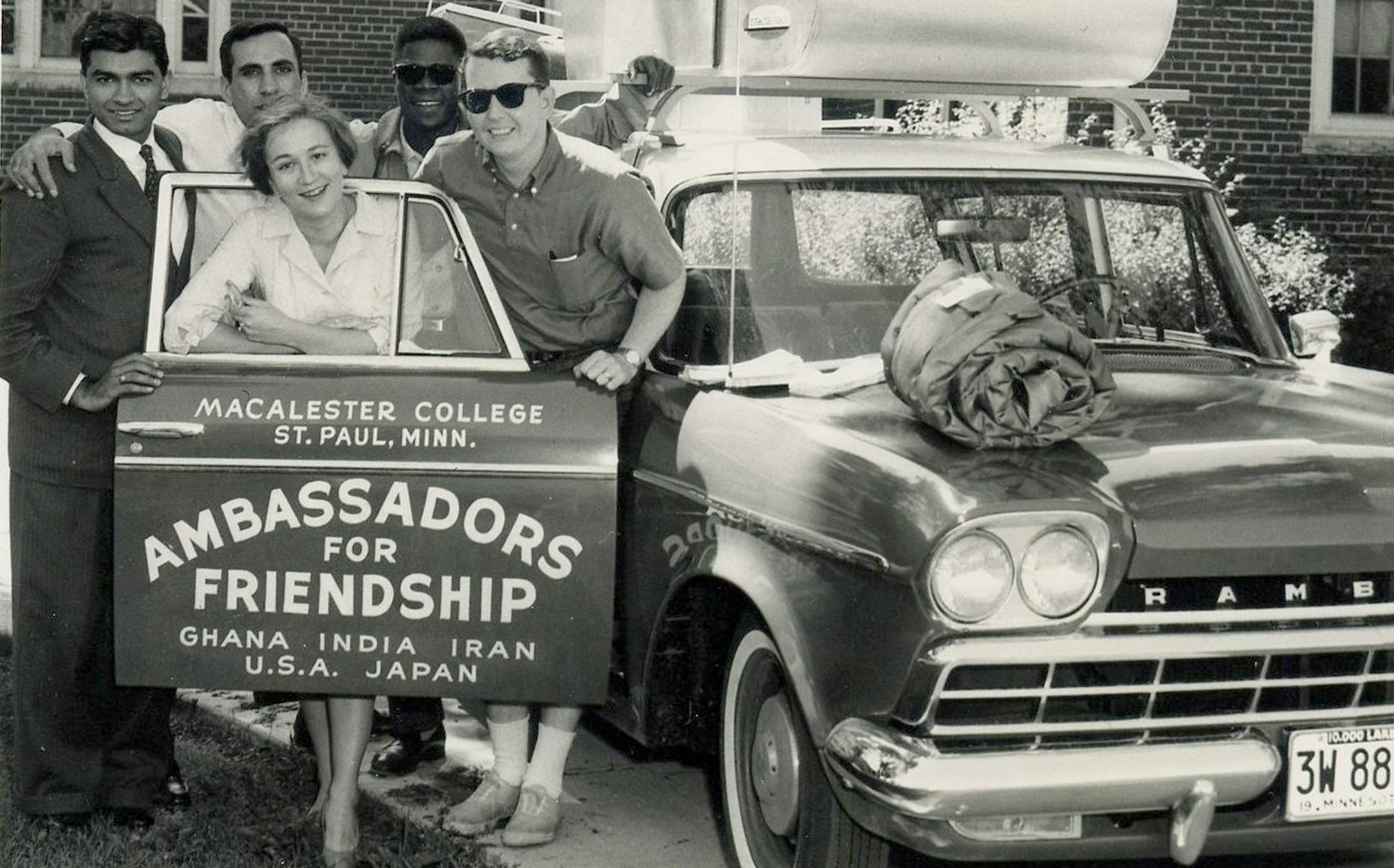
The Tennessee Williams line about depending on the kindness of strangers hasn't aged well. Our "breaking news" mentality provides a steady diet of fear and suspicion, while friends are confirmed and tallied from around the world, never far from a cell phone or Skype connection. The idea of interacting with strangers, much less depending upon their kindness, seems almost quaint.
But in the 1960s and '70s, a group of students, most from Macalester College in St. Paul, tested the premise of depending on strangers with an idealistic program called Ambassadors for Friendship. The idea was to introduce foreign students to the rest of the United States before they returned to their home countries -- an experience that, for many, was galvanizing.
This month, about 80 alumni returned to Macalester to relive those six weeks when they roamed the country wedged into Rambler station wagons, with $300 in spending money and a determination to foster goodwill and better understanding between themselves and their hosts, wherever they found them.
While the premise was to showcase the United States to the international students, many of the American students were surprised by how much they also learned.
Stefan van Drake, who grew up in South St. Paul, saw his first painting of a black Christ in Fayetteville, Ark. "This makes a deep impression on you," said Van Drake, who lives in Spain. Another alumnus recalled when the foreign students toured a retirement center, only to be horrified older people here did not remain with family.
Another remembered being shocked to hear her companion compare the Arizona landscape to Iran. Scandinavian students couldn't believe what passed for coffee.
Mostly, though, the students were impressed by people's hospitality. Eleanor Ostman Aune, St. Paul, was a driver for a 1962 group that included young women from Germany, Japan and Kenya. "There weren't always enough beds, but we managed," she said, noting how hospitality invariably extended to being taken to a baseball game, a factory, a powwow. "One mom even took me to the doctor when I needed to have a cyst lanced -- and she paid the bill."
The Ambassadors program was devised by Harry Morgan, a young man who had developed a seat-of-your-pants exchange program at Rutgers University in New Jersey. He'd heard a Pakistani exchange student share some severe verdicts of the United States, without ever having had the chance to travel beyond campus. When Morgan arrived at Macalester in 1959 to run the International House, he proposed a similar travel program, with the theme of friendship.


