

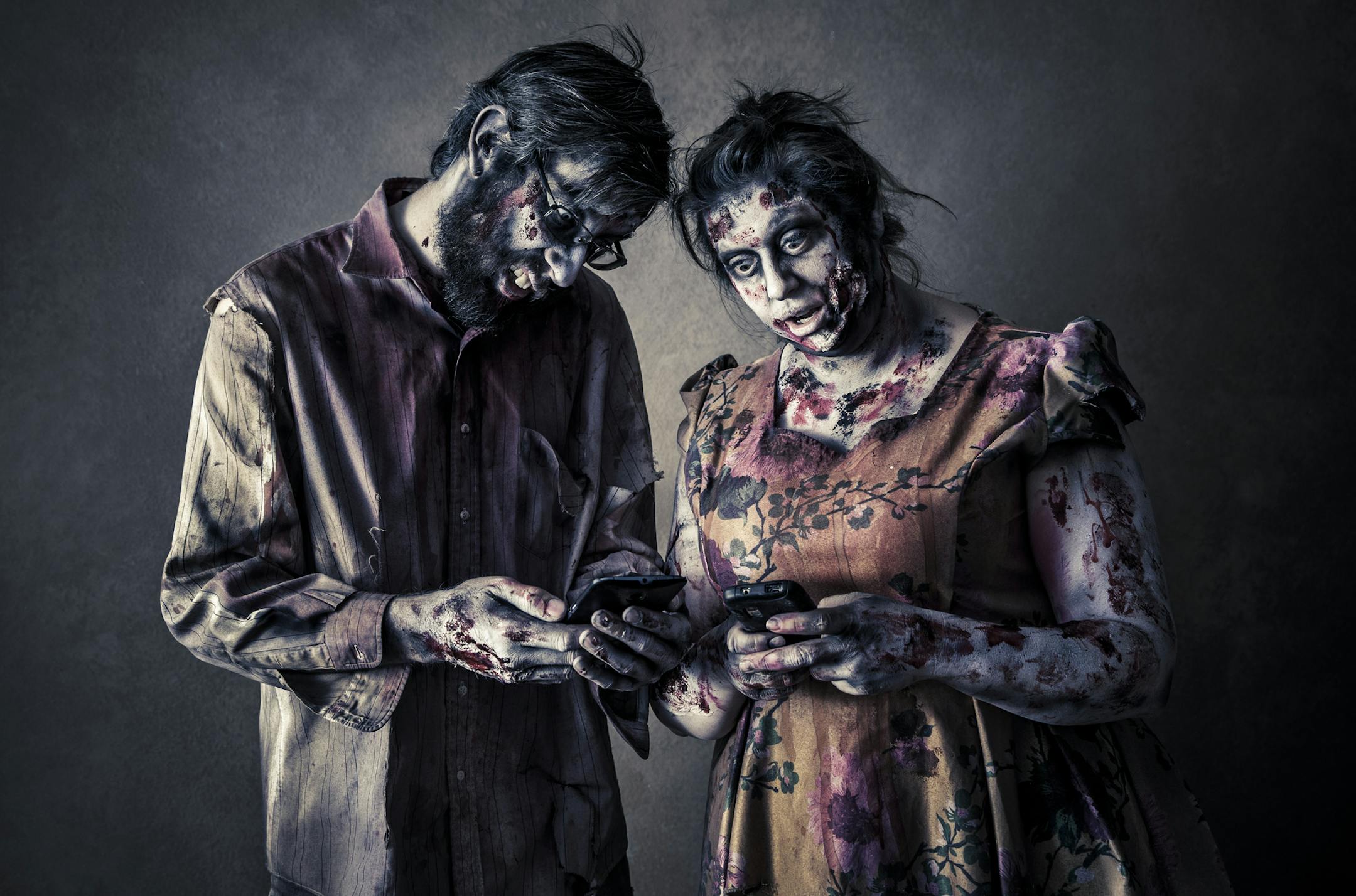
My wife and I decided to take advantage of the spring-like weather this week and head for the beach. We were not surprised to find that others had the same idea. Foot traffic was so thick on the boardwalk that we could move only at a sluggish pace. We didn't care. We were there to look at the dark, beautiful winter water, gently lapping up close, frothy further out. Visually, we drank our fill.
But what struck us as remarkable was how many of our fellow promenaders had no interest in the view. These were the cellphone zombies.
There they were, on a crowded beach on the warmest day of the year, faces buried in their phones. Had the Long Island Sound vanished in a silent puff of mystical energy, I doubt that they would have noticed.
How the cellphone zombies avoided colliding with each other is a question best left to Stephen King.
Whatever works on the boardwalk, it fails on the roads. Lately we read that drivers using their phones are causing so many collisions that insurance premiums can't keep up. Half of teenaged drivers surveyed admit to texting while behind the wheel, and a two-second glance at the screen exponentially increases the likelihood of an accident. Holding a phone in the hand makes things worse, but, as Tom Vanderbilt notes in his 2009 book "Traffic," statistics for hands-free phones are not much better.
OK, all of this is reasonably well known. (Maybe not the hands-free phone bit, which was news to me, but the rest.) Cell phones can be dangerous but the zombies at the beach weren't behind the wheel. True, even distracted pedestrians seem to be having more accidents. And there is growing evidence that young smartphone users exhibit the same behavior as addicts.
But my libertarian conscience does not want to tell anybody else how to live. If people want to come to the beach on a warm winter day and ignore the view, they should have the same freedom as anybody else to enjoy themselves in their own way. True, the zombies turned out to be the ones slowing foot traffic, and in that sense were uncivil. Given, however, that the zombies constituted a large majority of those strolling along the boardwalk, perhaps our norms of civility need rewriting.
Color me old: I can remember when strangers greeted each other on the street. There is a warmth in such behavior, a welcoming, a mutual assurance that each of us belongs. In the days of Jim Crow, many of the norms that supported the segregationist state were informal.


