

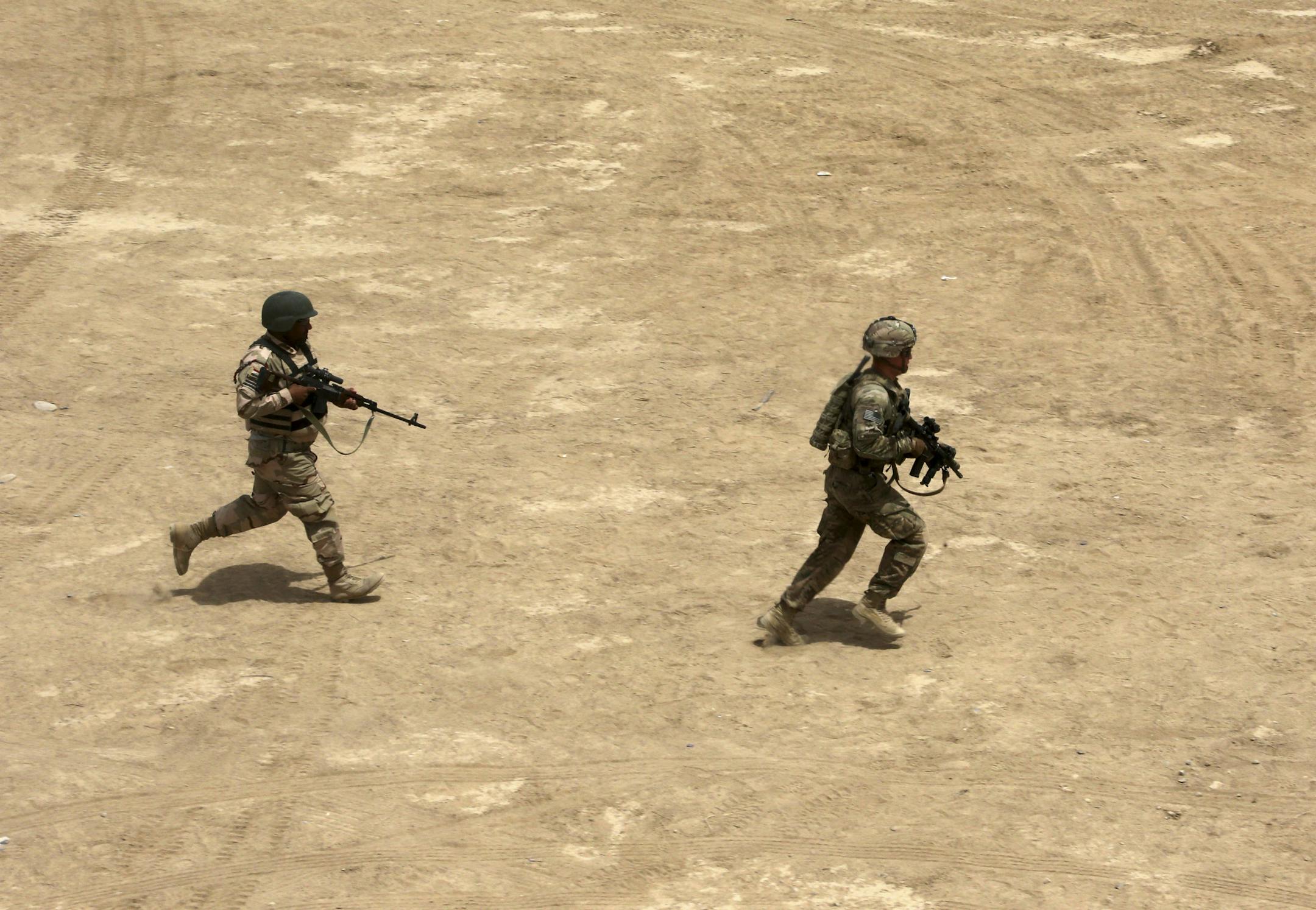
The announcement this month that 450 additional U.S. trainers and support troops will deploy to Iraq represents a modest step forward in the fight against the Islamic State. But the move by itself will not turn the tide in a faltering effort. To succeed in the president's ambition of ultimately destroying the Islamic State — or even to contain its gains or roll them back — a broader and more intensive effort is needed.
The fall of Ramadi in Iraq's western Anbar province was just the latest wake-up call for a Middle East reeling from the Islamic State's advances. The group has seized the Syrian city of Palmyra, launched attacks in Saudi Arabia, established a presence in Libya and the Sinai Peninsula, and won adherents in countries as varied as Afghanistan and Nigeria. The U.S. government now estimates that some 22,000 foreign fighters have joined the Islamic State from 100 different countries.
Iraq is the locus of the current U.S. military effort against the Islamic State, and the administration's strategy of working with and through Iraqi forces is the right one to achieve gains that are sustainable over the long term. But the execution of this strategy has lacked the urgency and resources necessary for success. A re-energized and more forward-leaning approach should combine the following elements:
• Establish an integrated political-military plan for Iraq. The United States has made progress in Iraq when its military and diplomatic lines of effort have been coordinated and mutually reinforcing. An integrated political-military plan should include stepped-up diplomacy with Baghdad to push for greater Sunni inclusion, devolution of authority and resources to provinces such as Anbar, and the establishment of a national guard as a vehicle for Sunni tribal militias to become part of the Iraqi security forces. At the same time, Washington should redouble its engagement with Arab allies who have watched Iran fill the vacuum formed while they have remained reluctant to provide significant support to Iraq.
• Provide arms directly to Sunni tribes and the Kurdish Peshmerga. The pipeline of weapons through Baghdad to those Sunnis and Kurds willing to take on the Islamic State has been slow and inadequate. The United States should speed the supply directly to local tribes and units, while holding out the prospect that arms will flow through Baghdad if the central government establishes a reliable process for their transfer and passes legislation to include these fighters in the Iraqi security forces.
• Embed Special Operations forces at the battalion level and allow them to provide advice during operations. The Iraqi security forces' will to fight has faltered repeatedly in the face of Islamic State advances. When Iraqis are trained, equipped and ready for combat, U.S. military advisers should embed with Iraqi battalions and advise Iraqi commanders during operations from "the last point of concealment" — i.e, a protected position closest to the fighting. It's hard to bolster morale, stiffen backbones or adjust a battle plan from a training base.
• Intensify the coalition air campaign and deploy forward air controllers to call in close air support during combat. The air campaign against the Islamic State has thus far been the centerpiece of U.S. strategy, yet as structured it is unlikely to help turn the tide. Employing U.S. air assets based in Iraq or neighboring partner countries, rather than on distant aircraft carriers, would enable far more strikes per day in both Iraq and Syria. Authorizing U.S. forward air controllers to identify targets and call in close air support for Iraqi units under fire would make those forces far more effective.
• More meaningfully aid the Syrian opposition. The Islamic State will pose an enduring threat to Iraq as long as it enjoys a rear base in Syria. While the U.S. Syria policy demands its own fresh look, it should include a substantial increase in the effort to aid those opposed to both the Islamic State and the Assad regime, as well as the embattled populations the opposition seeks to protect.


