

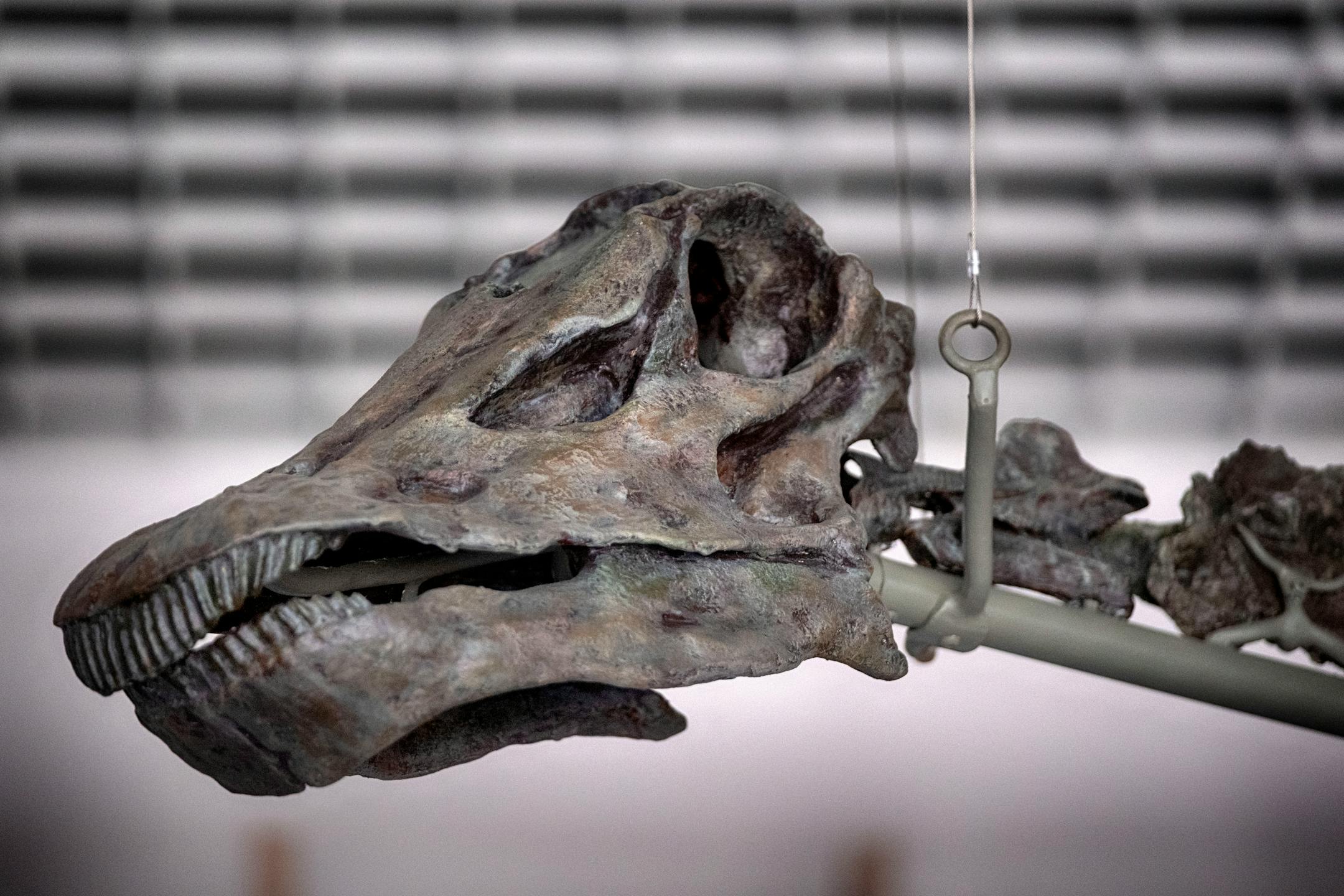
LOS ANGELES — The latest dinosaur being mounted at the Natural History Museum in Los Angeles is not only a member of a new species — it's also the only one found on the planet whose bones are green, according to museum officials.
Named ''Gnatalie'' (pronounced Natalie) for the gnats that swarmed during the excavation, the long-necked, long-tailed herbivorous dinosaur's fossils got its unique coloration, a dark mottled olive green, from the mineral celadonite during the fossilization process.
While fossils are typically brown from silica or black from iron minerals, green is rare because celadonite forms in volcanic or hydrothermal conditions that typically destroy buried bones. The celadonite entered the fossils when volcanic activity around 50 million to 80 million years ago made it hot enough to replace a previous mineral.
The dinosaur lived 150 million years ago in the late Jurassic Era, making it older than Tyrannosaurus rex — which lived 66 million to 68 million years ago.
Researchers discovered the bones in 2007 in the Badlands of Utah.
''Dinosaurs are a great vehicle for teaching our visitors about the nature of science, and what better than a green, almost 80-foot-long dinosaur to engage them in the process of scientific discovery and make them reflect on the wonders of the world we live in!'' Luis M. Chiappe of the museum's Dinosaur Institute said in a statement about his team's discovery.
Matt Wedel, anatomist and paleontologist at Western University of Health Sciences in Pomona near Los Angeles, said he heard ''rumors of a green dinosaur way back when I was in graduate school.''
When he glimpsed the bones while they were still being cleaned, he said they were ''not like anything else that I've ever seen.''


