

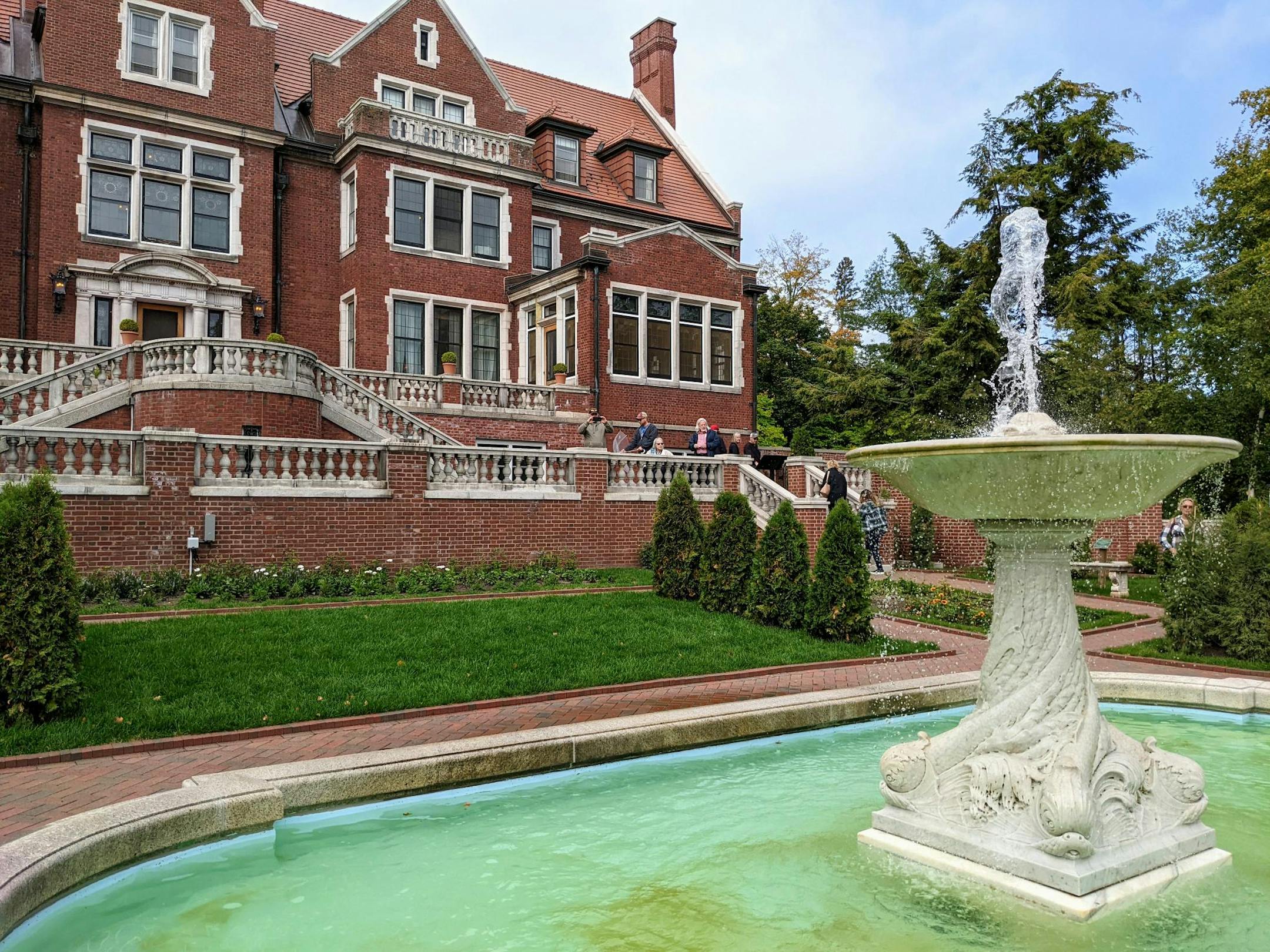
DULUTH — The formal garden at Glensheen Mansion has returned to its roots: the manicured, symmetrical English planting style of 1907, preferred by the estate's first owner, wealthy financier Chester Congdon.
Highlighting the "bones" of the garden with plenty of pruning and greenery is "very much Chester's dream," said head gardener Emily Ford.
The area housing the garden and opulent fountain, which sits directly in front of the mansion overlooking Lake Superior, has been closed for more than a year, as reconstruction of the crumbling brick walls, the leaky fountain reflecting pool, stairs, pathways and a new drainage system was completed. The $4 million project, which includes replacement of a 1940s-era boiler and reconstruction of vegetable garden walls — was paid for with state bonding money, approved in 2018.
The investment acknowledges the significance of the estate to Minnesota, said Dustin Heckman, its director.
"Glensheen is not just a Duluth story," he said. "It's a North Shore story, an Iron Range story, and very much a Minnesota story."
The popular 39-room mansion was completed in 1908 and is listed on the National Register of Historic Places. It was willed to the University of Minnesota Duluth (UMD) in 1968 and opened as a house museum in 1979, two years after the murder of the last resident of the home, Chester's daughter, Elisabeth Congdon. Chester Congdon was an attorney and a Minnesota lawmaker who made his fortune investing in mining on the Iron Range, and whose legacy includes protecting public access to Lake Superior in the Duluth area.
The garden restoration project was crucial to estate preservation efforts, Heckman said. The brick walls were rebuilt from the ground up, having deteriorated from decades of water damage. The goal was to return the structure and even some of the plants — there were originally 246 varieties on the property — to the era that defines Glensheen's historic period of significance. The former 1950s-style garden now matches the period of the Jacobean home. The initial design of the garden changed after Chester Congdon died in 1916. His wife, Clara Congdon, preferred a wilder style, full of bright color, Ford said.
The formal garden, with its centerpiece fountain and pool, was originally designed by New York landscape architect Charles W. Leavitt. The fountain itself wasn't replaced; it remains the pool's third iteration, carved from white marble.


