

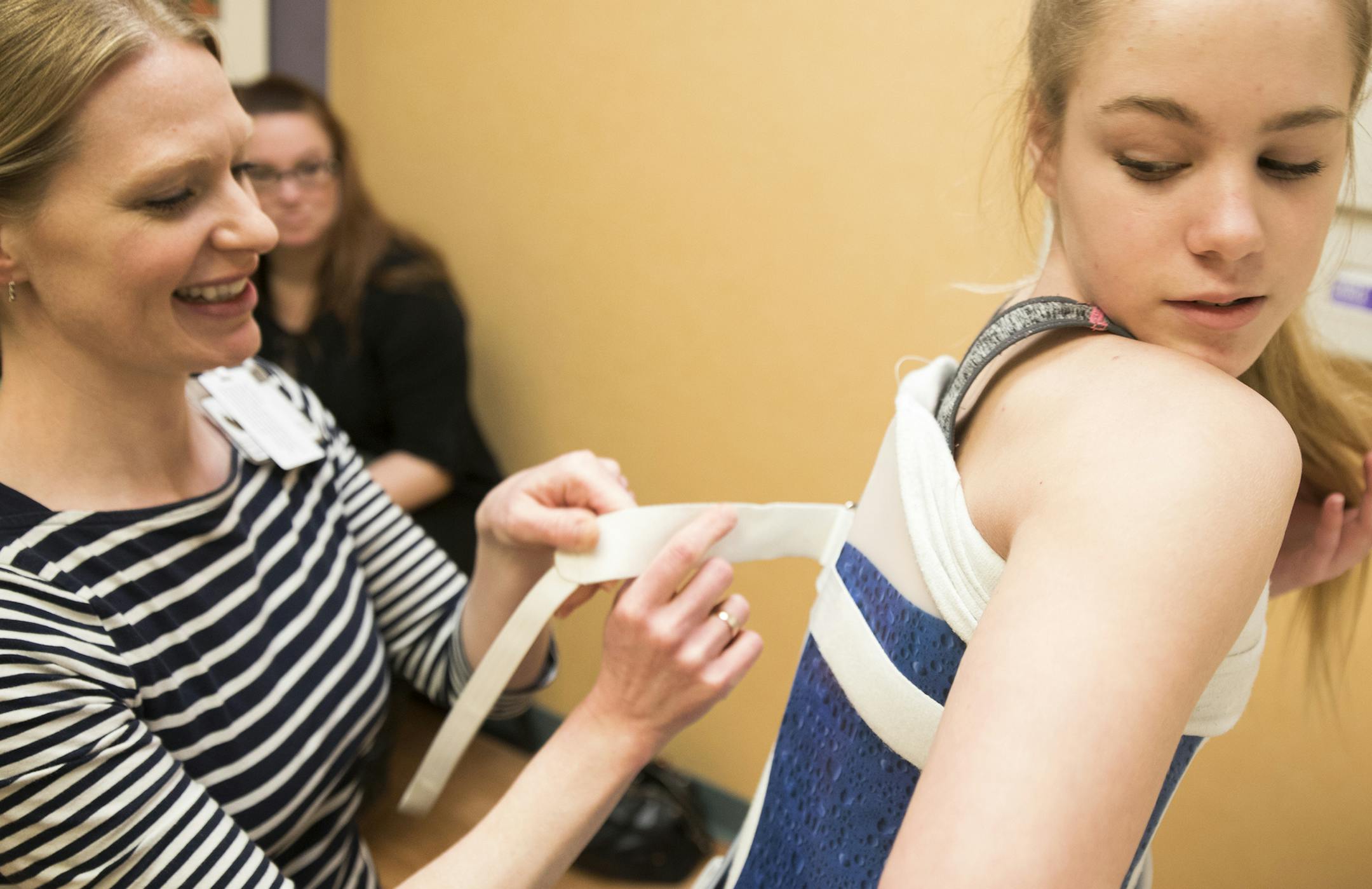
Not yet in her teens, Ellie Nadeau received upsetting news: the curve in her back was severe enough that she might need surgery.
The prospect of that potentially painful and lengthy ordeal brought Nadeau to a hospital examination room at Gillette Children's Specialty Healthcare, where a team of technicians had fashioned an alternative.
A binding brace, known as a TLSO for thoracolumbosacral orthosis, could halt the worsening of the S-curve in her back. But for up to 23 hours a day, for at least a year, she would be encased in plastic from her hips to her armpits. She would need to learn new ways to stand and sit.
And there would be regular clinic visits to tweak the brace to make sure it was applying the right pressure to help shape the growth of her spine. Getting the fit just right could be the key to a surgery-free future.
"Part of my job is to balance correction ... with comfort," Kristin Smith, a certified orthotist, explained as she inspected Nadeau's brace. "If she wears it and her arm pit is super-red, and she says it is falling asleep, then we will tweak it ... But if we trim [under the arms] too low, then we are not even effectively controlling the curve. So that's the balancing act."
It's a balancing act that orthopedic experts at Gillette have been performing for more than a century. Founded by an orthopedic doctor as a state-funded hospital, Gillette Children's today runs a self-sustaining network of clinics anchored by a main hospital in downtown St. Paul, generating more than $200 million in revenue.
More than 9,000 patients, about a third of the hospital's total, are served by its assistive-technology department, or ATD, which specializes in custom orthopedic devices for the spine, legs and skull.
Well-designed braces can mold kids' bones while they are still growing. But influencing that growth requires devices to fit precisely and be worn often — two major challenges for growing kids who can be easily irritated.
![Aaron Rasmussen, a certified orthotist, makes some adjustments to a leg brace in the lab at Gillette Children's in St. Paul. ] LEILA NAVIDI ï leila.navidi@startribune.com BACKGROUND INFORMATION: The custom-design lab at Gillette Children's Hospital in St. Paul on Tuesday, February 6, 2018.](https://arc.stimg.co/startribunemedia/25Q4KMGI72GAKZNGYYXTOZFF3A.jpg?&w=1080)
![Beulah Tarus, 8, gets undressed by her parents Everlyn, right, and Samson Tarus, during a follow up visit with Janet Cortes, a certified orthotist, after receiving a TLSO brace at Gillette Children's in St. Paul. ] LEILA NAVIDI ï leila.navidi@startribune.com BACKGROUND INFORMATION: The custom-design lab at Gillette Children's Hospital in St. Paul on Tuesday, February 6, 2018.](https://arc.stimg.co/startribunemedia/IDVJ3AISO757USZWYEBW2P26BM.jpg?&w=1080)
![Eight-month-old Evelyn Shenefield wears her cranial cap after an adjustment appointment with her mother Katie Jensen of Oakdale. ] LEILA NAVIDI ï leila.navidi@startribune.com BACKGROUND INFORMATION: Cranial cap appointments at Gillette Children's Speciality Healthcare in St. Paul on Tuesday, May 1, 2018.](https://arc.stimg.co/startribunemedia/K634BMPJ6IUFAP4X6DZAM5MTRQ.jpg?&w=1080)


