

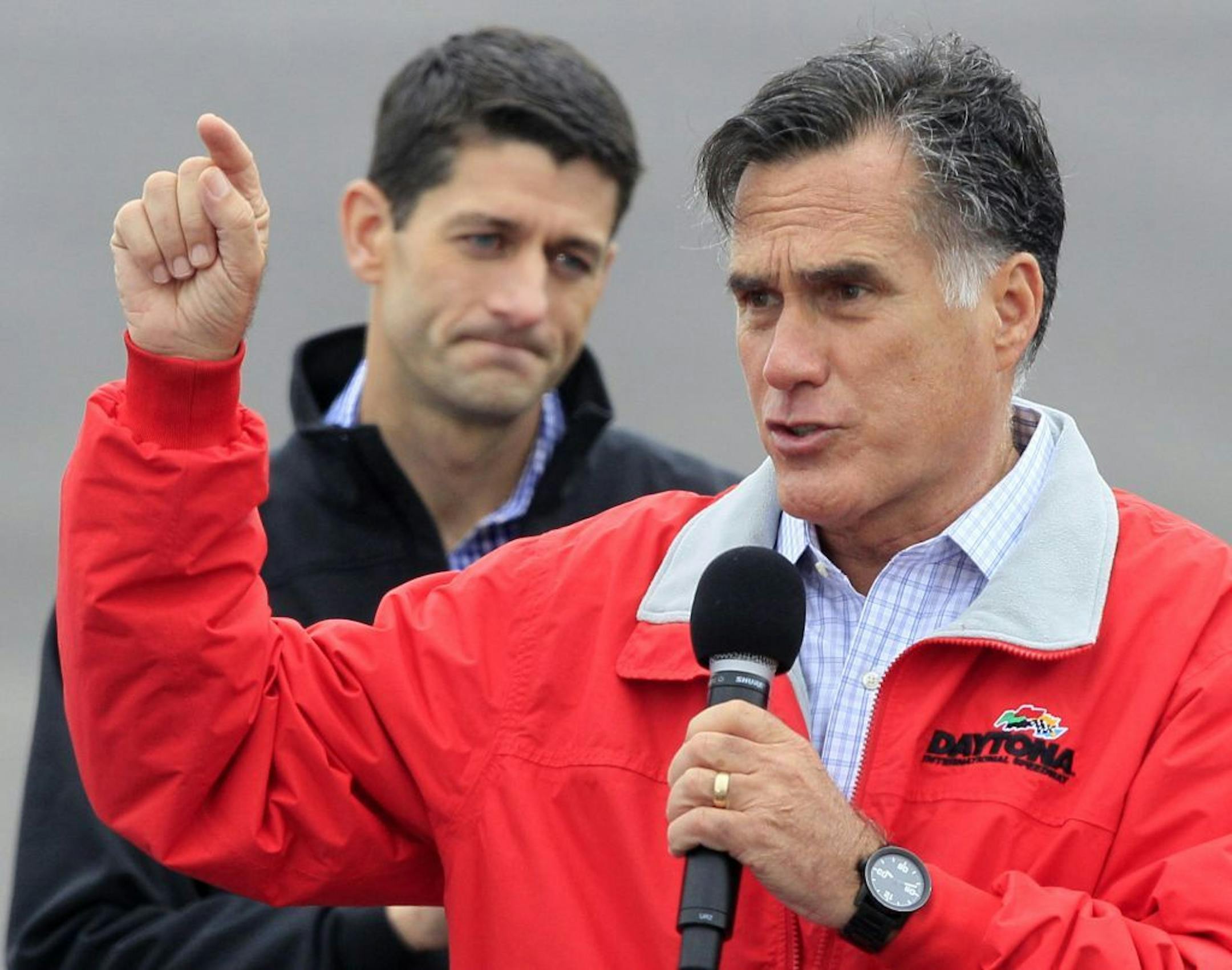
So it's over. Mitt Romney is now on his way to political oblivion. To hear the media tell it, a lukewarm convention, his gaffe accusing President Obama of apologizing to seething Muslim masses and his remarks at a fundraiser in which he impugned nearly half the country as self-pitying victims have done him in. A month ago, he was a candidate with a bulging war chest facing an opponent saddled with a creaky economy. Now he's toast.
But not so fast.
Here's a prediction. Regardless of what Romney does -- even if he continues to stick both feet in his mouth -- he is very likely to see his fortunes rise. That's because it is an iron law of American presidential campaign coverage that what goes up must come down and, conversely, what is down must go up. In short, Romney is going to be the beneficiary of what you might call the "media bounce."
The idea of a media bounce has very little to do with either Romney or Obama. In fact, it has very little to do with any candidate. It has to do with certain proclivities within the American media. As political scientist Thomas Patterson described it in his 1994 study of campaign coverage, "Out of Order," the media really have only four stories to tell: a candidate is winning or losing, gaining ground or losing ground. And he adds, "The press have a distinct narrative for each situation," which is why the coverage of one presidential election pretty much mirrors the coverage of every other election. In the media, every campaign is basically a sequel.
But, as Patterson also shows, these stories are not static. They are dynamic, and they are serial. They provide a narrative arc for the entire campaign, replete with twists and turns. When a candidate is riding high, the media magnify his success, creating a bandwagon effect. They tout his campaigning prowess, his human touch, his political instincts -- while, of course, telling us how his opponent founders.
And then something strange happens. Suddenly, with the slightest misstep, the aforementioned perfect candidate finds journalists saying that his prowess is faltering, his touch failing. The "losing ground" narrative kicks in, and guess what? Just as suddenly the once-trailing candidate is gaining ground.
His campaign has righted itself, he has become better on the stump, and his poll numbers are likely to rise.
In both cases, the media are magnifying small blips into large mountains. As Patterson puts it, "Journalists reason from effect to cause." If a candidate hits a bump or his numbers flag, they will adduce all sorts of reasons why, which only serves to accentuate what it is they are reporting.


