

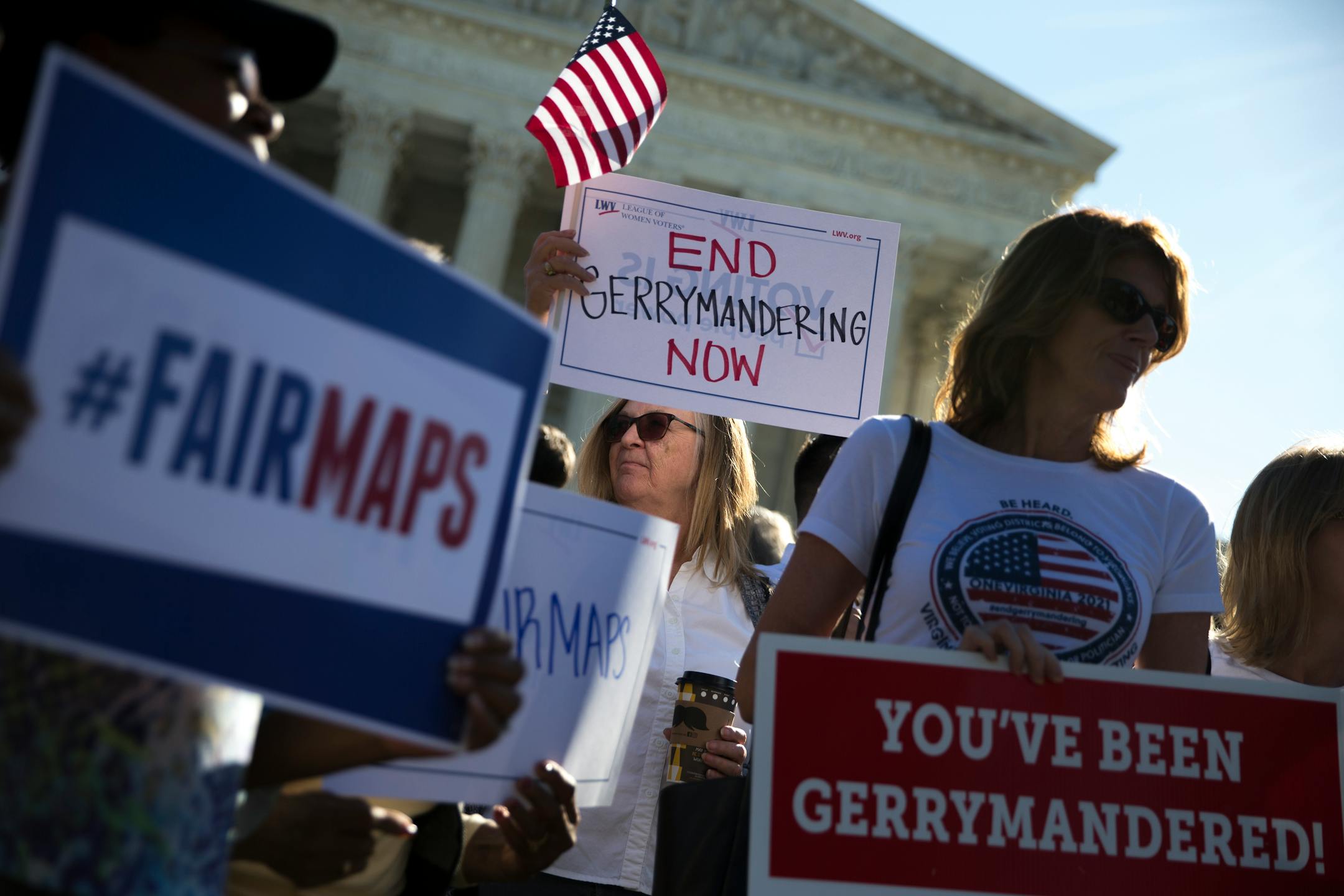
It's a redistricting year in the blue state of Illinois, which means that Republicans are getting less consideration than a missionary on the Las Vegas Strip. Democrats have been winning in the Land of Lincoln for a long while, controlling the state House for all but two of the past 38 years. But they see no harm in running up the score.
Democratic Gov. J.B. Pritzker campaigned on a vow to take reapportionment away from politicians and turn it over to an independent commission. But that didn't happen, and when the General Assembly sent him district maps that exemplified partisan gerrymandering, he signed them into law.
"Make no mistake, these maps were drawn solely for the Democrats to maintain their political power in the state of Illinois," House Minority Leader Jim Durkin said. Democrats outnumber Republicans 73-45 in the state House, and those numbers are likely to grow more lopsided.
Similar things are going on in New York, where Democrats have plotted new district lines with the goal of cutting the GOP's eight members of Congress to four or even three of the 26 seats the state will have. That's less than 16% of the seats in a state where 38% of voters went for President Donald Trump. New York's Republican Party chair Nick Langworthy said the redistricting "is a political sham built on a foundation of lies and hypocrisy."
Shams are the norm in this process, where lawmakers celebrate the glories of democracy while scheming to make elections an empty formality. Democrats in blue states are more than willing to ignore their good-government allies to cement their control in state legislatures — and to keep Nancy Pelosi in the speaker's chair.
After losing out on Maryland's last congressional map, Republicans took the fight to the Supreme Court, arguing that partisan gerrymandering is unconstitutional. (The court disagreed.) So you might think that Republicans would be determined to put an end to partisan reapportionment. But hypocrisy is a two-way street.
Today, the GOP has control of the governor's office and the legislature in 23 states, compared to 15 such "trifectas" for Democrats. Such dominance is never more valuable than in a redistricting year, giving those in power the chance to supersize their advantage for a full decade.
Political scientists Alex Keena, Michael Latner, Anthony McGann and Charles Anthony Smith wrote in the Washington Post, "We found that, after 2011, 45 state legislative maps had been drawn with extreme partisan gerrymandering. Of these, 43 favor Republicans, while only two help Democrats. Because of these gerrymandered maps, Republicans held onto power after losing the statewide popular vote in Virginia in 2017, and in North Carolina, Pennsylvania, and Wisconsin in 2018."


