

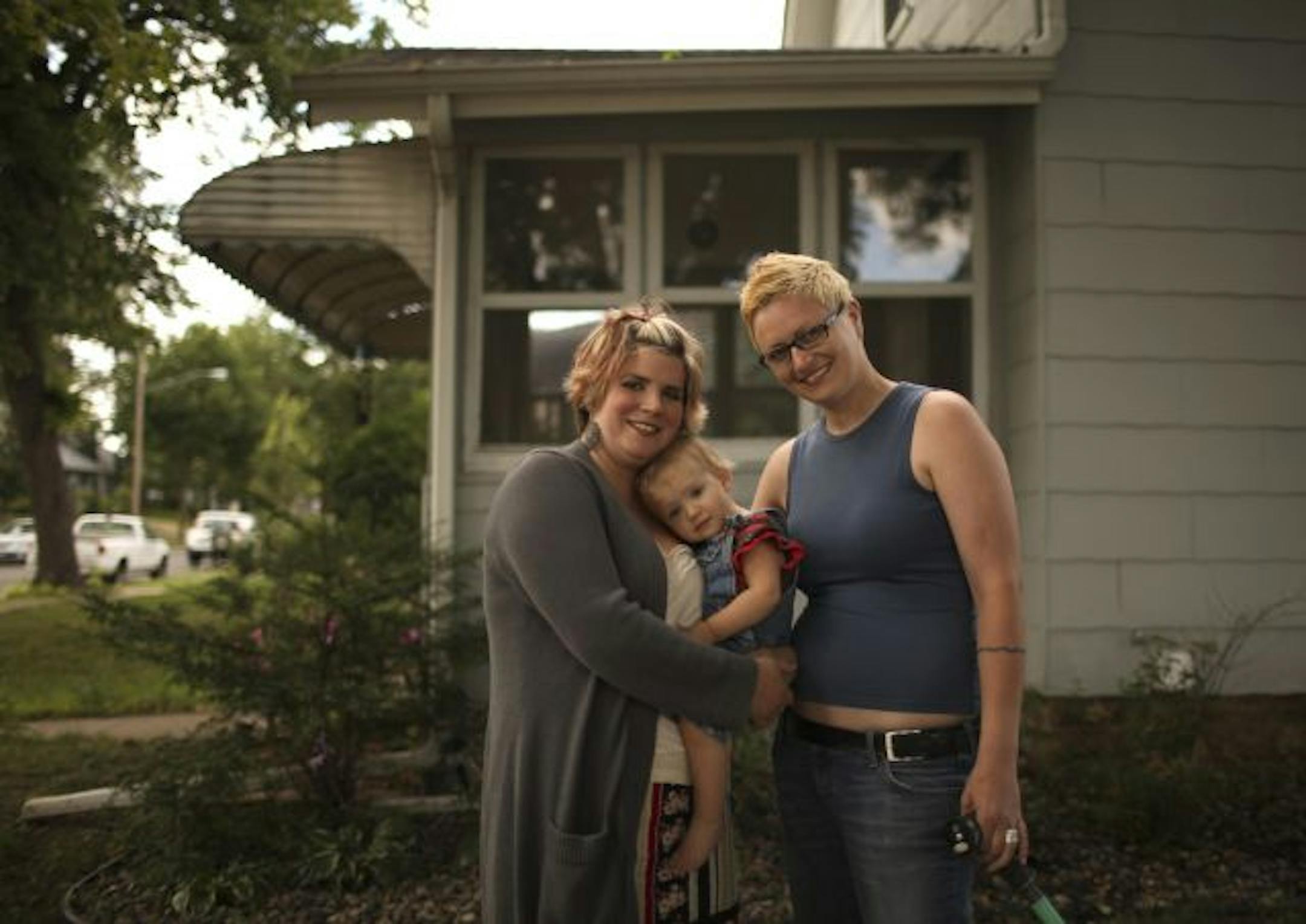
For Jada Hansen, breaking up was particularly hard to do. When her six-year relationship ended in 2003, she and her partner shared, among other things, a mortgage, a checking account and two dogs.
"It ended being a terribly, terribly messy thing," she said. "They kept sending us to this arbitration room and said, 'Just work it out.' Basically our lawyers just sat in a room [with a mediator] and talked about scenarios for about two years. In the end, I walked away with $10,000 of about a $135,000 house."
Hansen's case is hardly atypical for gay people in Minnesota. Five states, including Iowa, and Canada allow gay and lesbian marriages, and many Minneapolis couples have tied the knot in other states. But since Minnesota does not recognize gay marriage -- Hansen and her ex had held a nonbinding wedding ceremony before their split -- there's no such thing as divorce court for them.
While heterosexual couples' breakups are difficult and daunting, they face fewer hurdles than do their same-sex counterparts here. "If they have children, they go into family courts, and if they own property together, they go to civil court," said Melissa Houghtaling, a lawyer with the GLBT- focused firm Heltzer & Burg. "Whereas if they were a heterosexual married couple, they could go to one court to deal with all of that.
"Same-sex couples can have two lawsuits going on at one time, whereas heterosexual couples would have one dissolution case."
To avoid pricey lawsuits that would send them to civil court, gay and lesbian couples generally opt to go through a private mediation or arbitration.
Going to civil court involves what another GLBT attorney, Jonathan Burris, calls "a very archaic legal process called partition of a business partnership, which is always a long, slow road because of the extraordinary expense and overloaded court dockets."
Figuring out who gets what can be every bit as contentious as with traditional married couples -- with the occasional twist.


