
Gadget buybacks fuel sales

Retailers bet that if consumers think their gadgets - like textbooks - retain value, they'll replace them sooner.

March 29, 2011 at 9:35PM
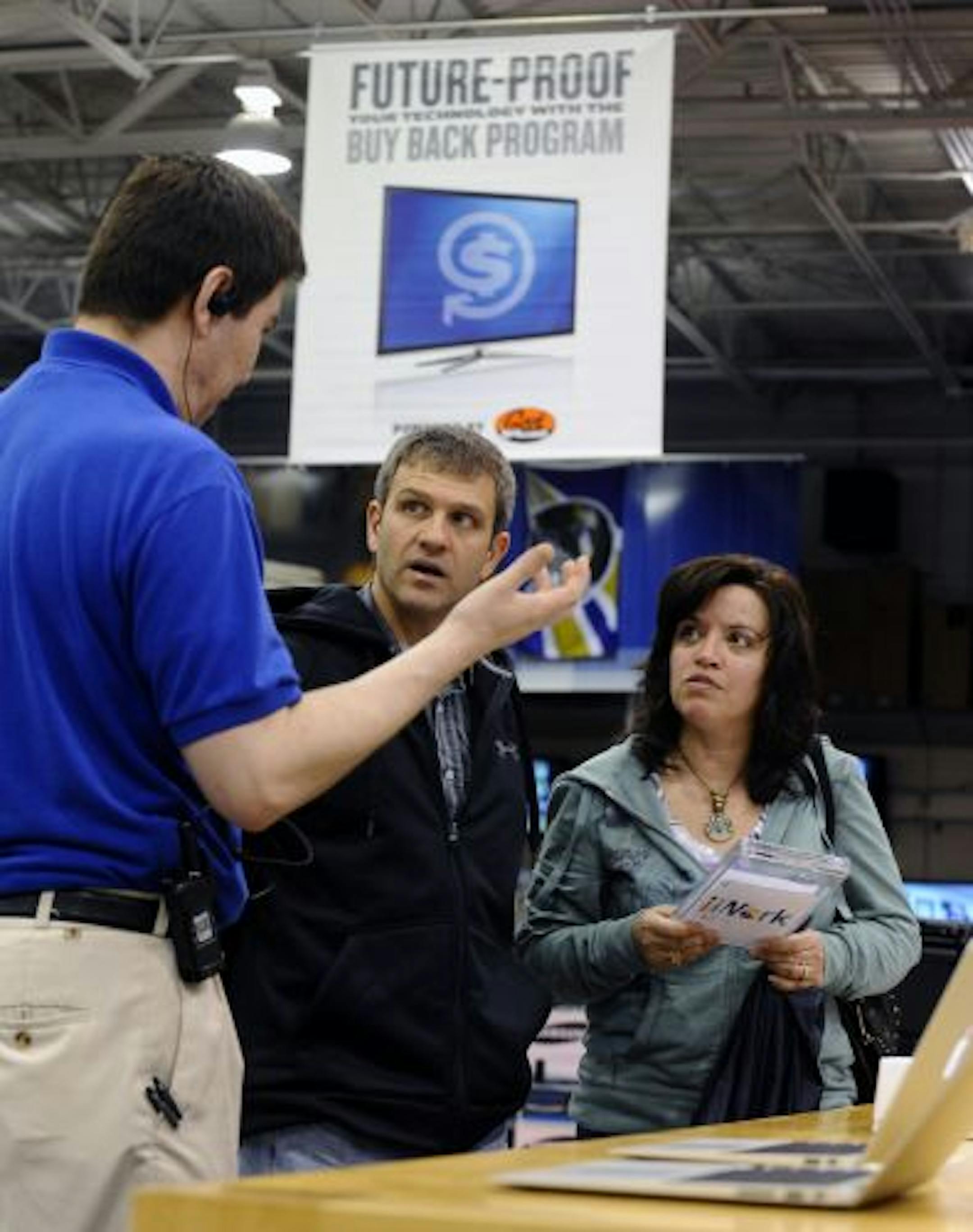
Best Buy employee Rustam Ibragimov, left, explained the company's buyback program to Roger and Robin Wilson, of Frostburg, Md., who were shopping for a laptop computer.
Best Buy employee Rustam Ibragimov, left, explained the company’s buyback program to Roger and Robin Wilson, of Frostburg, Md., who were shopping for a laptop computer. (Baltimore Sun/MCT/The Minnesota Star Tribune)

You know that shiny smartphone you bought six months ago? There's an even better one hitting the market right about now. Or how about that flat-panel TV you bought last year? Now they come in 3-D.

With the ever-quickening pace of technological advances, you can be left in the digital dust.

Retailers now have a solution for consumers -- and for themselves. They will buy back your old gadget in hopes that you turn around and buy the next hot new gadget on their shelves.

Under these "buyback" programs, big-box retailers and online merchants give cash or credit for a piece of used electronics. Best Buy, the world's largest consumer electronics retailer, launched its program earlier this year.

"Technology is changing so fast that the consumer a lot of times feels they're being left behind, so they'll postpone buying," said Cynthia Jasper, an expert in buying behavior and chair of the consumer science department at the University of Wisconsin-Madison. "So it's a way to make the consumer feel at ease."

For retailers, buyback programs are another way to lure customers into stores to spend on pricey gadgets such as smartphones, laptops, tablet computers and televisions. Retailers also see buyback programs as an alternative revenue stream because they can sell used products through online outlet sites.

One California start-up has put its own twist on the concept. Its vending machine model, called the "ecoATM," is an automated kiosk that accepts used gadgets and pays the consumer in cash or gift cards. The company behind the Redbox movie rental kiosks, Coinstar, has invested in ecoATM, which has already deployed some of the machines in California.

More willing to upgrade

Retail industry experts say the consumer electronics market is evolving the way markets in used cars or used textbooks did. And if consumers believe their gadgets will retain some value, they might be more willing to upgrade sooner because there's less risk of the device becoming outdated and worthless, industry experts said.

For years, early adopters of gadgets have used eBay and other online outlets to eventually sell the old stuff for cash to defray the cost of the latest models. Many consumers already upgrade their cellphones. Sprint, AT&T and Verizon have introduced their own buyback programs, some of which aim to lure customers from other carriers.

"The electronics business is built on people upgrading their products," said Stephen Baker, vice president of industry analysis at NPD Group, a technology research firm. "Anything to increase the turnover is a benefit to the industry."

Some consumer electronics retailers are finding a lucrative market in lightly used gadgets.

Dale Rogers, a logistics and supply chain expert and professor at Rutgers University, estimates that the secondary market is worth about $13 billion in annual sales --about 10 percent of the U.S. consumer electronics market.

Rogers said brick-and-mortar retailers increasingly feel threatened by online commerce and are strategizing ways to keep consumers coming through the doors. Best Buy's program, for one, requires customers to come into the store to sell back products.

"The brick-and-mortar, big-box retail store is experiencing some difficulty these days," said Rogers. "It's real easy to buy online, so these buyback programs are really a great way to get you into the store."

Reselling iPads

TechForward, a start-up company in California, has been offering this "guaranteed buyback" model for several years, partnering with clients such as Radio Shack and CompUSA, which offer the option to consumers. The terms of TechForward's program are similar to Best Buy's.

It had partnered with Best Buy to develop the retailer's own program, a federal lawsuit filed last month in California alleges. TechForward contends that Best Buy stole its trade secrets and launched its own program -- with a major commercial on Super Bowl Sunday this year -- and ultimately cut out the small company.

Best Buy declined to discuss the lawsuit.

TechForward revealed in the case that one way it makes money is by closely tracking the rate of return for different gadgets. The company can turn a profit from those who never take advantage of the buyback plan.

Gazelle.com, a Boston-based company founded in 2006, gives consumers the going market price for a gadget, whether it's a smartphone or an Apple iPad.

It also has developed its own technologies for quickly assessing the worldwide market for electronics. Gazelle users can get an online price quote for their equipment, ship the product for free to the company and get paid within two weeks.

Some of Gazelle's retail partners include Costco and Kmart. Consumers can trade in their electronics through these retailers' websites and get store credit, or they can opt for cash.

Kristina Kennedy, a Gazelle spokeswoman, said the company calls the nascent industry "re-commerce." The March 2 announcement of the Apple iPad 2 led to a watershed moment for the online service. Owners of the original iPad flocked to the website and sold 2,400 units the day that Apple CEO Steve Jobs announced the second version.

"That became the biggest day of business for us in the company's history," Kennedy said.

"What's really spurred our business is the pace of innovation," Kennedy said. "The last couple years have seen some very exciting products come out in consumer electronics."

Dawn Ward of Baltimore has sold two smartphones, including an iPhone 3G in October for $80, through Gazelle.com. She's excited about all the options she now has to sell her gadgets.

"For the consumer, it's awesome," Ward said.

about the writer

about the writer

GUS G. SENTEMENTES, Baltimore Sun