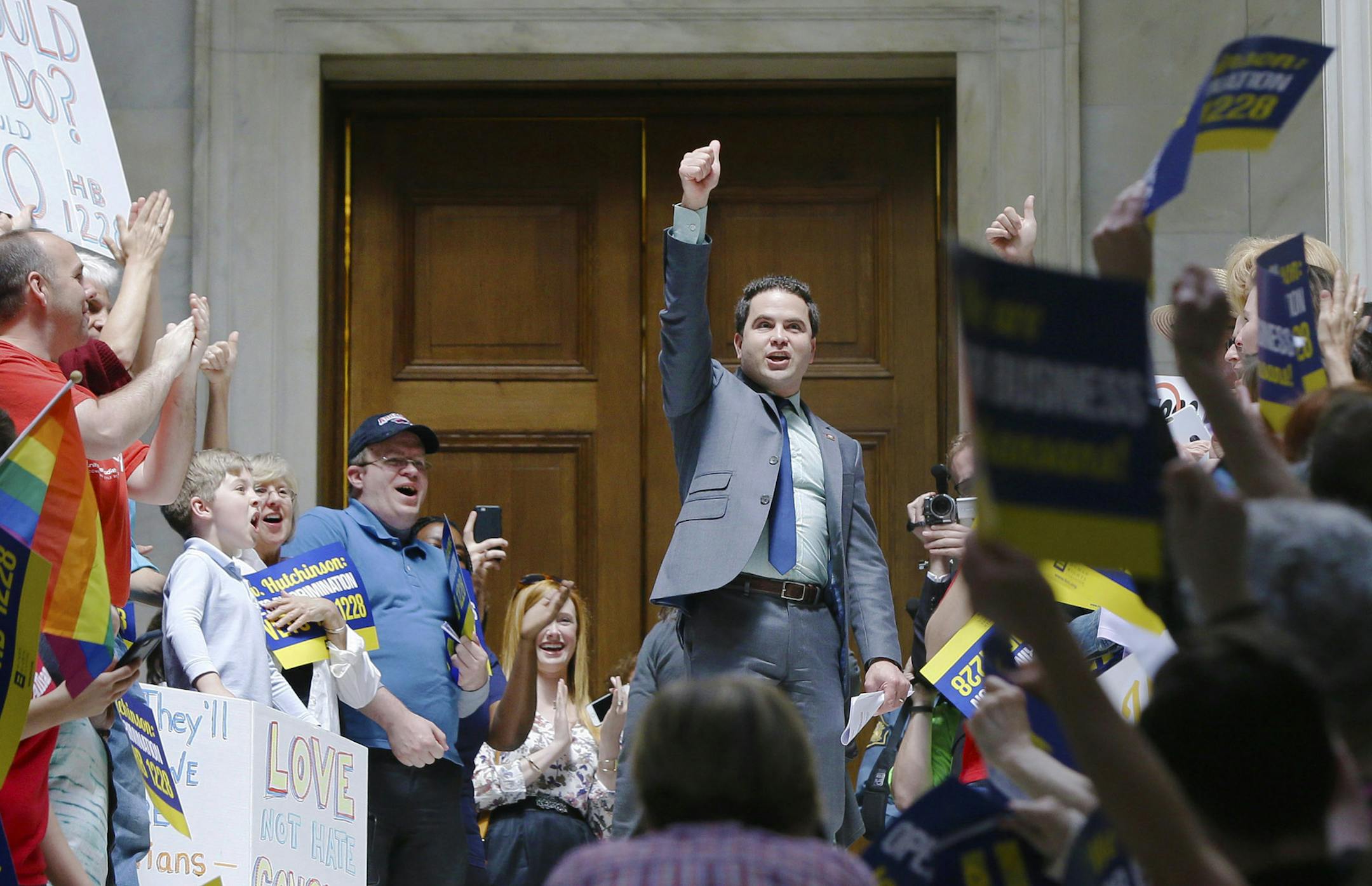
After a national uproar over bills promoted as religious freedom measures and criticized as anti-gay, lawmakers in Indiana and Arkansas reversed themselves and approved new legislation last week to remove the most contentious language. Indiana Gov. Mike Pence and Arkansas Gov. Asa Hutchinson, both Republicans, signed the revisions into law.
In Indiana, the changes, while not outlawing anti-gay discrimination, clarified that the religious freedom law does not authorize such discrimination. The new Arkansas measure is nearly identical to the federal Religious Freedom and Restoration Act — narrower in scope than an initial bill — but it does not directly address discrimination. Background to keep the debate in context:
Q: How did these laws originate?
A: Twenty states have adopted "religious freedom" laws that are derived from the Religious Freedom Restoration Act, which was adopted nearly unanimously by Congress in 1993 and signed by President Bill Clinton.
But more recent versions of such laws, like the original ones in Indiana and Arkansas, contained language that broadened the potential impact. For example, both states' bills would have applied religious rights to corporations and said the laws could be invoked in private lawsuits, not just when a government agency has taken action said to impinge on a party's religious beliefs.
The 1993 federal law was narrower in scope. It arose in response to a case in which two members of the Native American Church in Oregon had been fired from their jobs in a drug-treatment center after they used peyote, an illegal drug, in a religious ceremony and then the state refused to pay them unemployment benefits. The U.S. Supreme Court upheld Oregon's decision not to pay benefits, provoking a drive in Congress to pass a law to deter government actions that impinge upon religious beliefs.
The Supreme Court said later that the federal law applied only to actions by federal agencies, so many states started adopting similar laws.
The laws set up a common structure: When people feel that a "state action," like a fine or mandate, imposes a severe burden on their religious beliefs, they can ask a judge to decide whether the action is warranted by a "compelling" governmental interest.