
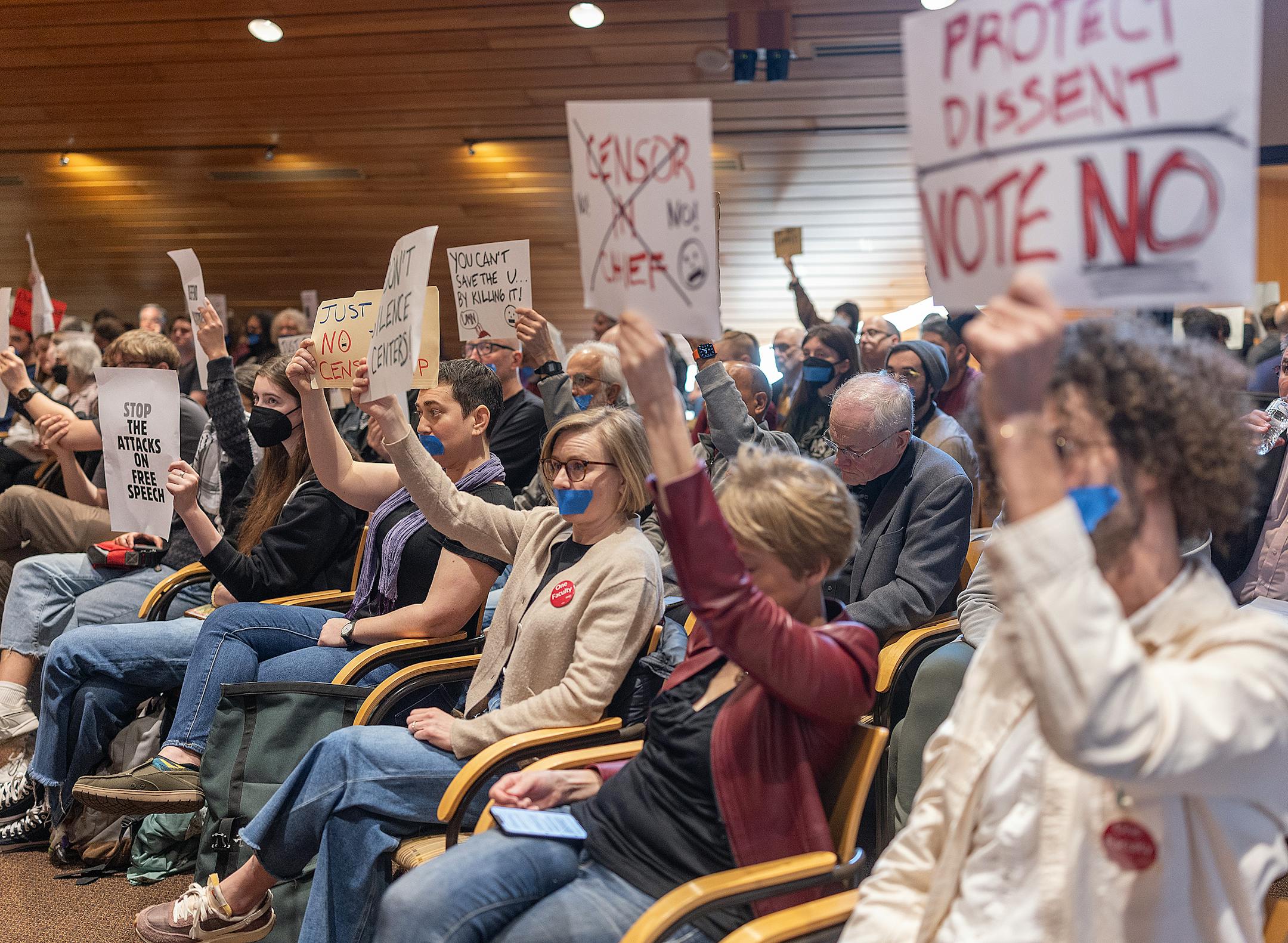
Frustration grows over speech resolution limiting what U departments, institutes can say

Local and national groups have weighed in on the measure, passed last March by the Board of Regents.

The Minnesota Star Tribune
December 12, 2025 at 12:00PM
Faculty and students fill the University of Minnesota Board of Regents meeting on March 14 in Minneapolis to protest a resolution that they say will limit faculty members' academic freedom and speech in Minneapolis. (Elizabeth Flores/The Minnesota Star Tribune)

Controversial limits on what academic departments can say through official channels have chilled campus speech at the University of Minnesota, according to a growing group of critics of the nine-month-old policy.

Through letters, reports and a rally planned for Friday morning, faculty members and free-speech advocates have voiced opposition to the U’s institutional speech resolution. The measure was passed in March partly to address earlier concerns about political posts, including some related to conflict in Gaza.

The board and President Dr. Rebecca Cunningham haven’t discussed the resolution again at a Board of Regents meeting since it was approved.

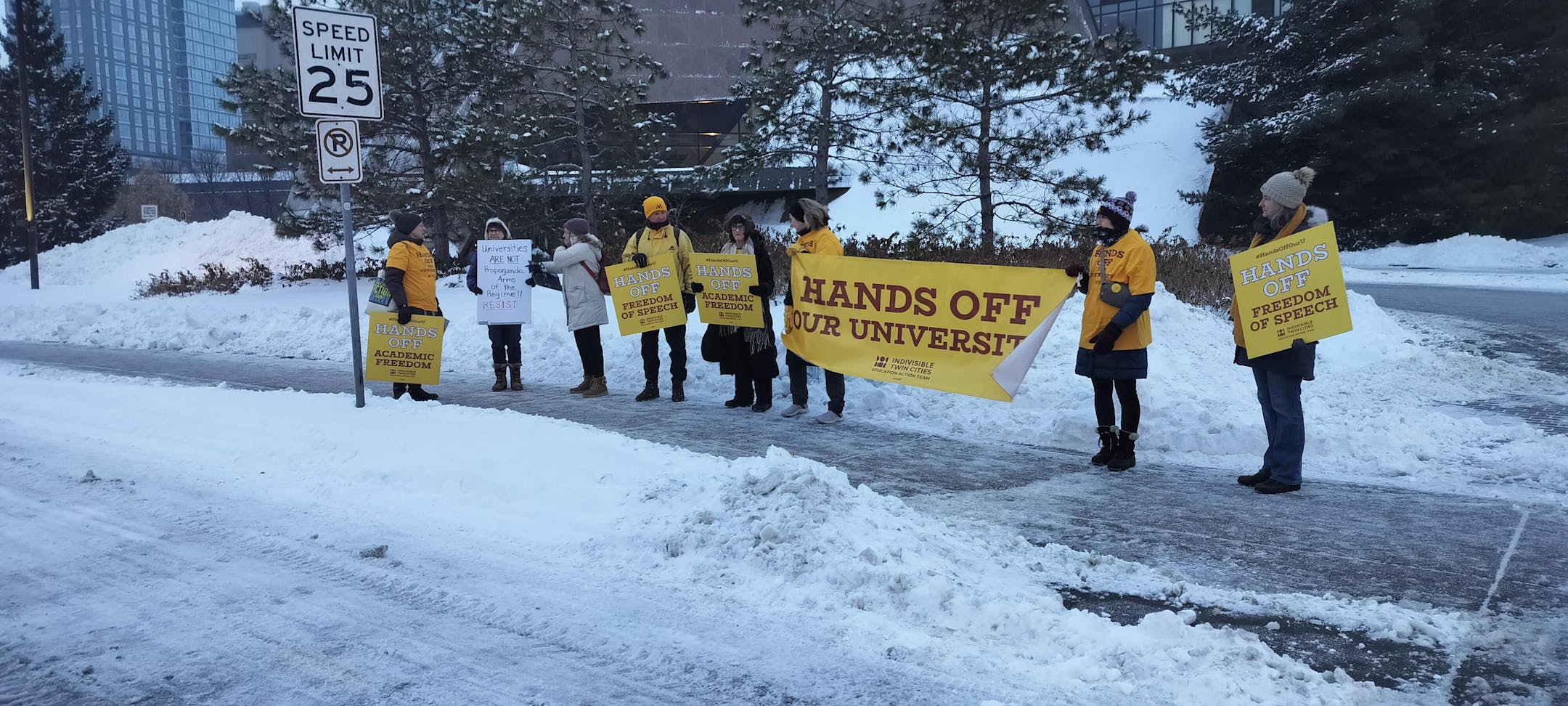
Indivisible, a group that pushes back on President Donald Trump’s agenda, including attacks on universities, said its members were denied permission to speak about the resolution at Friday’s regents meeting. They organized the rally instead.

“Our whole objective is to try to protect the U,” said Kaye Peters, a member of Indivisible’s local chapter. “I don’t think ... they are aware or have dealt with the damage this kind of top-down approach is [having] on the university.”
The resolution, which passed with a 9-3 vote, limits the ability of academic “units” — like departments, institutes or centers — to make collective statements about “matters of public concern” without Cunningham’s approval. It addresses who can officially communicate for the U, including on the U’s website, social media or letterhead.

Individual faculty members may still express themselves, and statements by units on issues that have an “actual or potential impact on the mission and operations” of the U are allowed with the president’s consent.

But many U faculty members have said they believe commenting on current events is central to their job.

The resolution’s opponents say it gives too much power to Cunningham and it’s unclear exactly what topics are restricted. They argue it has made students and faculty uncomfortable sharing ideas and opinions, something that’s central to the U’s mission and that of any university.

Some U faculty members decried the decision not to discuss the resolution at the regents’ October meeting. Instead, the board accepted a report containing online feedback about the change without comment. Other faculty said they’d hoped the item would show up on the regents’ December agenda this week, but nothing appeared.

“If they’re not going to just come out and revoke it, we wanted them to at least have a serious discussion of it,” said Will Jones, a history professor who is also president of the U’s American Association of University Professors chapter.

Regent James Farnsworth said he was “under the impression” the board would talk publicly about the resolution in October and was disappointed when that didn’t occur.

U spokesperson Andria Waclawski said the board has already received “considerable feedback” on the resolution, adding that the U is committed to ensuring that individuals and groups can “fully engage in scholarly work.”

“The board does not intend to bring this issue back before the board at this time, which is why requests to [speak] were not approved,” Waclawski said, adding that in October discussion wasn’t required or expected.

Before the measure passed, over 400 U academics asked the Board of Regents to retract it, as did the University Senate, a governing body made up of faculty, staff and students. A slightly different version was approved.

This fall, half a dozen groups weighed in, including a local academic association, a national group dedicated to free expression and various faculty groups and committees.

“Faculty, staff and students have reported an alarming pattern of censorship and self-censorship at the University of Minnesota” since the resolution passed, a report by the AAUP’s Twin Cities chapter said.

By prioritizing “even-handedness” over a commitment to freedom of expression and academic freedom, “the University has initiated a process that will undermine the institution’s values,” said a letter signed by 21 Humphrey School of Public Affairs faculty members.

“It is our strongly held conviction that all universities, including UMN, must resist political pressures to adopt policies of ‘neutrality’ that serve to muzzle faculty speech,” said PEN America, a group that recently led an academic freedom presentation at the U.

Some faculty support resolution

Universities across the country have been debating issues related to academic freedom over the past few years, some brought to the forefront after the October 2023 attack on Israel by Hamas and the consequent protests and public outcry.

Last March, one national news outlet estimated that more than 140 universities had implemented institutional neutrality policies since the conflict in the Middle East began, compared to fewer than 10 with policies before then.

At the U, one impetus for the resolution was pro-Palestine posts made by groups of academics on departmental websites after the attack. Two dozen state legislators called for the posts to come down.

After the March resolution passed, U officials removed a dozen statements posted on U websites related to the Israel-Palestine conflict or the war between Russia and Ukraine.

Several faculty members said they support the resolution and believe it doesn’t limit academic freedom or freedom of speech.

Bruno Chaouat, a French and Jewish studies professor, said he saw the “violently polarizing” posts as more about activism than scholarship.

“They had the potential to intimidate people within a certain unit,” he said, especially non-tenured faculty, junior faculty and students with different opinions.

“Everyone is free to write anything they want, they just can’t call it an official position of their unit of the U,” said Logan Spector, a pediatrics professor. “It’s a complete fabrication to call that any sort of suppression of free speech.”

Cunningham weighs in at faculty forum

Cunningham did address the resolution during a Nov. 19 forum with College of Liberal Arts faculty. The Minnesota Star Tribune obtained a recording of that meeting.

When a faculty member asked about the resolution, Cunningham said the regents passed a resolution that administrators had to implement, she said.

“I’ll own, in the busy time of last year, that implementation could have been done better,” she said. “I think there’s a lot of room for more explanation of what is or is not allowed.”

“We don’t want to chill speech” on campus, she said, adding that administrators “don’t always get everything perfectly right.”

Gretchen Ritter, executive vice president and provost of the U, said she didn’t believe restricting institutional speech was the same as limiting academic freedom but understood concerns about the resolution.

“We owe all of you more conversation on this,” Ritter said.

Eric Van Wyk, a computer science professor and chair of the Faculty Senate’s academic freedom and tenure committee, said more details are needed on the resolution because there’s currently no policy detailing its implementation.

“The situation is not a good one, and hopefully it can be rectified,” he said.

about the writer

about the writer

Erin Adler

Reporter

Erin Adler is a news reporter covering higher education in Minnesota. She previously covered south metro suburban news, K-12 education and Carver County for the Minnesota Star Tribune.

See Moreicon

More from News & Politics

See More
card image
Mead Gruver/The Associated Press

The scam’s target went to law enforcement after being asked for another $240,000, according to a court filing.