

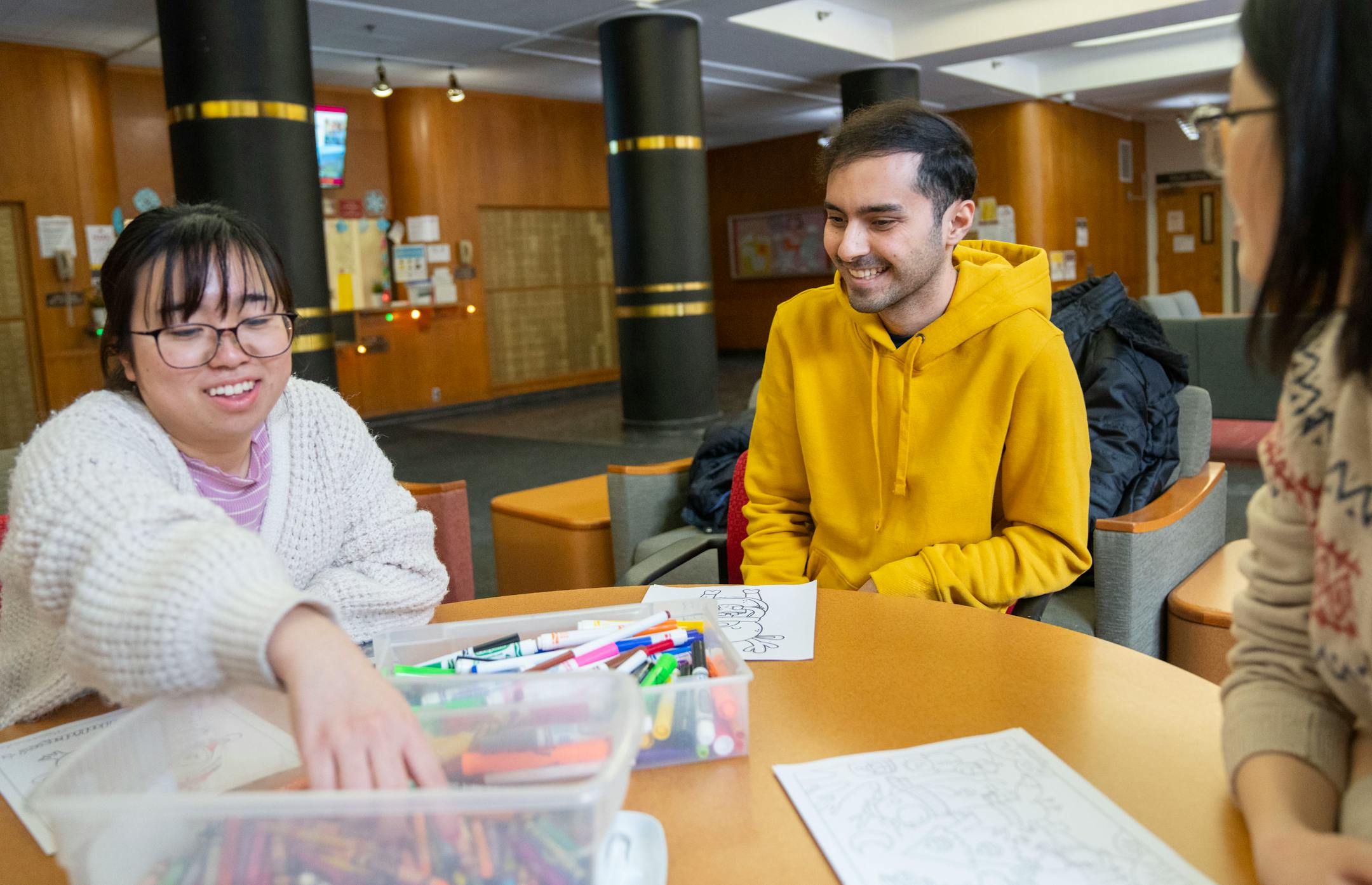
Every year when Minnesota college campuses empty out for the winter break, some students stay behind.
Six of them met one recent afternoon in the lobby of Centennial Hall on the University of Minnesota's Twin Cities campus. They shared pizza, colored, and chatted about everything from their majors to their plans for surviving the next, cold semester.
"It can feel like nobody's here," said Jessica Tsadwa, assistant director of social justice and inclusion in the U's housing division. She organizes the social hours twice a week to help students feel less lonely.
It's difficult to calculate how many of the state's roughly 400,000 college and university students remain on campus during the winter break, but it happens at many schools. And some campuses are organizing programs in hopes that students won't go hungry or feel isolated.
Some students stay for the whole break. Some come and go. The reasons vary: Some are international students who can't travel home or who delay their flights to catch the best deals. Some have difficult family lives or lack stable housing. Others work nearby. And some simply find it convenient.
Carleton College, an hour south of the Twin Cities in Northfield, has one of the longest winter breaks, running six weeks. As the college recruited more international students and more students from low-income families, administrators saw that more people were choosing to stay on campus over the winter holidays.
"Our demographics had changed and our students' needs had changed," said Carolyn Livingston, vice president for student life and dean of students.
So about six years ago, the college launched a food pantry called the Carleton Cupboard. It began with dry goods like pasta and canned foods and has grown to include dairy products and fresh fruits and vegetables. If they time it right, students might find Girl Scout cookies donated by one of the faculty members.


