
Free bike program shifts into high gear

About 5,000 children will receive free bikes just in time for the holidays, thanks to volunteers who are fixing up donated bikes.

For the Minnesota Star Tribune
December 6, 2011 at 10:01PM
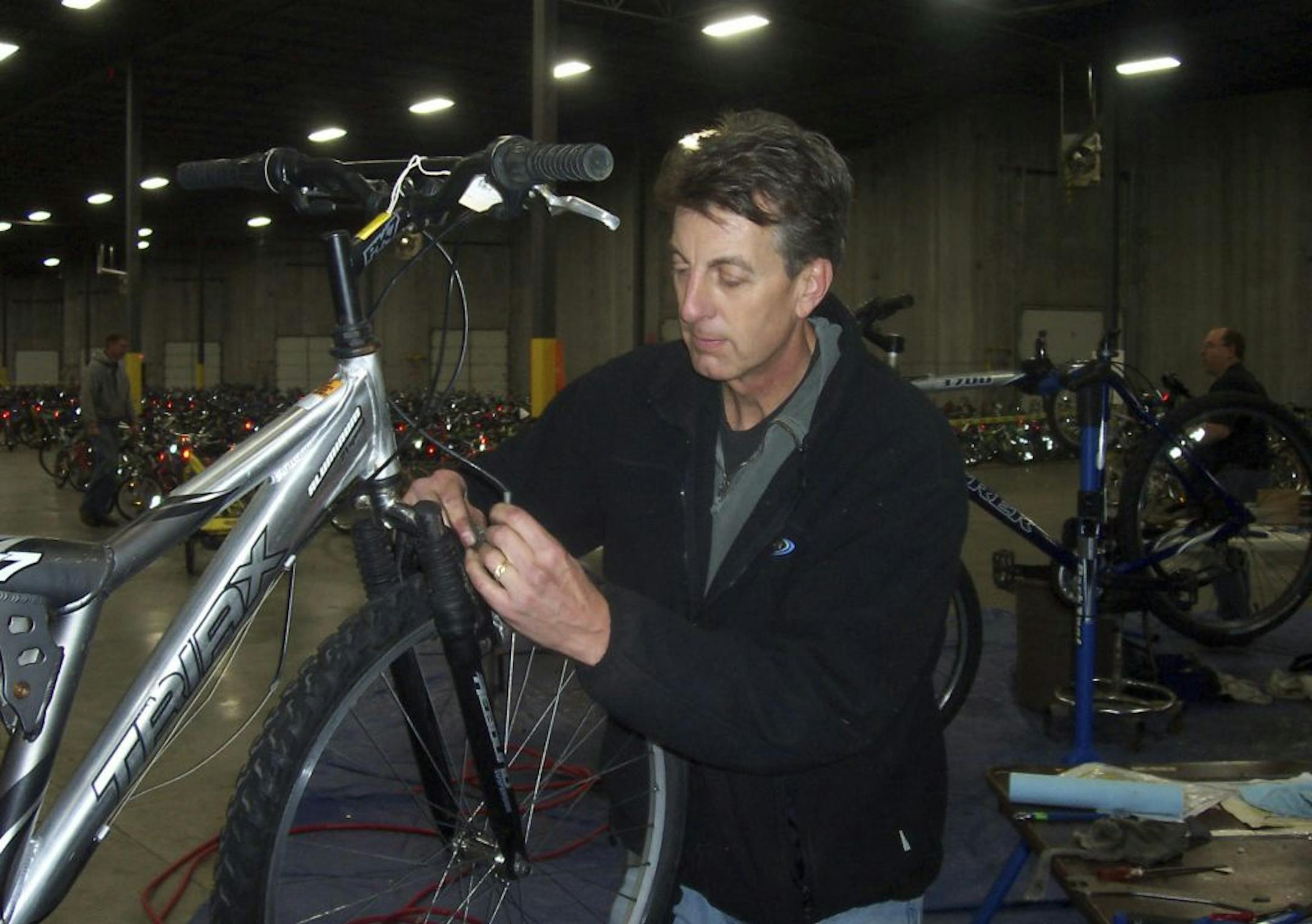
Volunteer Mark Hoffman of Plymouth worked on one of the 5,000 bikes.
Volunteer Mark Hoffman of Plymouth worked on one of the 5,000 bikes. (Special to the Star Tribune/The Minnesota Star Tribune)

In an ordinary-looking Hopkins warehouse, bikes of all shapes, sizes and colors move through an assembly line, where their tires are re-inflated or replaced, their cranks or pedals are tightened and their seat collars are greased.

What looks like a bike-repair shop full of mechanics is actually headquarters for the local nonprofit Free Bikes 4 Kidz, whose volunteers -- aka Santa's elves -- are in the process of restoring thousands of donated bikes.

It's all in preparation for this Saturday, when 5,000 bikes will be given away to new owners at 23 Free Bikes 4 Kidz giveaway sites throughout the metro area.

"The bikes need anything from just adjusting to total rebuilding. Some of them look okay, but the frame might be bent or the chain kinked. You have to look beyond the cosmetic and check every nut and bolt," said Mark Hoffman of Plymouth, who has volunteered with the nonprofit for two years.

Many of the volunteers -- more than 1,000 total over a six-week period -- have experience fixing bicycles. Hoffman, for example, put himself through college repairing bikes.

But there's room for others who simply want to help. They're put to work scrubbing frames and shining tires.

"I love bikes; they're just a great form of exercise for kids and a great activity for families," Hoffman said. "But not everyone can afford a bike."

Hoffman's sentiments are similar to those of Free Bikes 4 Kidz founder and executive director Terry Esau of Orono, who had the idea to collect old or outgrown bikes, fix them up and give them away to kids in 2008. An avid biker himself, he involved his Saturday biking group in the project.

Their efforts grew into a nonprofit that's become the largest organization in the country giving away bikes to children.

"A lot of people have responded to this cause," Esau said. "It's kind of a no-brainer. You talk about giving a bike to a kid and everyone says, 'That's a good thing.'"

Some of the companies helping out this year include Allina and Penn Cycle, along with many other sponsors. Free Bikes 4 Kids has also teamed up with about 30 kid-oriented nonprofits to coordinate who will receive the bikes.

Esau said his next goal is figuring out how to make Free Bikes 4 Kidz into a template that could be replicated elsewhere; several groups in other cities have contacted him with questions about the organization. "We have a few things to figure out, but this has the potential to really grow."

In the next few days, though, he'll be visiting several giveaway sites to witness bikes being distributed firsthand.

Esau said that seeing the lengths families go to to pick up their children's new bikes -- last year, many people walked or took public transportation through a severe blizzard to get there -- makes all his work worthwhile.

"This means a lot to people. Seeing the smiles on the faces of the parents and kids is the best part of the whole deal."

Erin Adler is a Twin Cities freelance writer.

about the writer

about the writer

Erin Adler

Reporter

Erin Adler is a suburban reporter covering Dakota and Scott counties for the Minnesota Star Tribune, working breaking news shifts on Sundays. She previously spent three years covering K-12 education in the south metro and five months covering Carver County.

See Moreicon

More from No Section

See More
FILE -- A rent deposit slot at an apartment complex in Tucker, Ga., on July 21, 2020. As an eviction crisis has seemed increasingly likely this summer, everyone in the housing market has made the same plea to Washington: Send money — lots of it — that would keep renters in their homes and landlords afloat. (Melissa Golden/The New York Times) ORG XMIT: XNYT58
Melissa Golden/The New York Times

It’s too soon to tell how much the immigration crackdown is to blame.