

Gunnar Ewert spent the better parts of his summer and winter breaks tinkering with the 1974 Chevrolet Nova sitting in his driveway, propelled by a childhood fascination with cars. So when he heard about a competition to build and race super-efficient vehicles, the Forest Lake High School junior signed up without hesitation.
"I've always liked working with metal, but my first class was in junior high," Ewert said. "I just like taking something from nothing and making something cool."
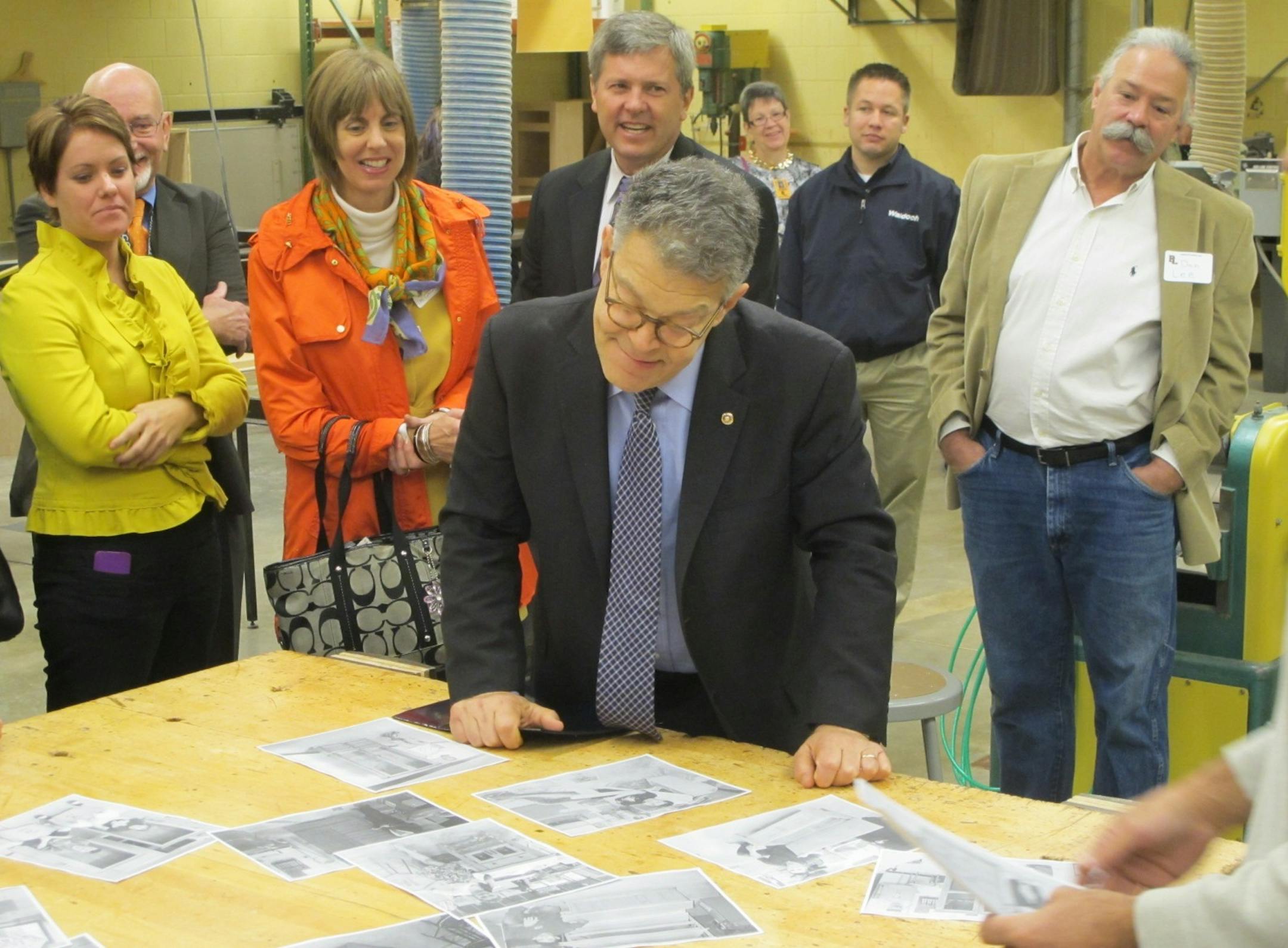
Ewert, 16, joined U.S. Sen. Al Franken and local business leaders who had gathered in the high school's metal shop, listening intently as the instructor explained how the skills Ewert and his classmates were absorbing would one day help them land a job.
Earlier in the tour, an auto shop teacher had demonstrated how students made old vehicles road-worthy again, mending their aging brake systems and fixing their damaged engines. As he spoke, he pointed to a forlorn-looking Chevrolet Suburban sport-utility vehicle.
Franken has been touring Minnesota factories and schools to draw attention to a bill he sponsored that aims to bridge the so-called skills-gap in the IT and health care fields. His visit to Forest Lake also coincided with the release of a weaker-than-expected jobs report.
The Community College to Career Fund Act, which was initially proposed by President Obama, would amend the Workforce Investment Act of 1998 to create an $8 billion competitive grant program aimed at creating job-training partnerships between businesses and community and technical colleges. Franken said the partnerships would provide students with on-the-job training, paid apprenticeships and internships.
Earlier this year, the senator also introduced legislation designed to aid educators who follow a Science, Technology, Engineering and Mathematics (STEM) curriculum.
"What I often find is as successful as these programs are, they could do them faster and they could do them better and they could do more and that's all we need to do those things. Very often it's, 'OK, there's a machine we need to buy,' 'or … we need to get a professor to teach this,'" Franken said.


