

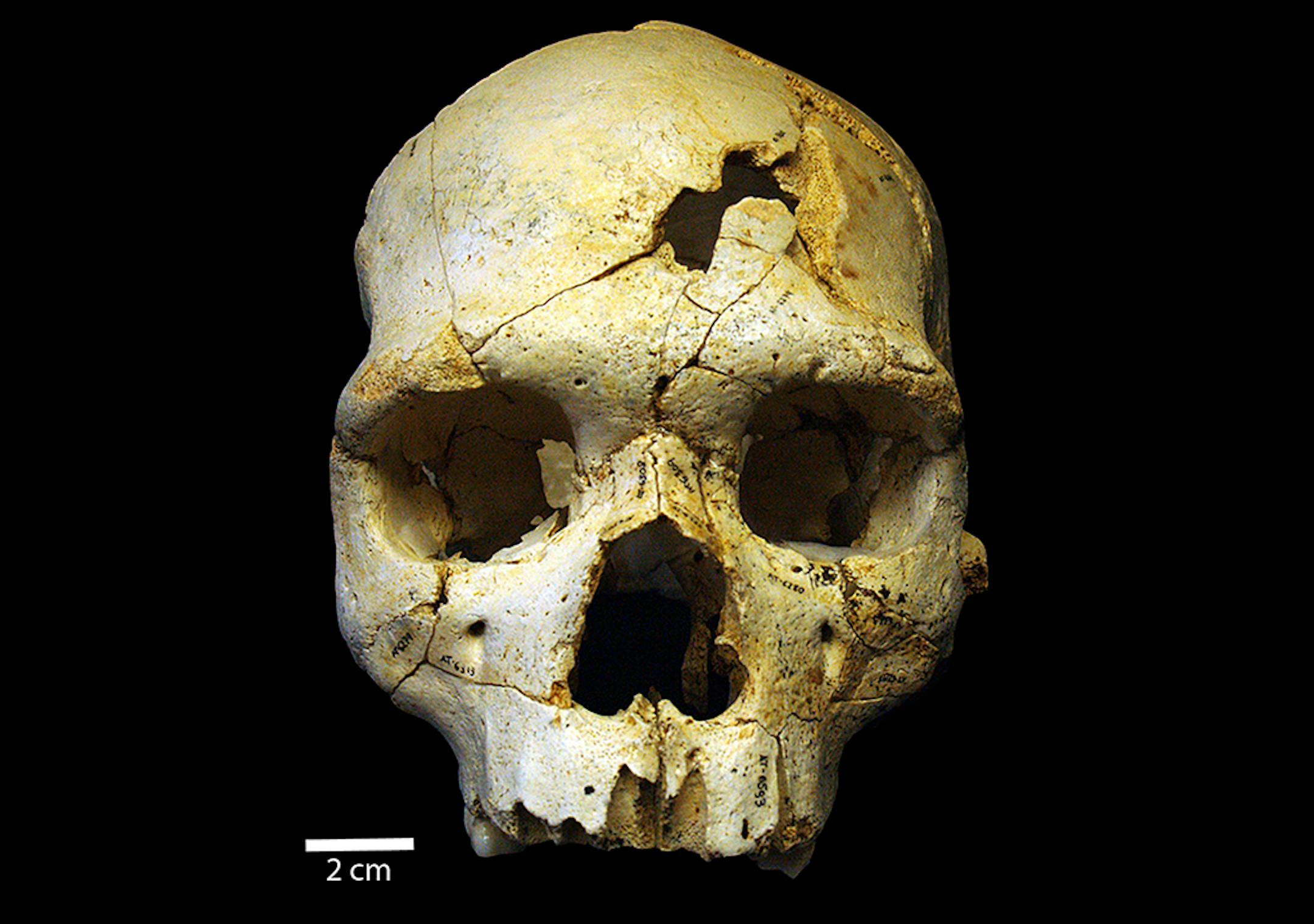
It's a whodunit that dates back 430,000 years.
After painstakingly piecing together the fractured skull of a pre-Neanderthal hominid, archaeologists say they have discovered the earliest known evidence of a human ancestor who was murdered. The findings, published in PLOS One, suggest that interpersonal violence may be baked into the human experience.
"Anthropologists are always asking what makes us human, and are humans inherently violent," said Danielle Kurin, a forensic anthropologist at the University of California, Santa Barbara. "This study contributes to that debate by suggesting intentional assault between two people has deep roots in our hominid human history."
Rolf Quam, a paleoanthropologist at Binghamton University, put it this way: "One implication of the study is that murder is a very ancient human behavior."
The victim was likely male and probably in his 20s, said Quam, a co-author on the study. The skeletal remains were discovered in a cave system in northern Spain known as Sima de los Huesos, or "Pit of Bones."
Using modern forensic techniques not so different from what you might see on "CSI," the researchers determined that the victim was facing the assailant when the violence occurred. They also know the strike occurred at or near the time of death because the pattern of the fracture on the skull suggests it broke while enmeshed in living tissue. The cranium shows evidence of two blows located adjacent to each other just left of center on the forehead. Both injuries were strong enough to break through the bone and puncture the brain, the researchers said.
"Keep in mind these guys were robust and this was one of the denser parts of the skull," said Kurin, who was not involved in the research. "You would need a lot of force to make a fracture that causes the bone to get knocked into the brain."
The authors are not sure what weapon was used, but a wooden spear or stone hand ax are likely candidates. Metal tools were not around at that time.


