![A load of sand was to be transported from the pile at rear to the Jordan Sands processing plant nearby where it will be washed, dried, and sifted Monday afternoon in Mankato. ] JEFF WHEELER ï jeff.wheeler@startribune.com Frac sand just isn't selling like it used to. The industry, with 63 mines in Wisconsin and seven in Minnesota, is projected to ship 15 to 30 percent less sand to oil drillers in 2015 compared with 2014, when some companies set production records. Scott Sustacek, CEO of Jord](https://arc.stimg.co/startribunemedia/GN7HDVNSLAZJQX3RK4JISGD6DY.jpg?&w=1080)
Low oil prices and reduced drilling in shale regions like North Dakota are hurting the once fast-growing frac sand industry, slashing demand and forcing price cuts that have led some players to reduce jobs.
U.S. sand mines, including 63 in Wisconsin and six in Minnesota, are projected to ship significantly less sand to oil drillers in 2015, compared with last year, when companies like Fairmount Santrol, U.S. Silica and Superior Silica Sands set production records, industry officials say.
"This whole ripple effect has taken hold and it is going to continue," Richard Shearer, CEO of Superior Silica Sands, a Texas-based company that operates sand mines in Wisconsin, said in an interview with the Star Tribune. "There are peak cycles and trough cycles, and we have hit a trough."
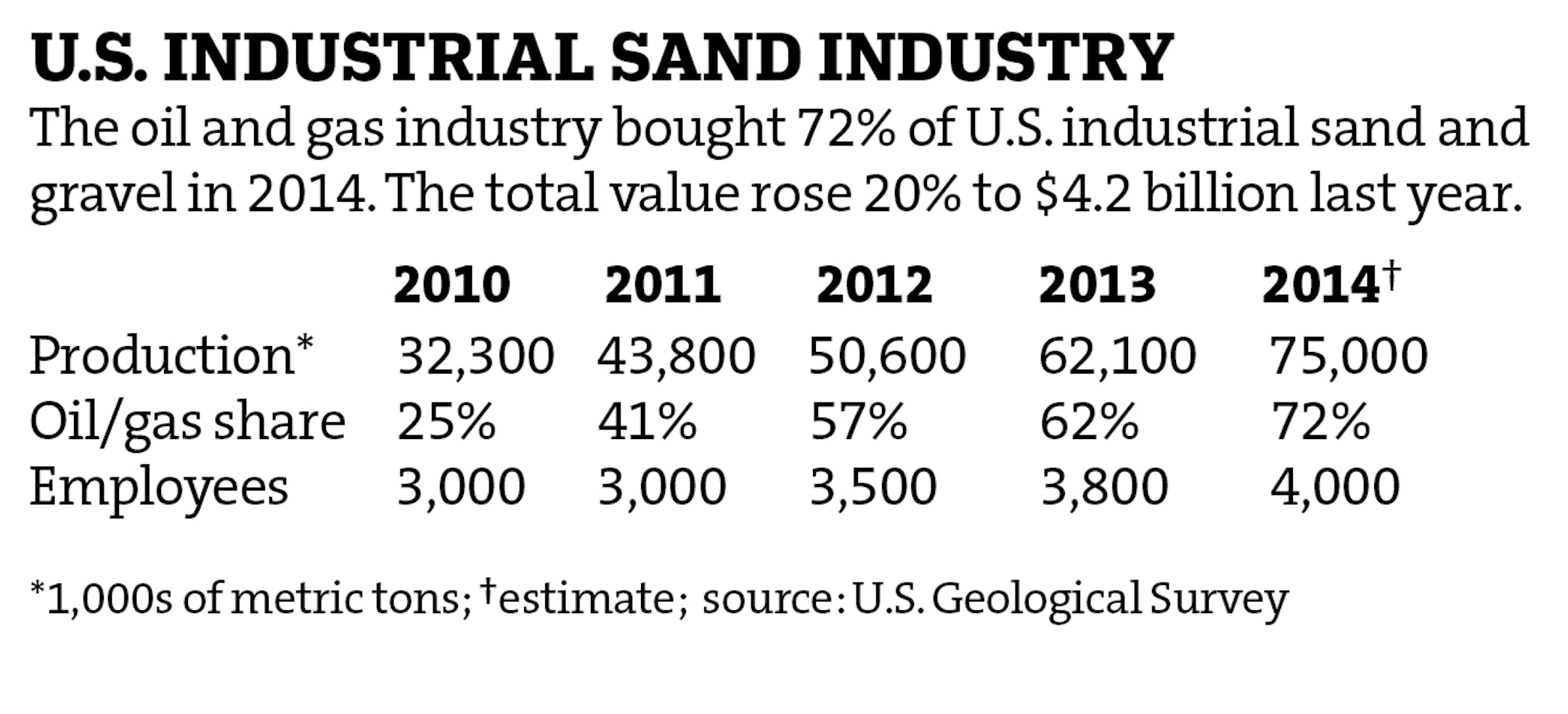
The nation's $4.2 billion industrial sand industry is increasingly tethered to the oil and gas sector, which now buys about 72 percent of the output. Sand production more than doubled in five years, and Wisconsin is the leading producer. Minnesota is fourth, behind Illinois and Texas, according to the U.S. Geological Survey.
Sand is used in hydraulic fracturing, or fracking, a process that injects sand, water and chemicals into shale to free oil and gas. As crude oil prices have dropped — by nearly 50 percent since June — drillers have idled rigs, reducing demand for sand and putting pressure on its price, industry officials say.
The number of U.S. rigs drilling for oil and gas fell last week for the 17th straight week to 1,028, which is about half the number operating in November 2011, according to oil field service company Baker Hughes. North Dakota's rig count slipped to 90 from a high of 203 in June 2012.
Reduced shipments in 2015
To make things worse for the sand industry, many newly drilled wells are not being completed right away. Instead, some drillers have delayed fracking, which can cost more than $3 million per well, hoping that oil prices recover. North Dakota has 850 uncompleted wells.
Shearer said some experts project that sand shipments could be down 30 percent to 40 percent this year. U.S. Silica Holdings, the nation's largest frac sand producer whose operations include a mine in Sparta, Wis., recently told Jefferies Equities Research that it expects a 15 percent drop in its sand demand in 2015.
![The sun set over the Bakken Oil Formation, behind an oil well near Williston. ] (JIM GEHRZ/STAR TRIBUNE) / September 26, 2013, Watford City, ND – BACKGROUND INFORMATION- PHOTOS FOR USE IN FIRST PART OF NORTH DAKOTA OIL BOOM PROJECT: Dozens of drilling rigs dot the North Dakota landscape in the Williston Basin and the Bakken Oil Formation. Once the rigs drill holes, several miles deep and then several miles horizontally, hydraulic fracturing technology (“frac](https://arc.stimg.co/startribunemedia/ZZB2KG3PYF5R6WGIOBCB5DHJDI.jpg?&w=1080)
![Scott Sustacek, CEO of Jordan Sands, at his company's sand processing plant Monday afternoon in Mankato. ] JEFF WHEELER ï jeff.wheeler@startribune.com Frac sand just isn't selling like it used to. The industry, with 63 mines in Wisconsin and seven in Minnesota, is projected to ship 15 to 30 percent less sand to oil drillers in 2015 compared with 2014, when some companies set production records. Scott Sustacek, CEO of Jordan Sands, which began operations just last December, was photographed](https://arc.stimg.co/startribunemedia/YCZ3Y6TQLS3WKBNTOQ4TWV3HK4.jpg?&w=1080)