
Four 'robot sisters' set the table for human life on Mars

Valkyries could be used to make habitats, do repairs.

The Associated Press
May 27, 2016 at 5:22AM
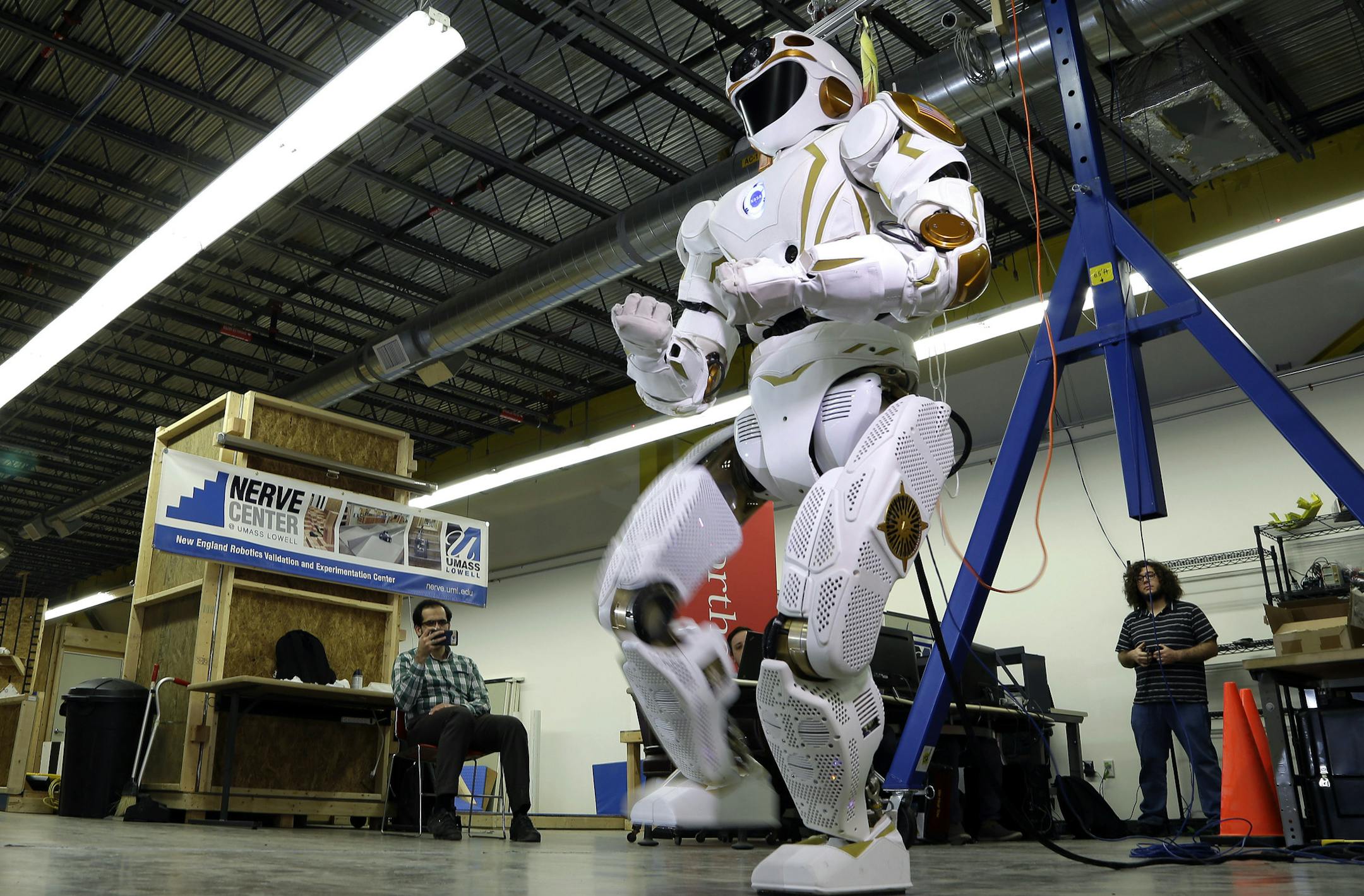
In this May 2, 2016 photo, researchers watch a six-foot-tall, 300-pound Valkyrie robot walk slowly at University of Massachusetts-Lowell's robotics center in Lowell, Mass. "Val," one of four sister robots built by NASA, could be the vanguard for the colonization of Mars by helping to set up a habitat for future human explorers. NASA spokesman Jay Bolden says the agency aims to get to Mars by 2035 and it’ll be the Valkyries or their descendants paving the way. (AP Photo/Elise Amendola)
Advances: Teams are working to enhance four robots so one day they, or their descendants, can work autonomously on Mars. (The Minnesota Star Tribune)

LOWELL, Mass. – Four sister robots built by NASA could be pioneers in the colonization of Mars, part of an advance construction team that sets up a habitat for more fragile human explorers. But first they're finding new homes on Earth and engineers to hone their skills.

The space agency has kept one Valkyrie robot at its birthplace, the Johnson Space Center in Houston. It has loaned three others to universities in Massachusetts and Scotland so professors and students can tinker with the 6-foot-tall, 300-pound humanoids and make them more autonomous.

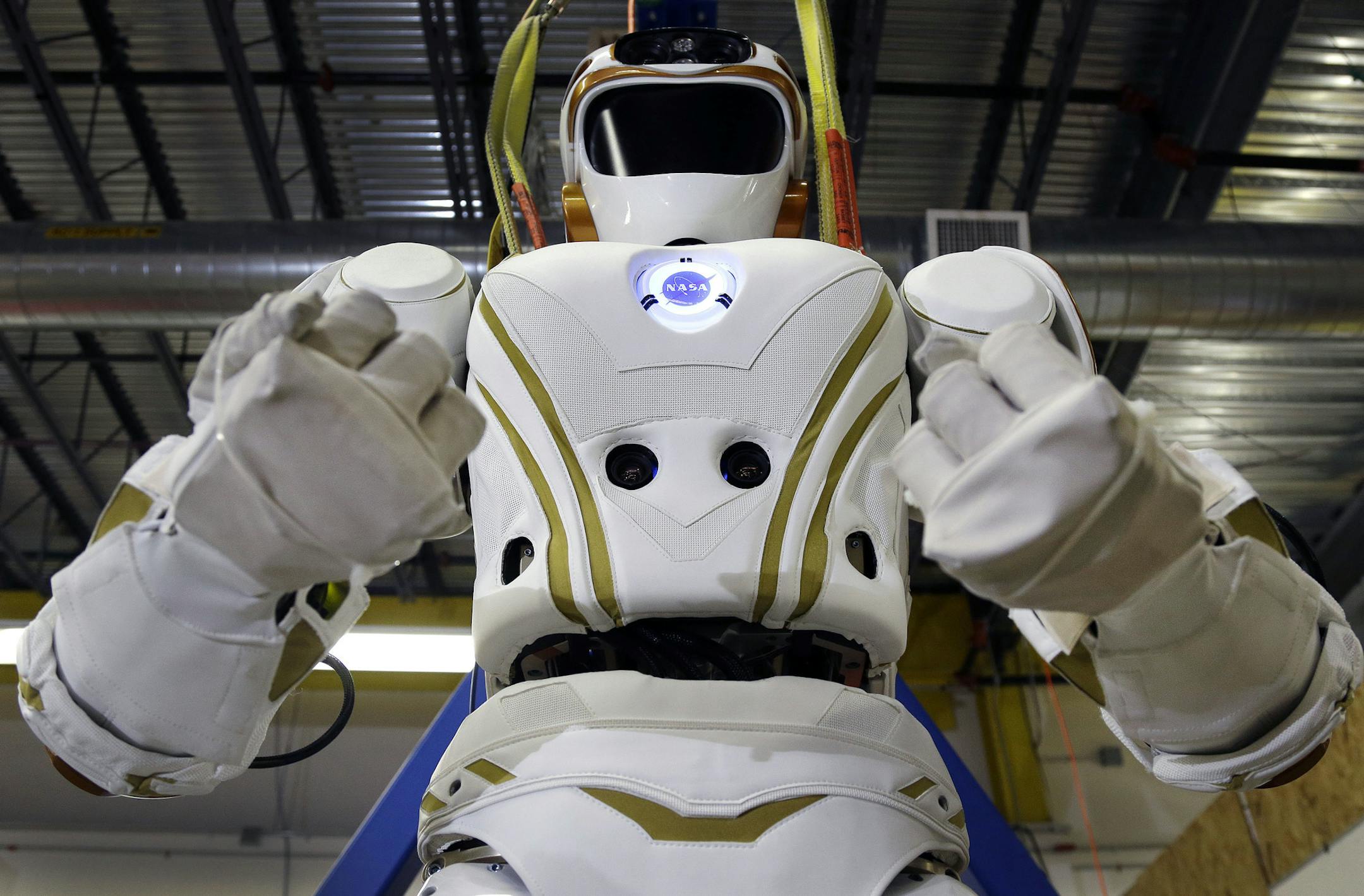
One of the robots, nicknamed Val, still hasn't quite harmonized its 28 torque-controlled joints and nearly 200 sensors after arriving at a robotics center at the University of Massachusetts-Lowell.

Engineering students let the electricity-powered robot down from a harness and tried to let it walk, only to watch as Val's legs awkwardly lurched and locked into a ballet pose.

"That doesn't look good," said Taskin Padir, a professor at Northeastern University, noting Val's $2 million price tag. Northeastern and UMass-Lowell are partnering on a two-year project to improve the robot's software and test its ability to manipulate tools, climb a ladder and perform high-level tasks.

There are still another two decades before NASA aims to land humans on Mars in the mid-2030s, said Johnson Space Center spokesman Jay Bolden. Now is the time, he said, to build the computer code that will make the robots useful in hostile environments.

A time delay between communications from Earth to Mars means humans won't be able to remotely control robots that will need to build structures and do emergency repair work.

There's a huge step between NASA's robotic rover Curiosity, which landed on Mars in 2012, and the capabilities of a robot such as Valkyrie, said Robert Platt, an assistant professor at Northeastern University who is part of the research team.
"The rovers get their instructions uploaded at the beginning of the day," Platt said. "Those instructions amount to, 'Go over there,' or, 'Check out that rock.' It's a completely different ballgame when the job for the day is to assemble a couple of habitats."

A number of technological advancements, from faster computers to better machine-learning algorithms, will soon make it possible for a robot such as Valkyrie to perform such tasks, Platt said.

"Robotics has been making tremendous strides in the past five years. Drones, autonomous vehicles," he said. "It's one of those situations where you work on the same problem for decades and decades, and something finally starts to happen. Maybe this is that time."

In this May 2, 2016 photo, a six-foot-tall, 300-pound Valkyrie robot is seen at University of Massachusetts-Lowell's robotics center in Lowell, Mass. "Val," one of four sister robots built by NASA, could be the vanguard for the colonization of Mars by helping to set up a habitat for future human explorers. But first they’re finding new homes on Earth and engineers to hone their skills. (AP Photo/Elise Amendola)
In this May 2, 2016 photo, a six-foot-tall, 300-pound Valkyrie robot is seen at University of Massachusetts-Lowell's robotics center in Lowell, Mass. "Val," one of four sister robots built by NASA, could be the vanguard for the colonization of Mars by helping to set up a habitat for future human explorers. But first they’re finding new homes on Earth and engineers to hone their skills. (The Minnesota Star Tribune)
about the writer

about the writer

MATT O'BRIEN

More from No Section

See More
FILE -- A rent deposit slot at an apartment complex in Tucker, Ga., on July 21, 2020. As an eviction crisis has seemed increasingly likely this summer, everyone in the housing market has made the same plea to Washington: Send money — lots of it — that would keep renters in their homes and landlords afloat. (Melissa Golden/The New York Times) ORG XMIT: XNYT58
Melissa Golden/The New York Times

It’s too soon to tell how much the immigration crackdown is to blame.