

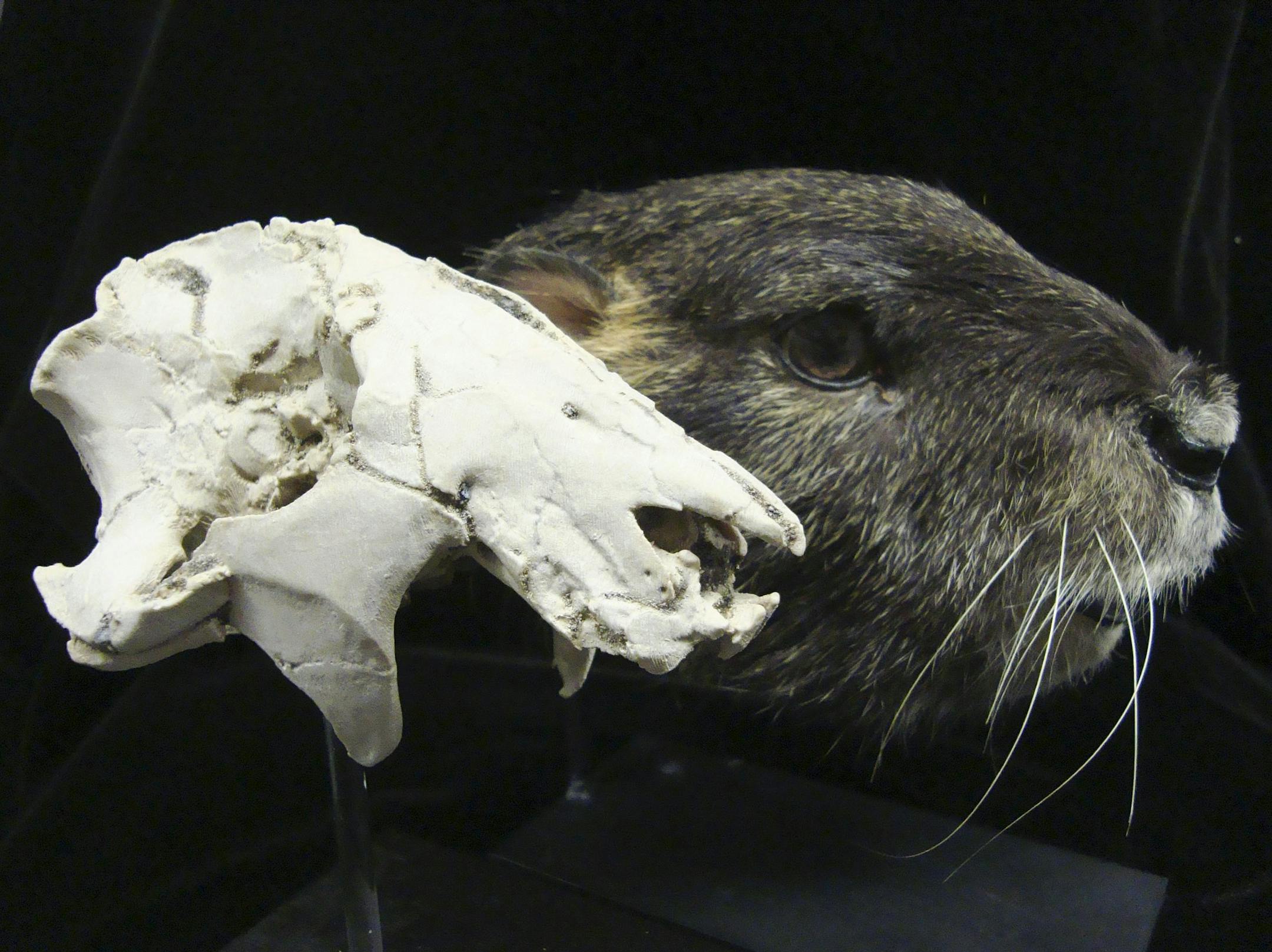
Four years ago on Madagascar, paleontologists came upon what proved to be a well-preserved cranium of a mammal that lived 66 million to 70 million years ago, in the closing epoch of the mighty dinosaurs.
Such a discovery, expected to provide new and important insights into early mammalian evolution, is rare anywhere in the Southern Hemisphere. The fossil record of primitive mammals there is frustratingly thin. Only two other mammal skulls — both from Argentina and not as large — have been found from the age of dinosaurs in the entire Southern Hemisphere.
Now, researchers say the fossil mammal is a distinct new genus and species, Vintana sertichi. Vintana means luck, which was smiling on Joseph Sertich, then a graduate student and now a curator at the Denver Museum of Nature and Science, in finding the slab of sandstone that held the skull.
The cranium, measuring almost 5 inches long, is twice the size of the one from the previously largest known mammal from the age of dinosaurs on the southern supercontinent known as Gondwana. At that time, nearly all primitive mammals were no bigger than shrews and mice, cowering in the shadows of hulking reptiles. Vintana is estimated to have weighed about 20 pounds, twice or even three times the size of an adult groundhog today.
"No paleontologist could have come close to predicting the odd mix of anatomical features that this cranium exhibits," said David W. Krause, a paleontologist at Stony Brook University on Long Island, New York.
The researchers determined that Vintana belongs to a group of early mammals known as gondwanatherians, the only previous evidence for which were a few teeth and jaw fragments. These mammals, in turn, were closely related to the multituberculates, an evolutionarily successful group of early mammals known almost exclusively from Northern Hemisphere fossils. All these relationships, scientists said, had been uncertain before now.
An anatomist at the University of Chicago, Zhe-Xi Luo, said the study published in the journal Nature "offers the best case of how plate tectonics and biogeography have impacted animal evolution — a lineage of mammals isolated on a part of the ancient Gondwana had evolved some extraordinary features beyond our previous imagination." He called it "the discovery of the decade for understanding the deep history of mammals."
New York Times


