

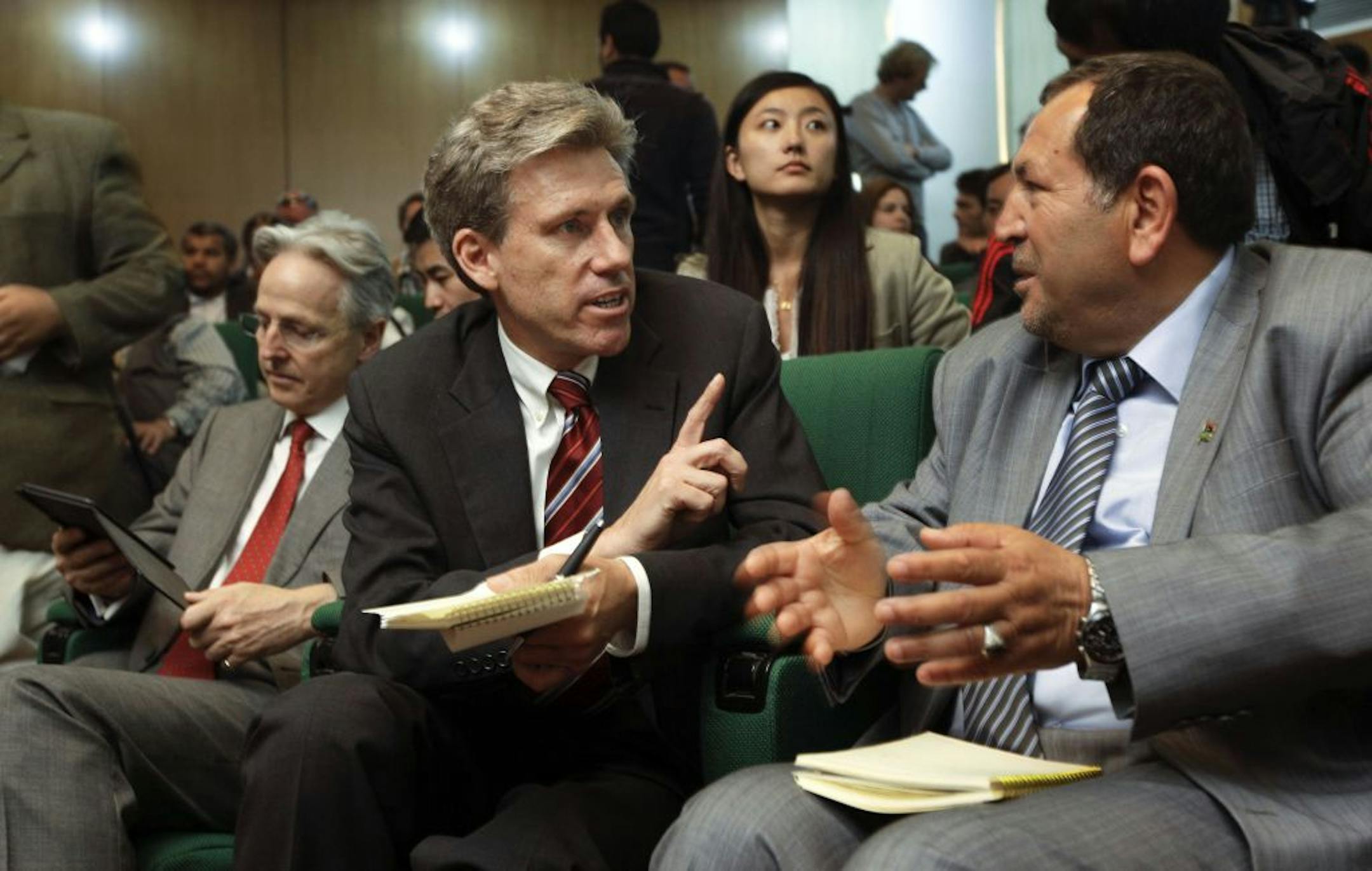
The tragic killing of Chris Stevens (the U.S. ambassador to Libya), and the anti-American protests and violence in the Arab world and beyond, have raised a towering question: What will be the foreign policy of the next president?
The answer will have enormous impacts on Americans, but the issues can be confusing. Part of the reason is that the partisan philosophies that imprint most domestic issues do not easily apply to foreign policy. Here's a bewildering tidbit for domestic-policy wonks that further complicates the matter: Major approaches to foreign policy find influential advocates in both parties.
President Obama's views are hardly a secret. He is best described, based on four years of foreign policymaking, as a "liberal internationalist," characterized by a commitment to a rules-based international system with strong multilateral organizations, but also by a reluctance to act unilaterally in international affairs. The 2011 Libyan intervention is a case in point: Obama supported the use of military forces to save lives, but probably would not have done so without Arab League endorsement and U.N. Security Council authorization.
At the same time, and much to the consternation of some human-rights activists from both the Democratic and Republican parties, he has been skeptical about ambitious moral objectives for U.S. foreign policy, such as exporting democracy.
This tilt toward a traditional foreign-policy realism that defines security interests more narrowly is also evident in Obama's willingness to part with some members of his party and use drones to target Al-Qaida leaders, even if they are U.S. citizens.
The Obama worldview gives us a sense of how he'd respond to any number of current and future challenges. For instance, on Iranian efforts to build a nuclear weapon, Obama would be unlikely to attack Iranian facilities and go to war without strong multilateral support, and he would continue to exercise strong pressure on Israel not to act unilaterally. Even in the event of an international armed conflict with Iran, Obama would be very reluctant to pursue the ambitious regime change and nation-building effort that characterized U.S. engagement in Iraq.
Mitt Romney's worldviews aren't so clear.
While he has called for an American century of freedom, peace and prosperity and has accused Obama of not being tough enough on Iran and being too tough on Israel, his statements reveal little about underlying national-security perspectives that would enable us to predict his responses to future crises. And the matter is further confused by the fact that his closest foreign-policy advisers have radically differing views.


