

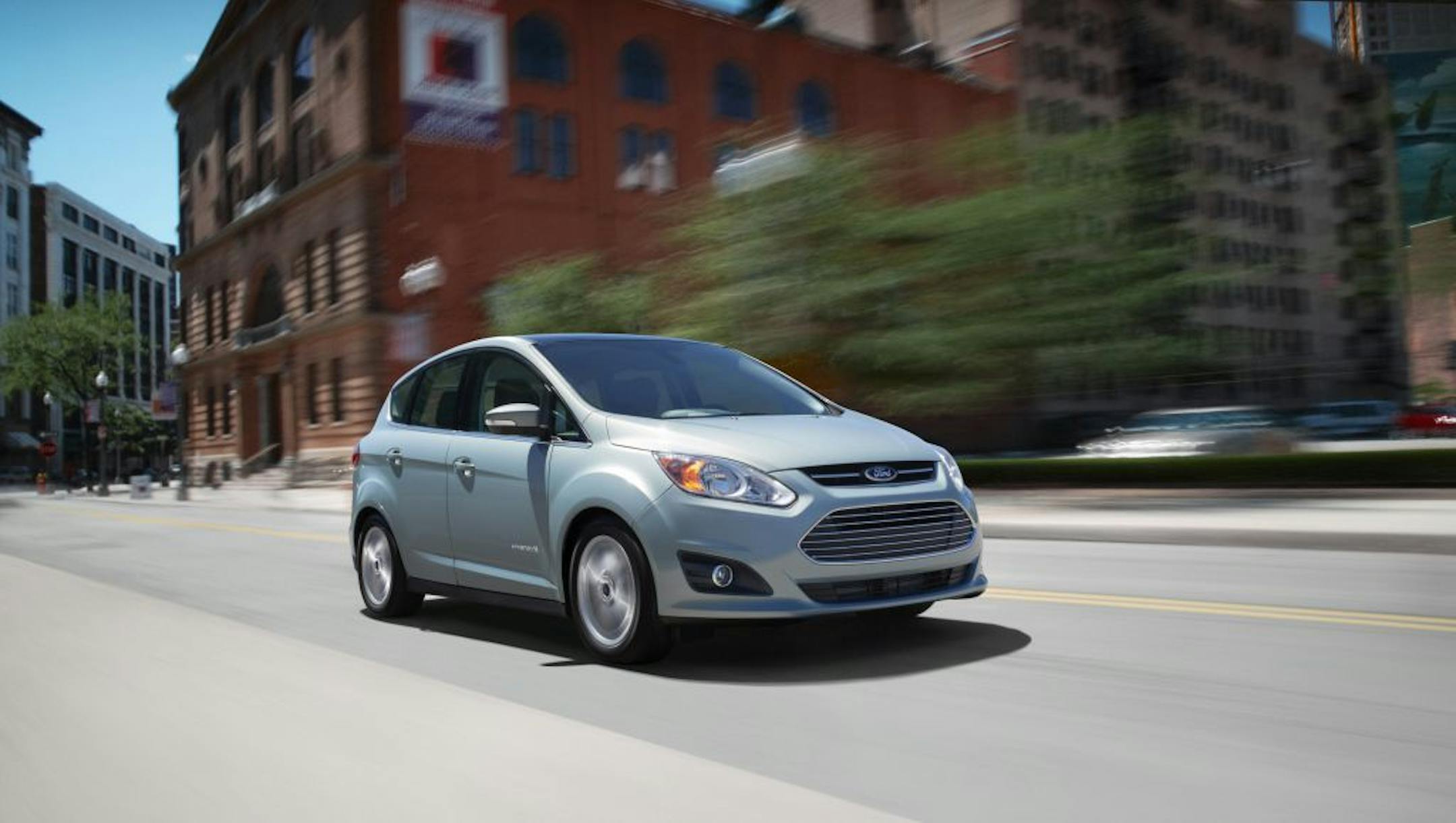
Fuel economy is a reason to buy the 2013 Ford C-Max hybrid crossover, but not the only reason. That matters because critics have questioned how close the C-Max's real-world gas mileage comes to its eye-popping EPA rating of 47 mpg in the city, 47 on the highway and 47 in combined driving.
The first thing to remember is that the EPA rating is not a prediction. It's a comparison. It means the C-Max should get better fuel economy than a Toyota Prius V minivan -- 42 mpg combined rating -- but worse than the 50-mpg-rated Prius hatchback. The C-Max also beat the Honda Insight and Volkswagen Jetta hybrids.
The EPA rating is generated in a lab, not on the road. That's why you can compare one vehicle to another: they were all tested under identical conditions. If automakers apply the test honestly -- I'm talking to you, Hyundai-Kia -- it's the best way to compare vehicles' fuel consumption and cost.
We'll get back to fuel economy, and how seriously to take anecdotal complaints, but let's talk about the actual vehicle.
The C-Max is a sleek and roomy compact minivan -- crossover, depending on how much you don't want to admit to liking a minivan. It's based on the same architecture as the Ford Focus.
In Europe, Ford sells the C-Max in two sizes and with a range of gasoline and diesel engines. The U.S. version, built alongside the Focus in Wayne, Mich., comes in one size and with two gasoline-electric hybrid powerplants.
I tested the simple hybrid, for want of a better term. It can travel short distances on electric power alone at up to 62 mph. Prices start at $25,200. It has lithium-ion batteries, 188 horsepower and a continuously variable automatic transmission. The C-Max's base price is higher than the Prius and Insight, but less than the Jetta hybrid and Prius V.
For this review, I tested a well-equipped SE hybrid that stickered at $28,180. All prices exclude destination charges. The other kind of C-Max is the Energi plug-in hybrid, which costs more and has bigger batteries. I expect to evaluate one later.


