

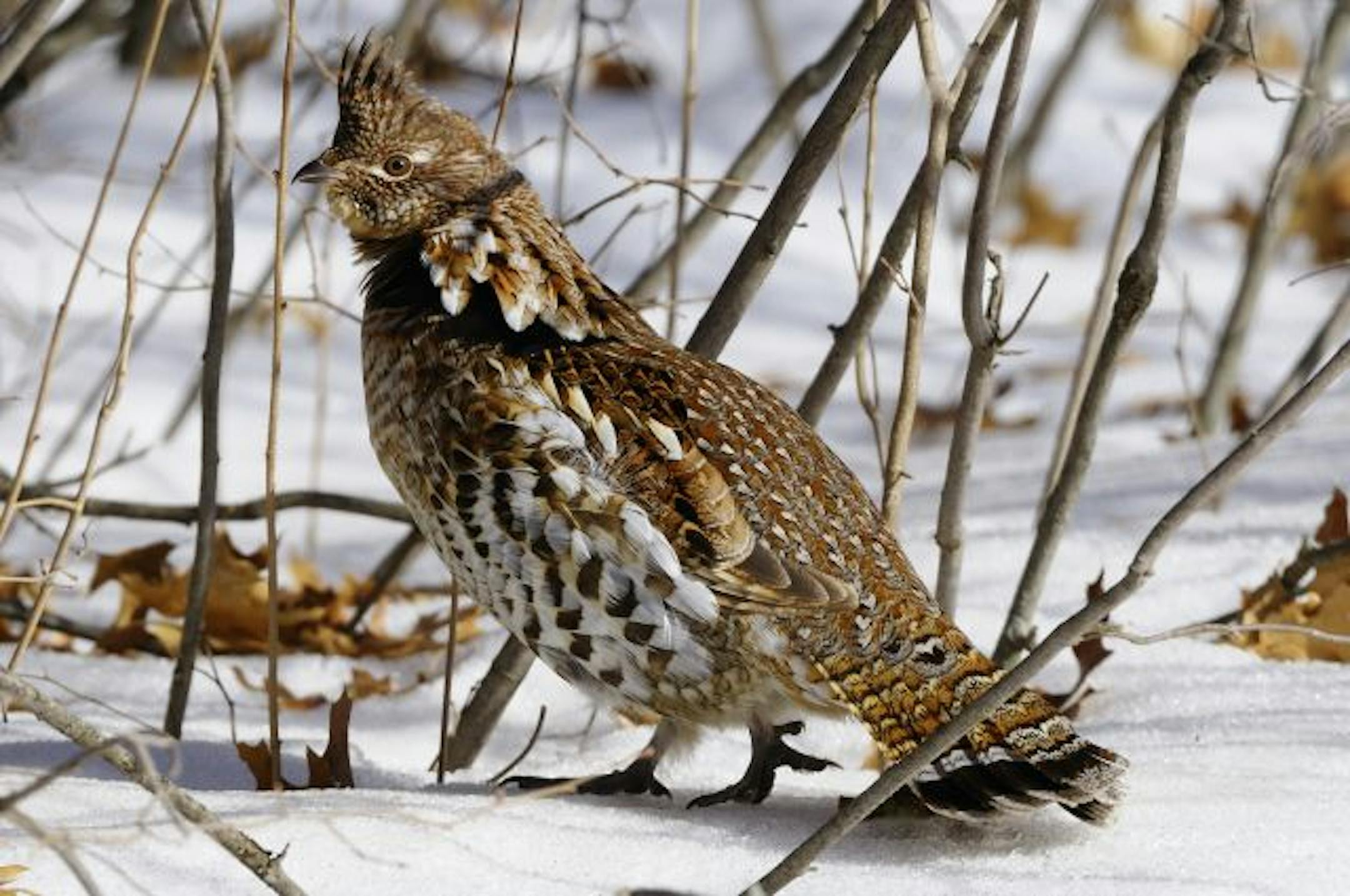
BAXTER, MINN. - Last Wednesday evening about 40 people kicked the snow off their boots and shuffled into the Northland Arboretum to attend a program about Minnesota's grouse. Despite an overnight storm that dumped nearly a foot of snow on the area -- leaving us wondering just when "real" spring might arrive -- the attendance was admirable.
The event titled "All About Grouse" was presented by Ted Dick, DNR grouse coordinator, and was sponsored by the Brainerd Lakes Area Audubon Society. Dick, from Grand Rapids, was hired last fall in a cooperative effort by the DNR and the Ruffed Grouse Society (RGS) to increase emphasis on ruffed grouse and grouse habitat. The RGS provides about 30 percent of the Dick's salary. He works out of the DNR's Aitkin wildlife office. Previously, Dick worked as an assistant manager of the area wildlife office in Baudette.
As ruffed grouse coordinator, Dick's job description is to "enhance habitat management, increase opportunities for hunting and enable stable management through coordination." His main focus is ruffed grouse, but Dick also is working with sharp-tailed grouse, spruce grouse and woodcock.
As most hunters know, ruffed grouse populations tend to cycle, with population peaks occurring roughly every 10 years and "super peaks" every 20 years. The most recent peak occurred in 2009.
According to Dick, throughout most of the state, long-term ruffed grouse population trends appear to be stable since records were first kept in 1949, although recent peak numbers have not reached quite as high as those in the early 1950s and 1970s. But there has been a decline in ruffed grouse populations in the southeastern part of Minnesota. Dick believes the decline is caused by a change in forest management that has a bias toward tree species other than aspen.
"Grouse do best in aspen forests," Dick said. Stands featuring a mixed age class of aspen provide mature aspen buds for grouse to feed on in winter, and grouse chicks are generally raised in high-density stands of young aspen.
Minnesota has about 6.5 million acres of aspen/birch forest of which 2.7 million acres is in young aspen. We also have roughly 11 million acres of public land. It's no wonder Minnesota usually leads the nation in the annual harvest of ruffed grouse with an average of more than a half-million birds bagged per year.
Oddly, though, ruffed grouse hunter numbers are on a downward trend. So, too, are participants in other outdoor activities, according to Dick.


