

You may know the Children's Theatre Company (CTC) as a nationally renowned place of magic for children of grade-school ages, housed adjacent to the Minneapolis Institute of Arts in south Minneapolis.
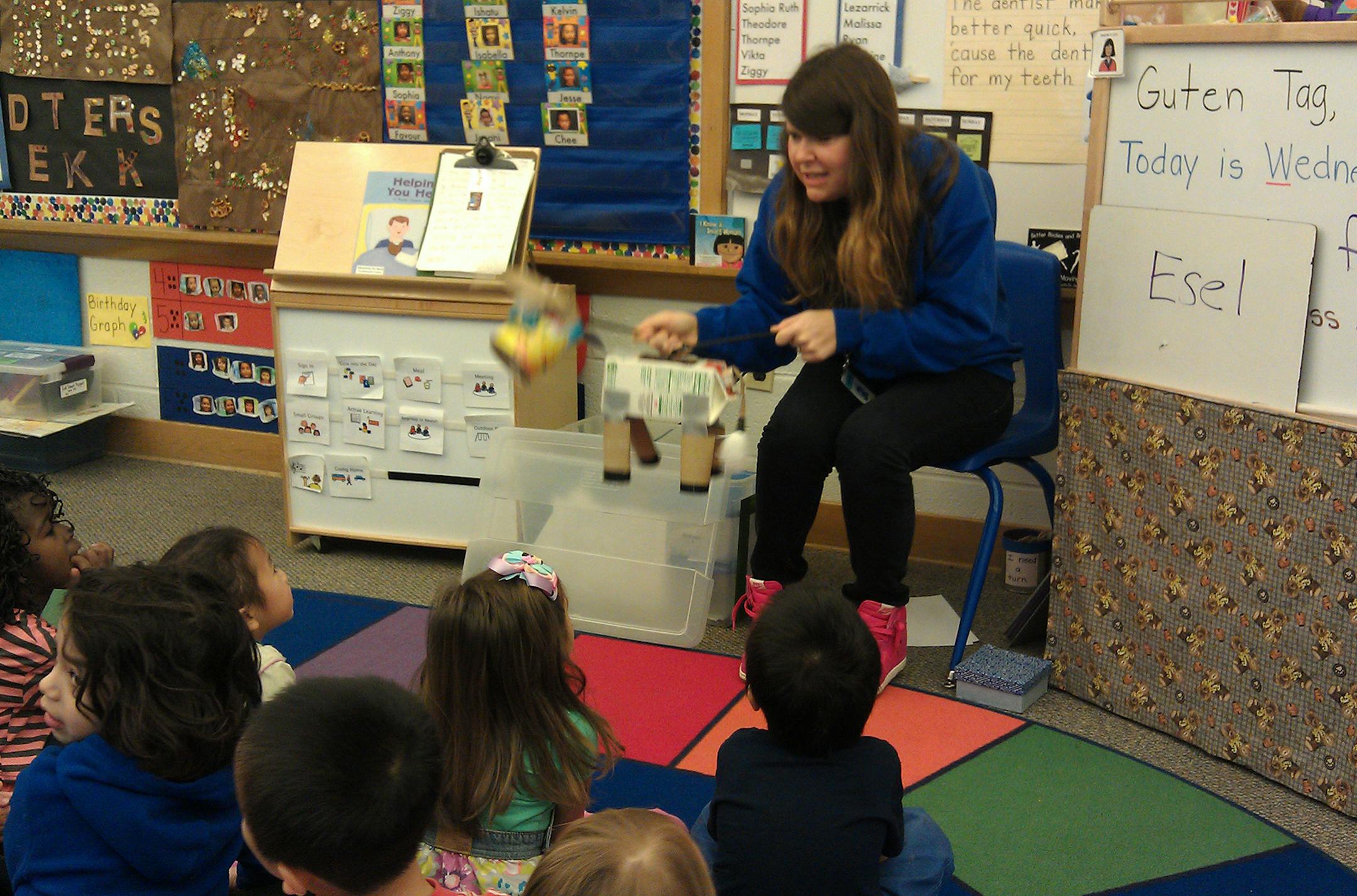
You may not know that the Children's Theatre is also Tessa Flynn and a box of homemade puppets, engaging 16 preschoolers for 45 minutes each week in teacher Mary Harris' classroom at Eastern Heights Elementary School in St. Paul.
Flynn's puppets may be fashioned with milk cartons, cereal boxes and duct tape, and her "orchestra" a controlled cacophony of hooting, humming and hand-drumming. But magic happens there, too — the kind that has 4-year-olds who barely spoke in class two months ago now eager to tell and act out stories of their own invention, with themselves as the lead characters and their peers taking part.
"We really believe that if children can learn to tell their own stories, they are going to be able to advocate for themselves later in life," Flynn said at the close of last week's class. "If they don't, someone will tell their story for them."
Literacy is the stated aim of the CTC's Early Bridges program, but along the way, it also schools young children in the democratic arts of participation, persuasion, self-assertion and teamwork. The program is at work in — as of now — seven St. Paul and two Minneapolis preschools. It ought to be in more places; the CTC is seeking funding to expand.
More than that: Early Bridges ought to be an inspiration for other Minnesota entities that might add an early-education dimension to their work. Minnesota needs an early-education surge. It's the most promising remedy for the biggest impediment to this state's future prosperity — the academic underachievement that's too prevalent among low-income and nonwhite populations.
One way for that to happen is for nonprofit organizations geared toward other age groups to consider how they might help younger children learn. The CTC — which once discouraged attendance by children under 5 — began that exploration when artistic director Peter Brosius arrived in 1997, intent on expanding the theater's reach to children from 2 to 18. He had been impressed with the work of a puppet theater for preschoolers in Stockholm, Sweden, and "stole shamelessly, with their permission" when he visited it soon thereafter.
"Their goal is the same goal that all great theater has, which is to stir up the muscle of the imagination, the muscle of empathy. It helps you rehearse stages in life — loss, separation, surprise, disappointment. That's our goal, too," Brosius said. "We ask: 'How are we building empathetic global citizens?' "


