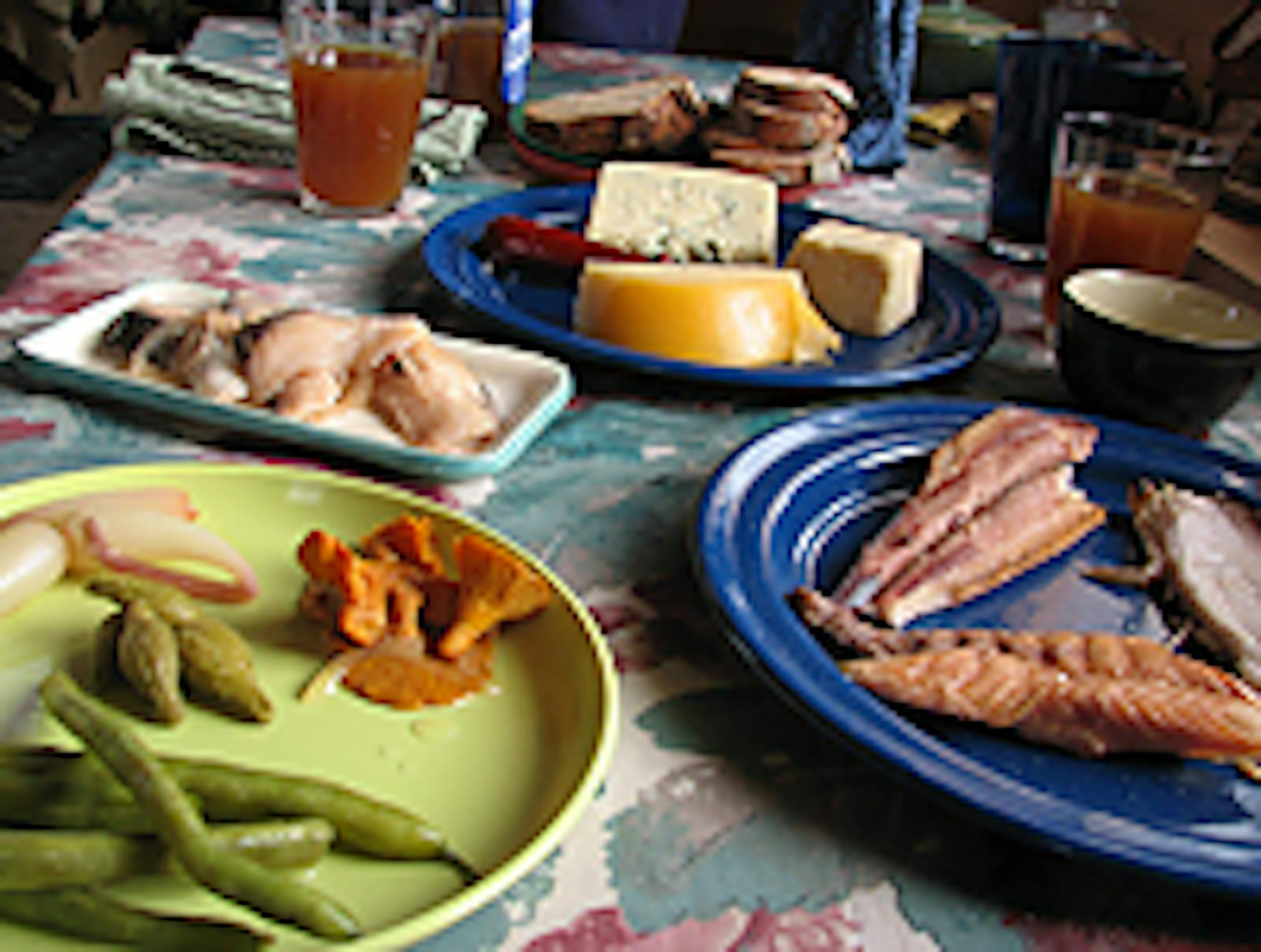
Since 2008, Brett Laidlaw's blog, Trout Caviar (troutcaviar.blogspot.com), has allowed readers to tag along on his bucolic ambles, foraging through woods, streams, cheese shops and farmers markets and almost always emerging with the ingredients for a fine meal.
Laidlaw's poetic descriptions of life in his primitive Wisconsin cabin, Bide-A-Wee, and the food-laden fields and streams nearby, cast him as a mash-up of Thoreau and a kind of forager's Julia Child. He is equal parts nature and food writer. And though he often writes of farm-grown and locally produced foods, his blog makes wild foods (like sorrel, honey mushrooms or chokecherries) less intimidating, using them in tasty yet not-too-precious recipes.
Fans of the blog will be pleased to discover that Laidlaw's new book, "Trout Caviar: Recipes From a Northern Forager," is equally delightful to read and packed with many new anecdotes and recipes.
Q: On the blog, I get the impression that you kind of scurry about over the course of your day, popping over here for this or there for that -- sort of gathering ingredients.
A: In my shopping and foraging, I've gotten to the point where I rarely set foot in a big grocery store -- you know, I'll buy paper towels and toilet paper, and that's about it. So it's the co-op, farmers markets, the garden and smaller shops, like Clancey's [Meats & Fish] or a cheese shop. I say in the introduction that 90 percent of good cooking is good shopping, taking shopping in a very broad sense of getting the best local, seasonal ingredients and doing the best that you can by them. I don't mind spending a lot of time gathering the ingredients of a meal because it's a pleasure to pop into Clancey's and see what crazy cuts of meat they've got in -- and I get really inspired to cook through that, too.
Q: Explain your take on local -- the Trout Caviar manifesto: "Our stuff is as good as anybody's stuff, and part of the reason it's good is that it's ours."
A: I feel it kind of viscerally, that connection to these local ingredients. There has been this huge boom in interest in local and seasonal foods, but I think it's when you get to the wild foods, the stuff that's really of this place, that it reaches its highest expression. But even though we have a lot of chefs emphasizing that they got this chicken from this farm and use this lettuce from this grower, they might still end up sprinkling Parmigiana-Reggiano on it or frying it in olive oil. And maybe that's the next step: not necessarily rejecting food from other places, but appreciating what we do have here and finding different uses for it in our cooking. Which is not to say that I don't use olive oil -- but I don't buy Parmigiana-Reggiano anymore. If I want something like that, I'll look for a 10-year-old cheddar or an aged Gouda from Minnesota or Wisconsin and see how that works.
The churn
On Tuesday, 10 local chefs are putting on "A Salute to Lake Superior's Sustainable Fisheries," featuring a cook-off, samples and information on local fisheries. (4-6:30 p.m. Tue. $10. McNamara Alumni Center, University of Minnesota, Mpls. www.seagrant.umn.edu/fisheries/salute.)