

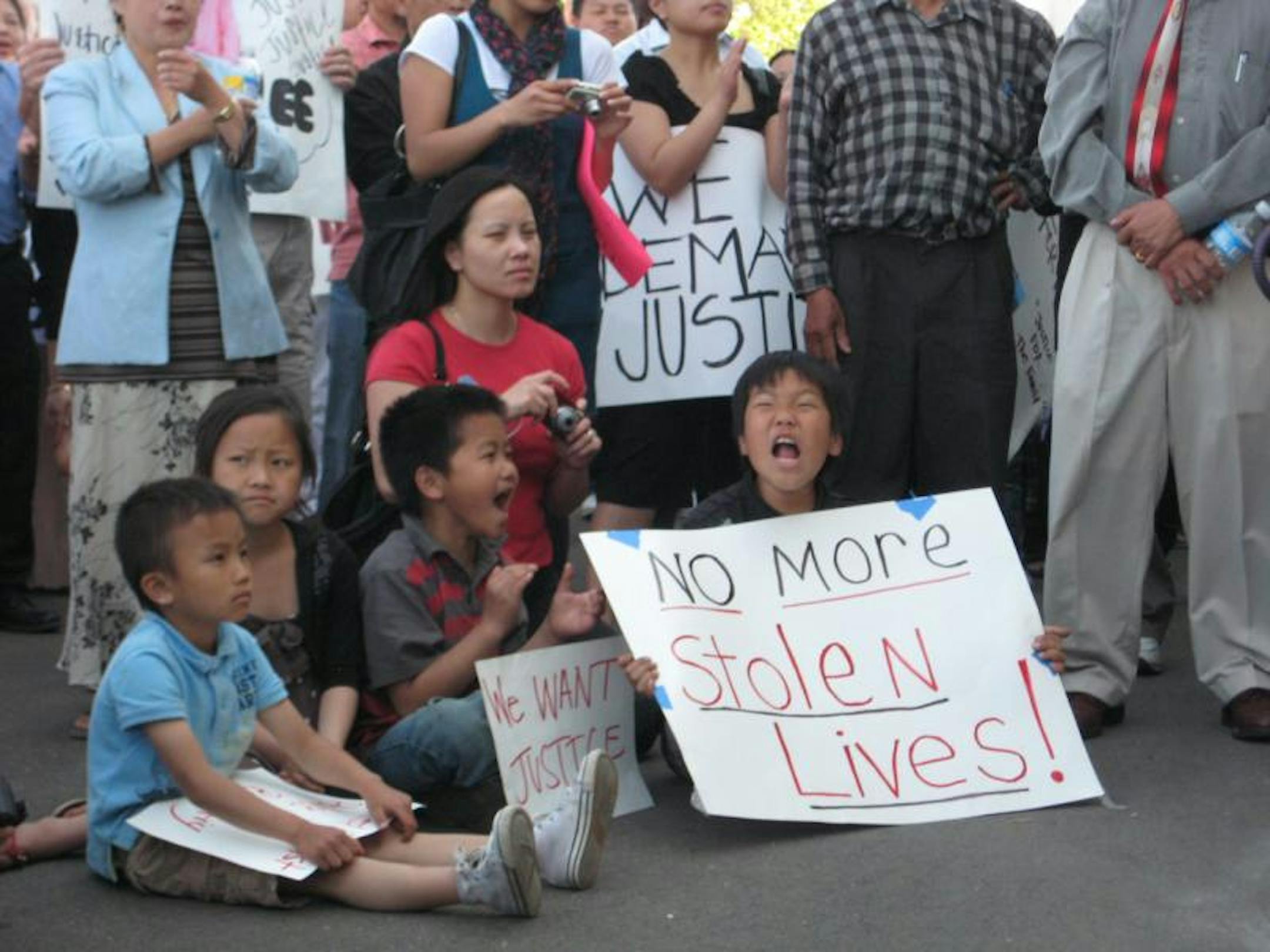
UP IN ARMS: A Night of Hip Hop and Spoken Word to Honor Fong Lee and End Police Brutality
Saturday, October 3rd, 8 p.m. (doors at 7:30)
Kagin Commons at Macalester College
1600 Grand Avenue, St. Paul, MN 55105
Featuring performances by Magnetic North (NY), Nomi of Power Struggle (Bay Area), Michelle Myers of Yellow Rage (Philadelphia), Maria Isa, Blackbird Elements, Guante, Rodrigo Sanchez-Chavarria, e.g. bailey, Tou SaiKo Lee with PosNoSys, True Mutiny, Shá Cage, Kevin Xiong with Pada Lor, Tish Jones, Maipacher, Logan Moua, Bobby Wilson, Poetic Assassins, Hilltribe, and special guests. Tou Ger Xiong and Amy Hang will emcee and DJ Nak will be on the one's and two's.
$5-$10 suggested donation. All proceeds go towards legal costs for the Family of Fong Lee.
As an artist and community member, I was asked to be a part of the organizing committee for this benefit concert for Fong Lee's family. And it made me consider how violence has always been a part of my life. I was three months old when the Communists shelled the airport all night to hinder our escape from Vietnam. My family came to Phillips in South Minneapolis, where we encountered different types of violence. There were war vets who blamed us for the war, who would yell at us and threaten us in parking lots, on the street, who screamed that they fought for our people and that we owed them. There were gangbangers and crack dealers – every neighborhood in the world has bullies, and they were ours, mercurial, lively with friendship and smack talk one second and livid with menace the next. There were straight up racists who hated us for the color of our skin, who believed it was our fault that there were no jobs and no homes, or maybe they just hated anyone who didn't look like them, eat like them, talk like them. And then there was the police, whom I was taught to wave at as a child when they drove by, their cars slow in the tight streets, stand up straight, smile.
As I got older, I stopped waving to police cars and firemen. No, I never rolled with a crew, but in the 90s during my very early teen years I did rock the Raiders clothes and caps, mostly because that's what we did back then, and partly, I admit, because I wanted to be feared. I never went looking to beat up anyone, bully anyone. But too often, as a young man I found myself fighting or fleeing from all manners of people who wanted to do me harm for all different reasons. You tire of it. Some young men join gangs, some take up martial arts and boxing. Me, I tried to perfect my swagger, practiced my stoic look, blew my paycheck from my minimum wage job on overpriced sports gear, walked like I belonged. And if something did happen to me or my family or friends, we hesitated to call the police, because too often they threatened us rather than served and protected us. Threatened us with violence, with false accusations, with deportation. For us, if we were victimized by violence from a civilian, calling the police felt like an invitation for round two. And they'd walk away to do it another day. By most standards I was an easy child who didn't get into much trouble despite the circumstances. And still I feared the police – because they had an almost mythical power, especially if you were a person of color, to make you feel guilty even if you weren't doing anything wrong. Chris Rock once joked, "police officers scared me so bad, they made me think I stole my own car."
When I heard that joke, I laughed hard, because I knew exactly what he was talking about. Years before Chris Rock's joke, I was repeatedly pulled over for no reason whatsoever, and on several occasions asked by police officers if I had stolen the car I was driving though they had no reason to ask me this other than my race. Once, I was in a van full of Asian American college students coming back from a student conference and, confused by some construction and the haphazard traffic signs, made a minor driving mistake. A police officer, who made the exact same mistake as we did, swung his car around, stopped us, and verbally berated my friend who was driving, asking in a derogatory fashion if she spoke English. Of course her family had been in America for generations and English was the only language she knew.
At this point, those of you who are not people of color may say, that's not fair. It's more about our own psychological issues, and anyway, it's not about race, it's about the law. And maybe it's not fair. Maybe it's not fair that I, as a young man of color from an economically poor urban environment, have an instinctual fear of police officers, some of whom are no doubt good people underpaid to do a very dangerous job, and whom honestly want to serve the community and should not be stereotyped because of a few bad apples. Honestly, it's not fair.
Let me tell you something else that is definitely not fair, and which is rarely ever considered: the oppressive fear of violence that every person of color faces, every day, in this country, and the proven record of failure of the criminal justice system to treat us and our families fairly.
We all have our fears. Some of these fears are consciously and subconsciously taught to us by society, some of them may be reinforced by personal experience. And these fears are absolutely impacted by race, gender, class, sexual orientation. Those of us who are people of color, women, from poor and GLBTT communities have the added fear that if we are victimized by violence, we will be harmed more than helped by law enforcement and the criminal justice system.

