

Following 'Scaffold' controversy, artist Sam Durant wins $25,000 prize

Seriously though, what's Durant up to now?

August 15, 2017 at 6:22PM
A pile of broken concrete was all that remained of "The Scaffold" sculpture at the Walker Sculpture Garden Tuesday afternoon. "Spoonbridge and Cherry" is in the background.
A pile of broken concrete was all that remained of "The Scaffold" sculpture at the Walker Sculpture Garden Tuesday afternoon. "Spoonbridge and Cherry" is in the background. (Star Tribune/The Minnesota Star Tribune)
Sam Durant, the artist behind the "Scaffold" sculpture, looked to the floor as Walker Art Center director Olga Viso and Minneapolis Park Board Superintendent Jayne Miller took questions during a Q&A Wednesday afternoon.   ] AARON LAVINSKY ' aaron.lavinsky@startribune.com
(STAR TRIBUNE/The Minnesota Star Tribune)

Sam Durant, right, during a press conference in June at Walker Art Center with Walker executive director Olga Viso and Minneapolis Park Board Superintendent Jayne Miller. (Photo by Aaron Lavinsky, Star Tribune)

It seems only yesterday that Sam Durant's sculpture "Scaffold," intended as a way to discuss capital punishment and U.S. colonialism, set off an uproar in the Twin Cities, followed by its removal from the Minneapolis Sculpture Garden.

So what's Durant up to now?

Last month, he won the $25,000 Rappaport Prize, presented annually by the deCordova Sculpture Park in suburban Boston to an artist who has a relationship to New England. (Durant was raised in the South Shore area near Boston.)

"[Durant] has an impressive record of international and solo exhibitions and a substantial history of scholarly and critical attention," Executive Director John Ravenal said in a statement. "His thoughtful and timely exploration of social justice and civil rights aligns perfectly with the Rappaport Foundation's commitment to a better society through supporting leadership in public policy, medicine, and the arts."
(Campbell, Tim/The Minnesota Star Tribune)

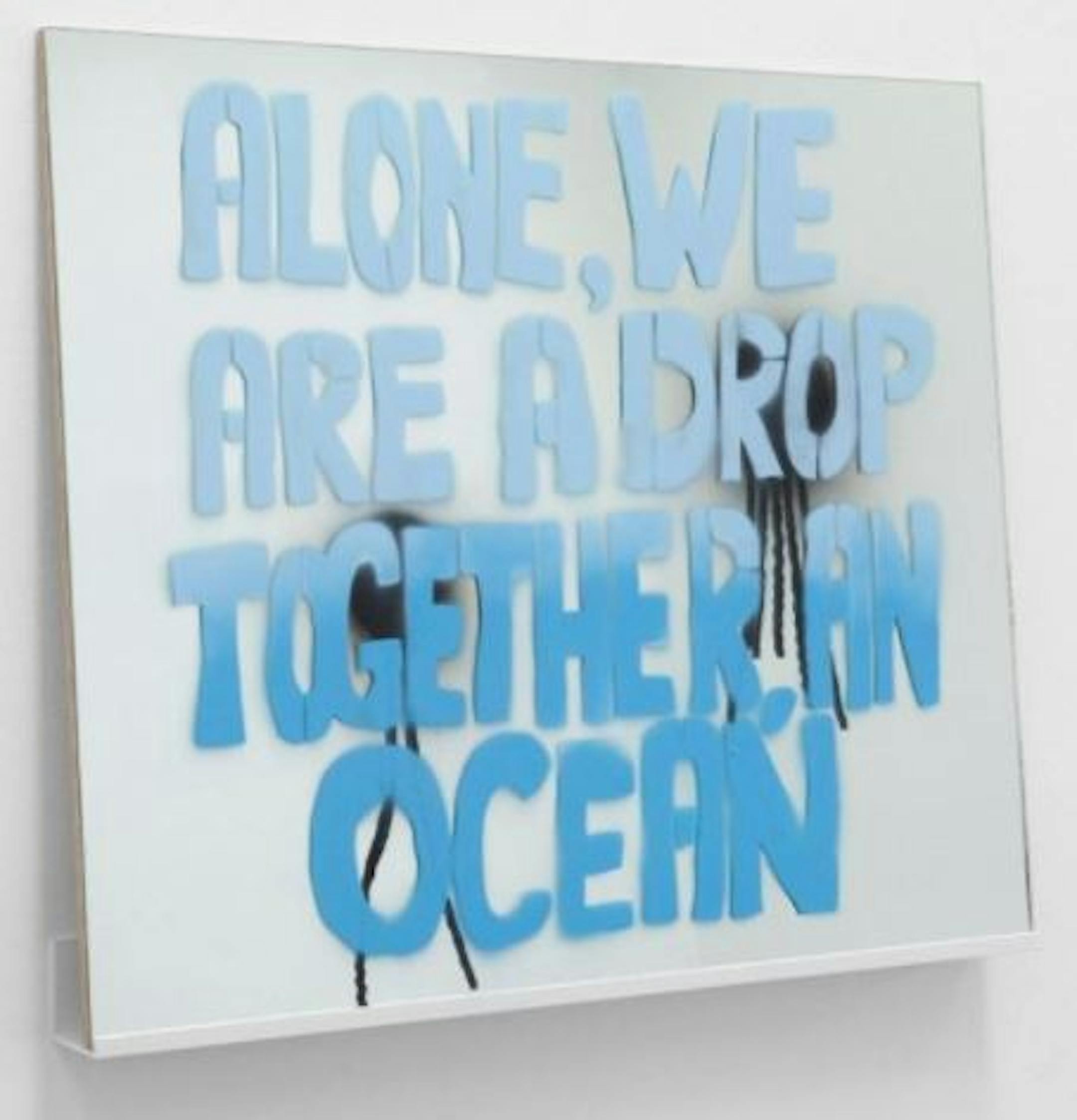
Durant also is participating in the Leonardo DiCaprio Foundation's annual art charity auction in St. Tropez to combat climate change. He contributed a piece called "Together and Ocean (Mirror)" -- a 3-foot-wide mirror, mounted on plywood, and spray-painted in blue with the words: "Alone, we / are a drop / together, an / ocean." Starting bid for the piece is $20,000. The online auction continues Aug. 10-23. The DiCaprio Foundation art sales have raised a total of $80 million over the years, according to reports from LLNYC.

The artist also gave a talk last month in Mexico City at the headquarters of the SOMA educational organization, where he addressed some of the lingering concerns he had from the "Scaffold" controversy.

Durant noted the ways that the conversation on social media was more polarizing than constructive, as Devon Van Houten Maldonado reported for Hyperallergic:
"He pointed out that many of the Dakota protesters had acted as water protectors at Standing Rock, and still carried much of the pain from that historic protest with them after their camp was bulldozed and razed soon after the inauguration of Donald Trump. But what was challenging to stomach, he said, was the so-called 'alt-right' that took to the internet to encourage white nationalists to attack the Dakota protesters, lauding the sculpture as a 'trophy' of white supremacy."

The renovated Minneapolis Sculpture Garden opened on June 10 without Durant's massive structure, created from designs of seven historic gallows used in U.S. state-sanctioned executions, including the one used to hang 38 Dakota warriors in Mankato after the 1862 U.S.-Dakota War -- the largest mass hanging in U.S. history.

Although the piece was previously exhibited in Europe, its placement in Minneapolis by Walker Art Center did not take into account its potential effect on Native American communities of the region, particularly the ancestors of the Dakota who lost their lives.

Walker Art Center executive director Olga Viso took full responsibility for the error, noting that the Walker did not consult Native communities, and that in Minneapolis, Durant's sculpture could only be read "through the lens of trauma."

The U.S.-Dakota War was started by a number of Dakota who, having agreed to treaties granting territory that includes much of modern-day Minnesota, were facing starvation after being forced onto reservations and cheated out of money they were owed. Over its six weeks, the U.S.-Dakota War cost the lives of an estimated 600 white settlers and soldiers, and 100 Dakota warriors.

In hasty trials, 303 warriors were sentenced to death for accusations of murder and rape. President Abraham Lincoln commuted most of the sentences, finding insufficient evidence for the verdicts. Another 160 to 300 Dakota men, women and children subsequently died of malnutrition and disease while imprisoned at Fort Snelling.

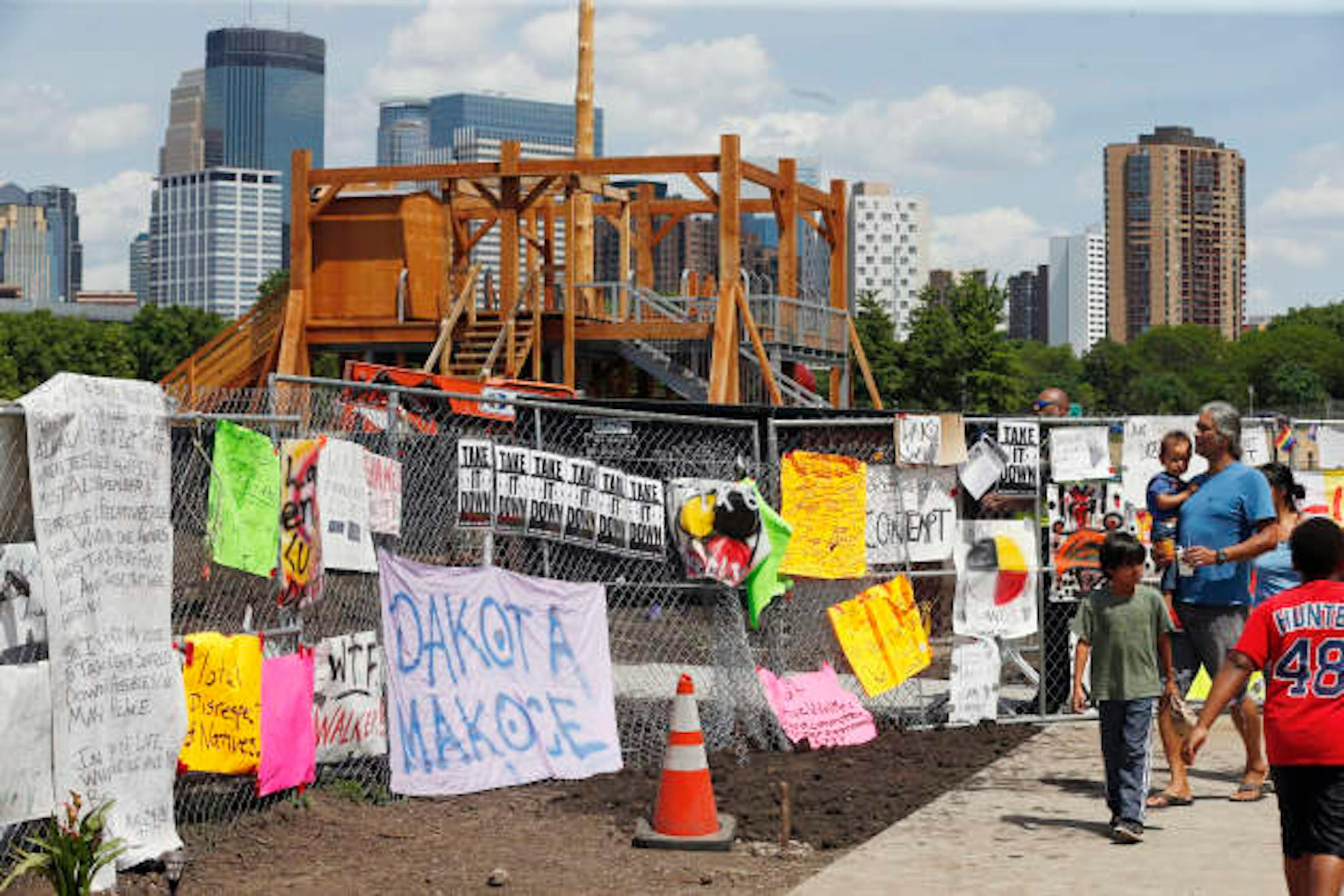
Pubic sentiment is displayed on fencing Friday, June 2, 2017 at the Walker Art Center in Minneapolis. where four-days of dismantling of the controversial sculpture "Scaffold", center, was to begin. Dismantling will be overseen by Dakota tribal elders. The Dakota people say "Scaffold", based in part of the design of the gallows used to execute 38 Dakota men in Mankato, Minn., in 1862, is not art and represents a painful history that Minnesotans have log ignored. (AP Photo/Jim Mone)
(Associated Press/The Minnesota Star Tribune)

(Associated Press photo by Jim Mone)

about the writer

about the writer

Alicia Eler

Critic / Reporter

Alicia Eler is the Minnesota Star Tribune's visual art reporter and critic, and author of the book “The Selfie Generation. | Pronouns: she/they ”

See Moreicon