

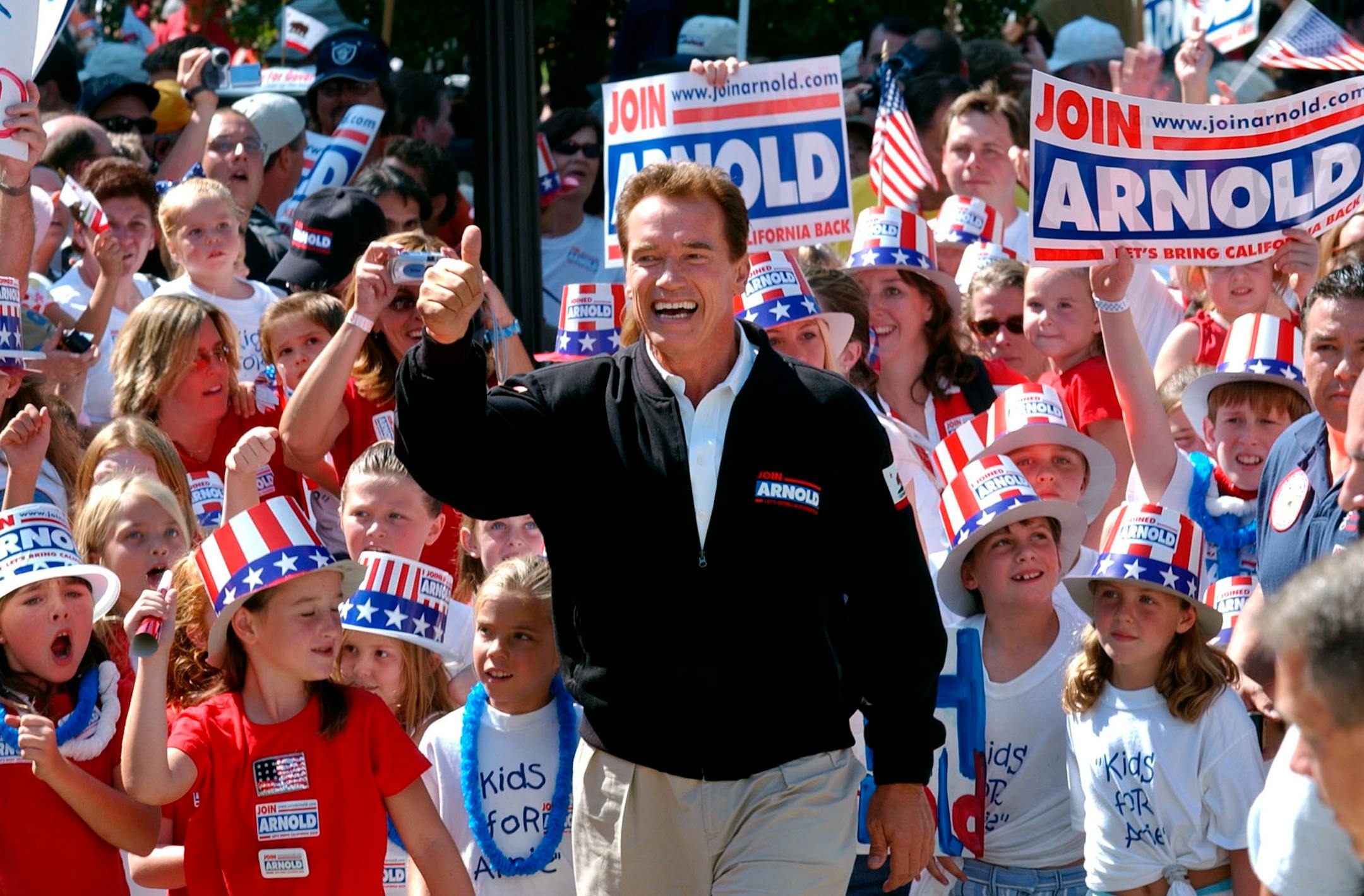
In October 2003, I was working at the CBS affiliate in Bakersfield, Calif., running the assignment desk and helping produce our political coverage. It was an exciting time to be in both news and politics.
On our very own news set, country music icon Buck Owens, who had made Bakersfield his adopted home, presented Arnold Schwarzenegger with an autographed guitar. I remember so vividly the energy and excitement that filled the atmosphere. One of the loudest campaign events I've ever experienced was when the would-be "Governator" campaigned with the man who was then-known as "America's Mayor," former New York City Mayor Rudy Giuliani.
There was a palpable feeling that this could be a fresh start, for the state but also for the Republican Party. Even though we were in the midst of an unprecedented political upheaval in California, the environment was positive and enthusiastic.
During his victory speech, Schwarzenegger declared that he would "reach out to Republicans, to Democrats and independents, to those who supported the recall and those who did not, those who supported me today and those who did not. I want to reach out to everybody, to young and old, rich and poor, people of all religions, all colors and all nationalities. I want to be the governor for the people. I want to represent everybody."
In many ways, the recall election of 2003 was a battle between the state's more moderate and conservative factions. Schwarzenegger, who was then a member of the Kennedy family, became the standard-bearer for the moderates while then-state Sen. Tom McClintock ran as the conservative choice.
McClintock openly questioned Schwarzenegger's party loyalty, saying, "This is a man who just a few years ago said he was ashamed to be a Republican."
Schwarzenegger, the moderate, won decisively.
That was the last time the Golden State elected a Republican governor.


