
Flood forecasters keeping watch over the Red River

After several dry springs, the Red could be due for another flood.

February 4, 2017 at 9:50PM
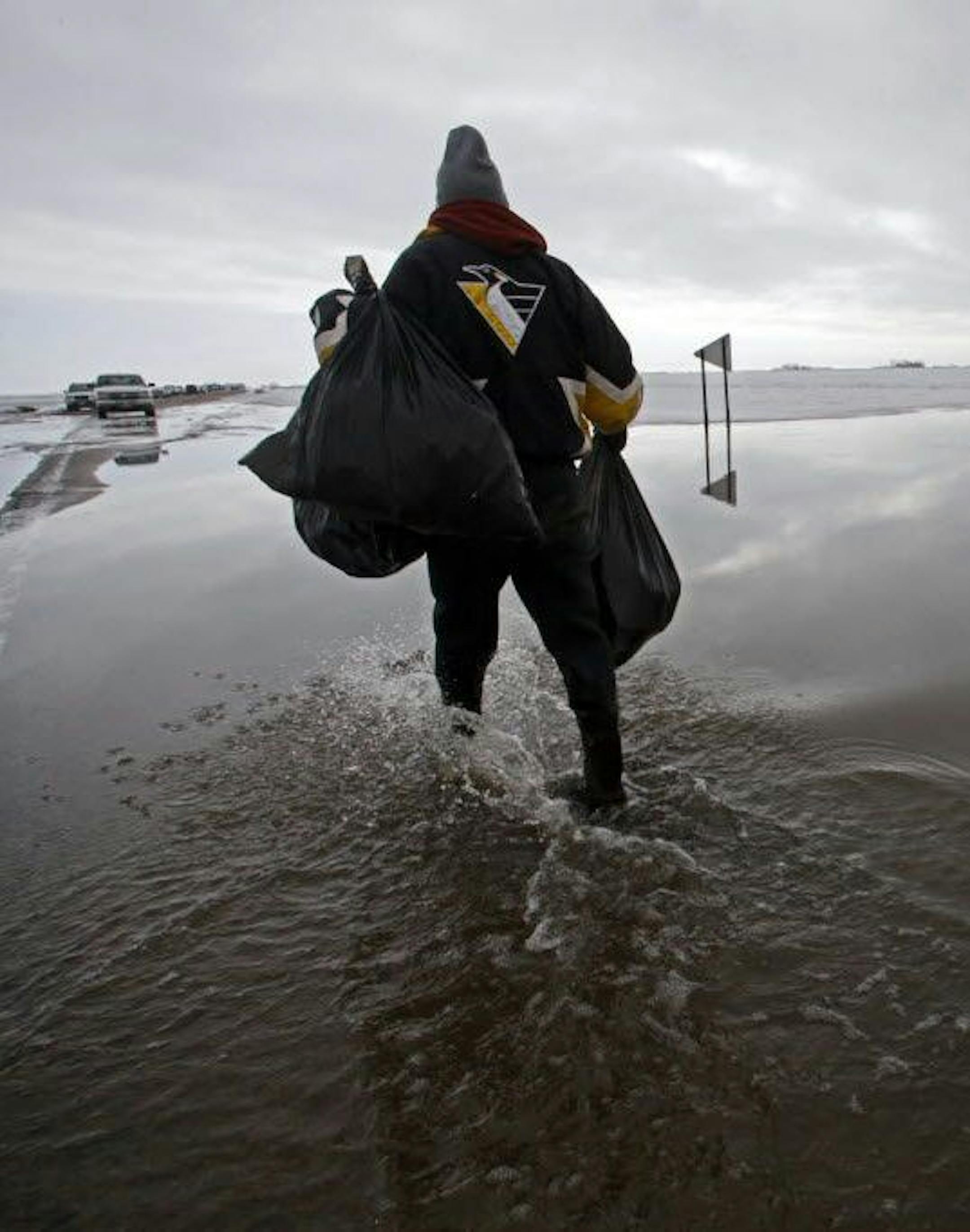
BRIAN PETERSON ï brianp@startribune.com Fargo, ND - 3/28/2009 ] After reaching an all-time high at 40.82 shortly after midnight, the Red had slowly slipped to 40.68 feet in Fargo and Moorhead at 11:15 a.m. That's still three-quarters of a foot higher than the Red has ever reached in recorded history. (IN THIS PHOTO) Ice flows that could cause daming still present a problem along the Red River, this was the scene in the Oxbow area south of Fargo, ND. Some of these homes had lost the battle.
Homes were submerged in Fargo during flooding in 2009. Current forecasts say there’s a risk of moderate flooding around Grand Forks and East Grand Forks. (The Minnesota Star Tribune)

With spring's thaw only weeks away, communities along the Red River are keeping a wary eye on the flood forecast.

After a long dry stretch, the region has been soaked with double the usual amount of winter rain, sleet and snow, prompting the National Weather Service to recently issue an early warning about potential spring floods.

The Red has flooded in 50 of the past 111 years, although in recent springs, it has stayed largely within its banks, keeping flood-prone communities from breaking out the sandbags. If that changes this spring, Minnesota officials say they're ready, after years spent shoring up their flood defenses.

"We don't do much of any sort of sandbagging anymore, with the flood protection system we have here," said East Grand Forks Fire Chief Gary Larson.

This year marks the 20th anniversary of the catastrophic flood of 1997, when the worst flood in a century submerged most of the city, destroying hundreds of homes and inflicting billions of dollars in damage across the region.

East Grand Forks rebuilt with hundreds of millions of dollars worth of flood defenses.

"We're protected up to 60 feet" of floodwater, Larson said.

Meteorologists are currently forecasting a risk of moderate flooding around Grand Forks and East Grand Forks, where the Red could rise to 43 feet.
Spring snowmelt ripples across the north-flowing Red and into ice jams in still-frozen stretches of the river downstream. But the real problem is the region's pancake-flat terrain, which allows floodwaters to spill and spread across the prairie for miles in every direction.

"The slope of the Red River Valley is so gentle," said Brad Hopkins, observations program leader for the National Weather Service in Grand Forks. "It takes a long time for water to move out of the system once a flood occurs."

The Red floods slowly, giving downstream communities time to mobilize and prepare. Floodwaters might crest in Breckenridge, Minn., and Wahpeton, N.D., then a few days later in Fargo and Moorhead, then four or five days later, peak around Grand Forks and East Grand Forks.

"The crest will eventually work its way to the Canadian border and on toward Winnipeg," Hopkins said. "We're not talking about a flash flood. We're talking more of a long-term, aerial flood."

If the floodwaters come, communities such as Moorhead, which has spent the past few years beefing up its defenses, will be ready.

If a major flood hit the Fargo-Moorhead area this spring — which seems unlikely at the moment — it would be the first test of a new network of $105 million worth of flood control structures, including new pumping stations and some 12 miles of levees.

With all the new precautions in place, the current forecast "presents no issue for the city of Moorhead," City Engineer Bob Zimmerman said. The river would have to rise to at least 38 feet in the city before Moorhead experienced problems, he said, "so the forecast is not as grave a concern as it would have been in previous years."

At the moment, the National Weather Service is forecasting a 50 percent chance that the Red will spill over its banks this spring.

Around Fargo-Moorhead, where flood stage is 18 feet, the Red is now projected to crest at just under 30 feet.

The forecast could change between now and spring, however. The National Weather Service will update its flood outlook for the Red River Valley at the end of February.

Jennifer Brooks • 612-673-4008

The 2009 Red River flood broke records and isolated Fargo-Moorhead residents in their homes. Here, John Schultz wades through the frigid water that surrounded his home in the Crestwood subdivision.
The 2009 Red River flood broke records and isolated Fargo-Moorhead residents in their homes. (The Minnesota Star Tribune)
about the writer

about the writer

Jennifer Brooks

Columnist

Jennifer Brooks is a local columnist for the Minnesota Star Tribune. She travels across Minnesota, writing thoughtful and surprising stories about residents and issues.

See Moreicon