

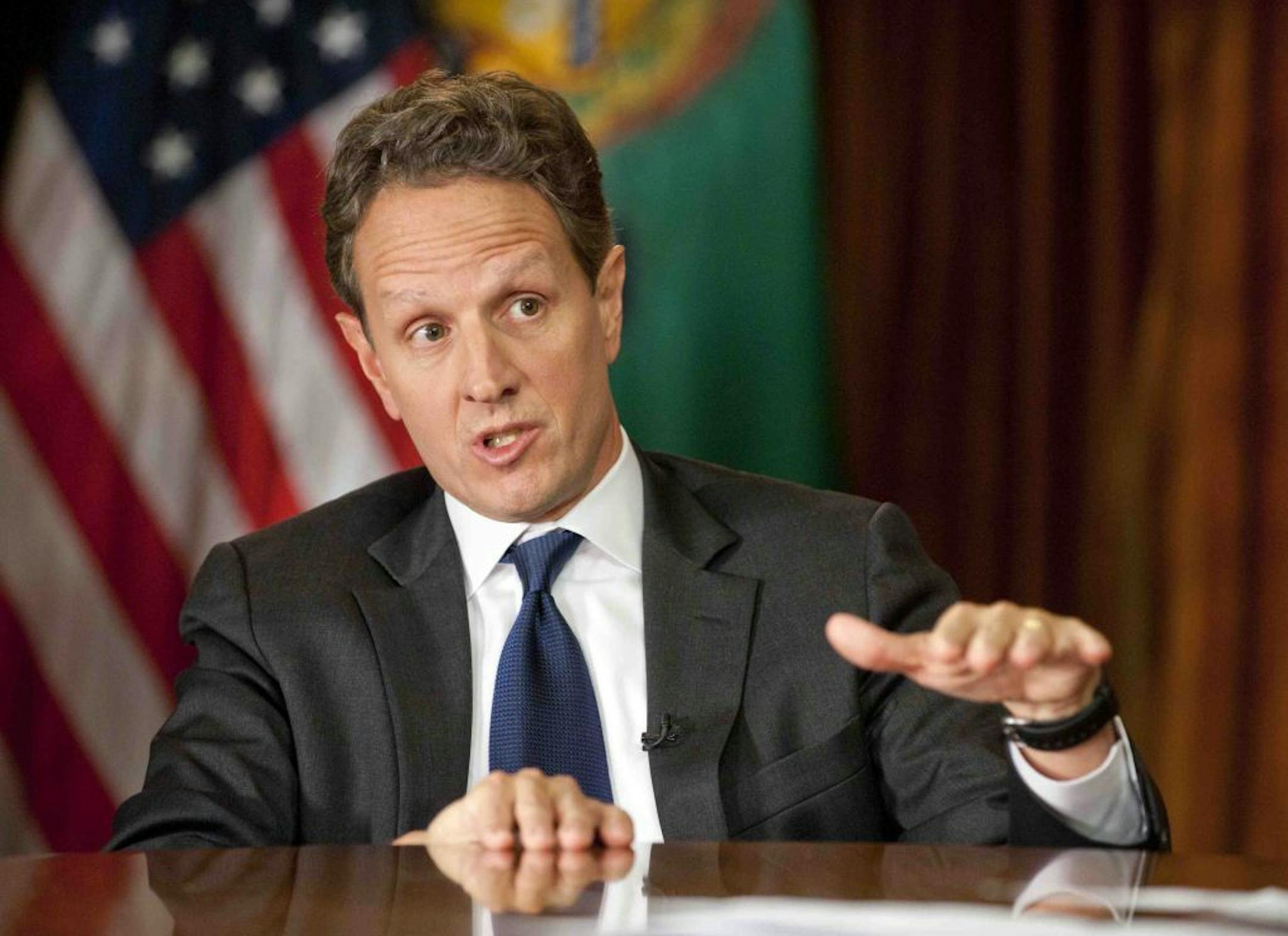
Four years ago, it looked like Timothy Geithner might not survive his confirmation hearings, much less complete a term as Treasury secretary. A background check revealed that he hadn't paid payroll taxes for over two years while working at the International Monetary Fund.
Meanwhile, his chief qualification for the Treasury job was his tour as president of the Federal Reserve Bank of New York, where he executed President George W. Bush's bank bailout.
Geithner leaves office as one of the most important Treasury secretaries in history, having helped rescue the economy from collapse. Clearly there were a few things we misunderstood about him. Here are five of the biggest.
1. Geithner is a creature of Wall Street.
When even the wife of Rahm Emanuel believes you're a Goldman Sachs alumnus, it's going to be tough to convince the country otherwise. But the truth is that before taking over as Treasury secretary in 2009, Geithner spent 20 years in public service, save for a few months at the Council on Foreign Relations.
He worked at Treasury for more than a decade, including a tour as an attache in Tokyo, before joining the IMF and the New York Fed - but he's never worked on Wall Street. His only private-sector experience came at Henry Kissinger's consulting firm right out of grad school. Not surprisingly, Geithner has been defensive about his apocryphal investment-banking past. Appearing at a House Democratic retreat not long after his Senate confirmation in 2009, he blurted out: "I never worked for Goldman. I never worked on Wall Street. I don't come from money."
If there was a problem with Geithner's relationship to the financial sector, it wasn't corruption but intellectual capture. Geithner spent his two decades as a bureaucrat adopting many of the views of the financial-sector elite. When he was New York Fed president, several titans of finance sat on his board of directors. So it came as no surprise when he told me in 2011 that preserving Wall Street's outsize role in the economy was one of the keys to America's strength. "I don't have any enthusiasm for . . . trying to shrink the relative importance of the financial system in our economy," he said.
2. Geithner is mild-mannered and understated.


