

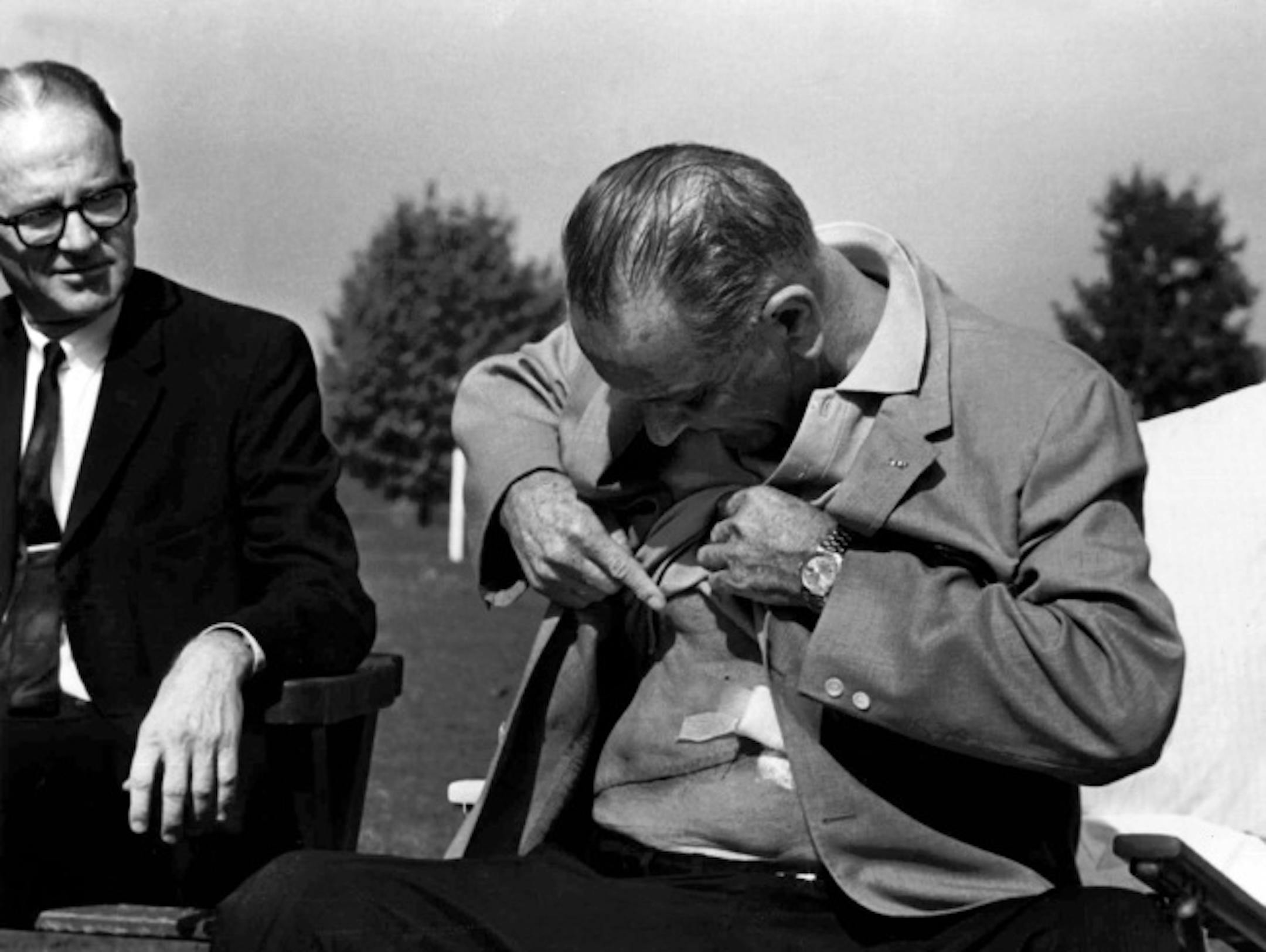
When Hillary Clinton announced a diagnosis of pneumonia last week, soon after leaving a Sept. 11 memorial service, she elicited a predictably partisan response. Fans of Donald Trump speculated that she wouldn't survive the year, while her own supporters pointed out that hardworking people get sick all the time. Both presidential candidates have been pressured to release more information about their health. But this information may not be as useful as we think. Past assumptions about the health of presidents and candidates often have been shrouded in myth.
Myth No. 1
Franklin D. Roosevelt gave away Eastern Europe to the Soviets because he was sick.
As the Soviet Union took control of more and more of Eastern Europe after World War II, critics of Franklin D. Roosevelt argued that he - increasingly lethargic and confused because of illness - had been unfit to negotiate. The "sick man of Yalta," according to this theory, had been duped by his Soviet counterpart, Joseph Stalin. Lord Moran, Winston Churchill's physician who attended the 1945 Yalta conference that divided territory after the war, wrote that Roosevelt "intervened very little in the discussions, sitting with his mouth open. . . . I doubt, from what I have seen, whether he is fit for his job here."
The reality was probably much more complex. It is true that Roosevelt was suffering from severe hypertension and congestive heart failure, which the medications of the era could not effectively treat. And the trip to Yalta, located in the Crimea region of the Soviet Union, had been arduous. Roosevelt had suffered periods of extreme fatigue. But his personal physician Howard Bruenn, who was also at Yalta, observed that the president's mental faculties remained intact. "His memory for both recent and past events was good," Bruenn wrote in a 1970 article in the Annals of Internal Medicine. "His behavior toward his friends and intimates was unchanged and his speech unaltered."
Moreover, Yalta represented a complex series of negotiations on many postwar issues, not only the fate of Eastern Europe. Churchill, who was surely of sound mind, had participated in the negotiations and had trusted Stalin as well. And, as historian James MacGregor Burns has argued, the West had only so much leverage over the Soviets, who, after all, had suffered the greatest human sacrifices in defeating Hitler. Roosevelt, Burns wrote, was a realist who had "reached the limit of his bargaining power." His illness did not determine the fate of postwar Europe.
Myth No. 2
Sick presidents aren't good at the job.


