

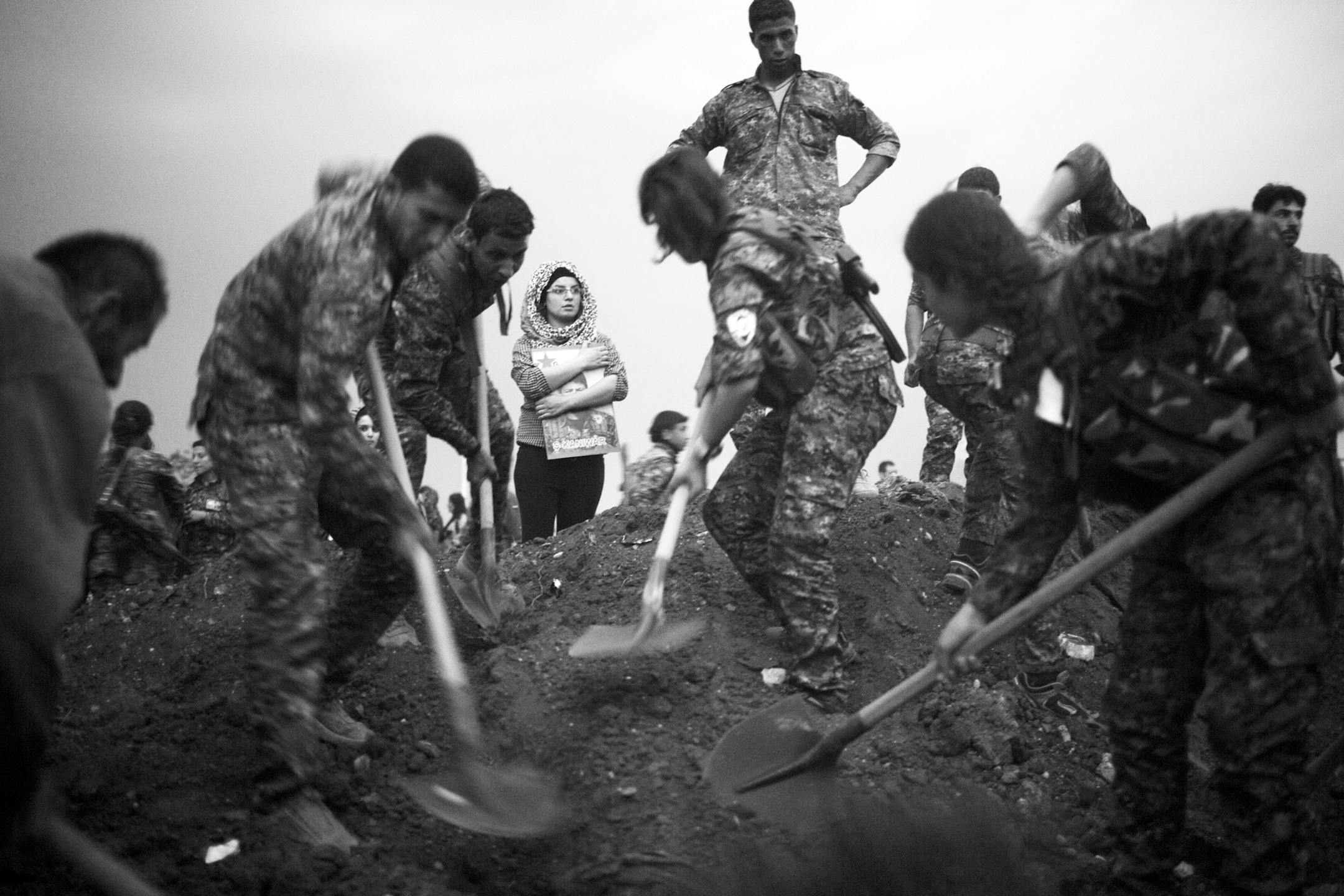
The Kurds are the largest ethnic group in the world without a state. They were promised autonomy by world powers after the collapse of the Ottoman Empire, but the Allies rescinded and carved up their population, subjugating them as ethnic minorities across Turkey, Iraq, Syria and Iran. In each country, Kurds have experienced varying degrees and forms of oppression but also have encountered opportunities for political expression. "The Kurds" are not a single entity with one common political aim. And President Donald Trump's decision last month to pull back U.S. troops from the Syrian border, exposing the Syrian Kurds to a Turkish incursion, has revived a raft of myths about them.
Myth No. 1: The Kurds are a nation fighting for independence.
"Their century-old quest for independence is marked by marginalization and persecution," a Council on Foreign Relations paper holds. Israeli Prime Minister Benjamin Netanyahu described that quest categorically in a 2014 speech: "We need to support the Kurdish aspiration for independence." (In fact, an independent Kurdish state briefly existed inside Iran in 1946 before Tehran crushed it.)
But while the Kurds in Iraq have sought to separate themselves from Baghdad, the aspiration for statehood is not held by all Kurds, and independence is not always an immediate goal. For the Kurdistan Workers' Party (PKK) in Turkey, founded in 1978, the initial goal of its insurgency was to achieve an independent Kurdish state, but the PKK eventually dropped that ambition and now seeks equal rights and regional autonomy. In Syria, the Kurdish Democratic Union Party (PYD) has been explicit that it does not seek an independent state — just regional autonomy within Syrian borders. The Kurdistan Democratic Party (KDP) in Iraq commenced a process toward independence in 2017, approving a referendum, but since then it has moderated that goal after Baghdad responded to the vote with violence.
Myth No. 2: The Kurds are superior soldiers on the battlefield.
The broader political goals for Kurds are some form of regional autonomy, self-governance within the confines of the state and basic national rights, such as the recognition of their identity and language.
Given their long experience in armed resistance against governments in Iran, Iraq and Turkey, Kurdish populations have generated seasoned war veterans. A former U.S. military adviser who helped them in Iraq described them in a Washington Times commentary as "Fearsome, fearless fighters." As a U.S. officer who fought with Syrian Kurds told Foreign Policy magazine, "Both their competence in battle and their commitment to the mission have been proven over and over."
But despite their bravery — the term "Peshmerga" means "those who face death" — Kurdish military culture remains largely grounded in traditional guerrilla warfare, and units often lack the type of organization and resources required to fight conventionally. Syrian and Iraqi Kurds absorbed heavy casualties fighting the Islamic State and would have lost many more troops without foreign air support, training and military hardware. In fact, recent spurts of global security cooperation with the Kurds came at times when Kurdish forces faced potential collapse. This was the case in 2014, when American airstrikes helped the Peshmerga in Iraq deflect an Islamic State assault and when U.S. support helped break the Islamic State siege of Kobane, a city in northern Syria.
Since then, with the help of foreign training missions, many units in Syria and Iraq have developed expertise in counterinsurgency and conventional warfare. But there is still wide variation between the different Kurdish armed groups, and from unit to unit within the same organizations.
Myth No. 3: The Kurds are friendless.
Kurds have a proverb: "Kurds have no friends but the mountains." This lament is also the title of a 1993 history of the ethnic group by John Bulloch and Harvey Morris. It highlights their long and lonely struggle for domestic security and international recognition, especially at times when the Kurds have felt betrayed by foreign powers. Iraqi Kurds, in particular, have a long history of being deserted by Washington. In October 2017, they felt abandoned when the United States failed to keep Iraqi troops from advancing on Peshmerga-controlled territory after the independence referendum. "The U.S. has now betrayed the Kurds a minimum of eight times over the past 100 years," Jon Schwarz wrote in the Intercept last month.


