

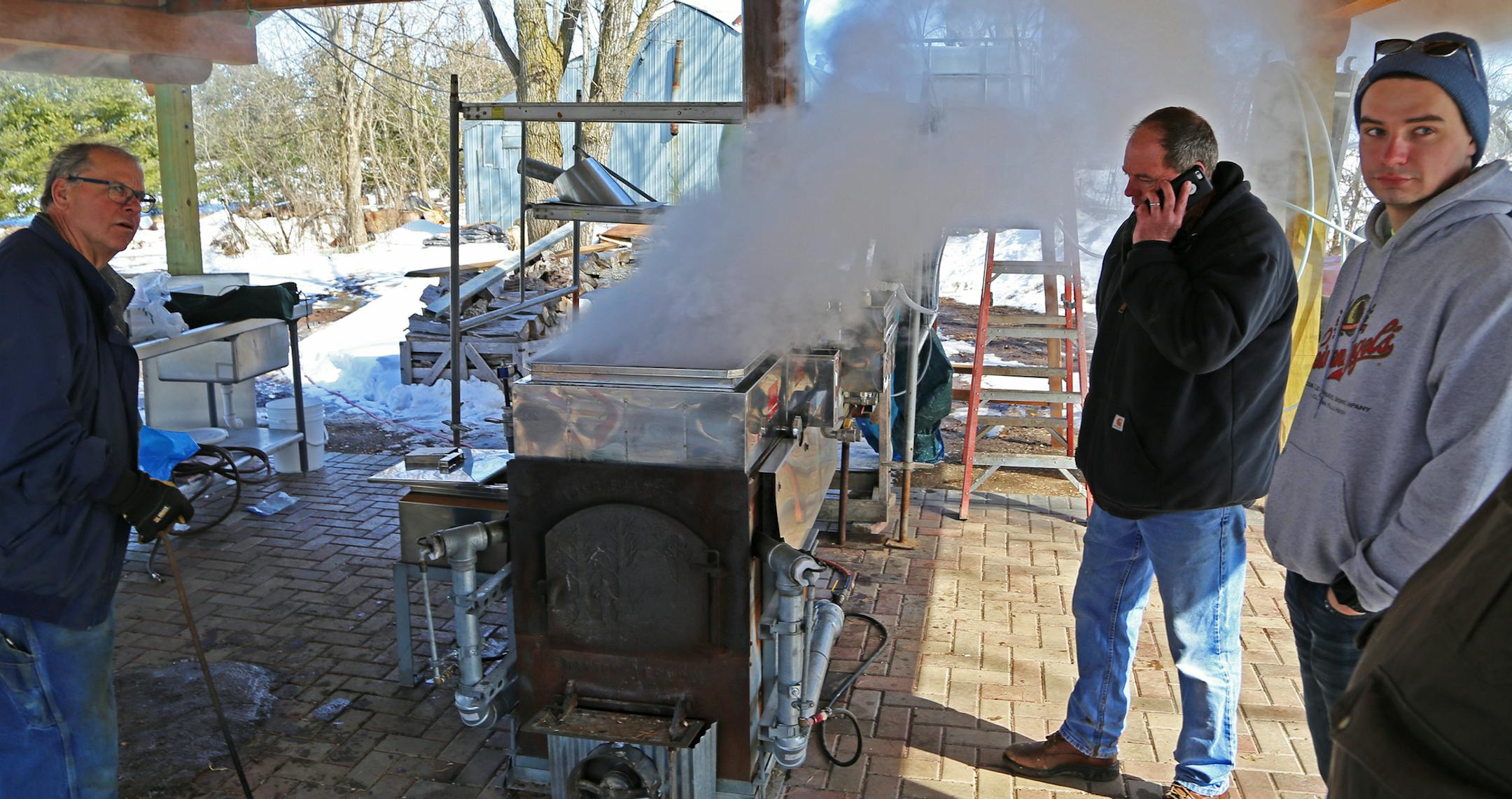
The other day as a pair of Canada geese arrowed overhead, Jim Smith tossed a log on a fire, above which maple sap boiled in a stainless-steel pan.
The geese might have just arrived from points south. Or perhaps they were locals that had passed the winter in Minnesota. Either way, flapping their wings and honking, and flying low, as if curious, the birds and their arrival seemed synchronous with Smith and his fire-tending.
During these warming days and still-cool nights, similar sap-burning fires will crackle throughout Minnesota, Wisconsin and many other states.
Silver maples will discharge the season's first sap, followed by sugar maples. When both flow freely, men, women, boys and girls will collect bag after bag of the sweetened water and carry it to fires that in many cases are kept ablaze all day and all night.
"I got into this kind of by accident,'' Smith said. "My neighbor was having a garage sale and I went over there to see what they had. One thing led to another and … here I am.''
Where Smith is, is in his backyard, not far north of Stillwater. Dave Swager was there the other day, too, as was Vince Anderson. Each is a member of a five-family syrup-making operation that to the casual observer might resemble a moonshiner's hooch factory.
"We didn't know Jim when he came to the garage sale, which was at the home of Pam and Eric Lindberg, who are in our syrup-making group,'' Swager said. "But when we found out Jim owned the house we had been watching that had a yard full of sugar maples, we were glad to meet him.''
Syrup makers often keep one eye peeled for maple trees whose full potential is not being realized. Meaning they are not being tapped. Owning such trees is best. Next best is knowing the trees' owner, or knowing someone who knows someone who knows the owner.
Last year, Smith, et al, tapped 500 trees, a big number for what is essentially a hobby operation.


