
Five big political questions for 2023

After the election we've been left with a few cliffhangers.

Bloomberg Opinion
January 1, 2023 at 12:00AM
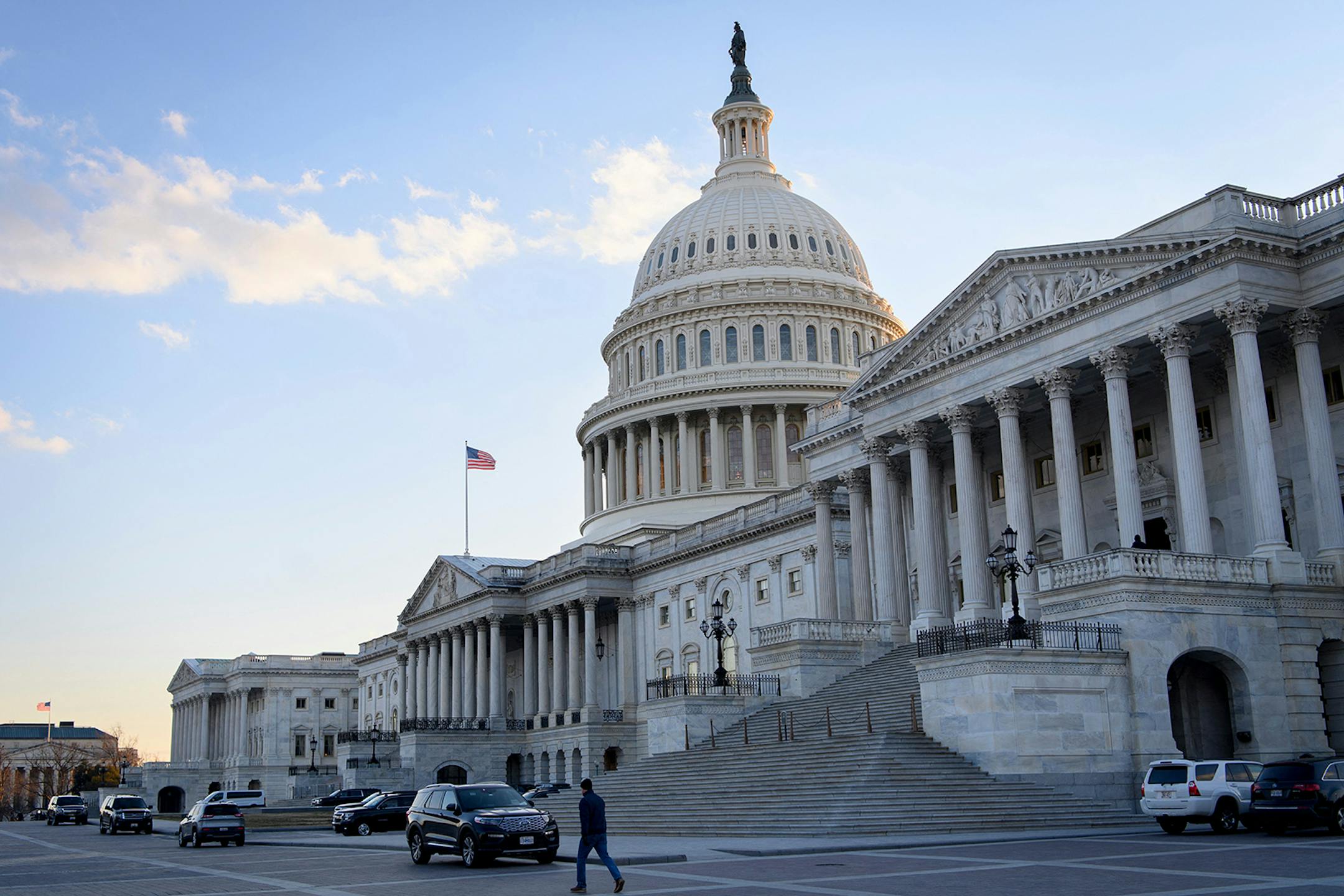
The U.S. Capitol is seen in Washington, D.C., on Feb. 14, 2022. (Mandel Ngan/AFP, TNS - TNS/The Minnesota Star Tribune)

Opinion editor's note: Star Tribune Opinion publishes a mix of national and local commentaries online and in print each day. To contribute, click here.

•••

Political prognosticators are facing a mountain of unknowns for the coming year, starting with whether President Joe Biden will seek a second term. Other cliffhangers include whether former President Donald Trump will be indicted and whether Rep. Kevin McCarthy will succeed in getting elected speaker of the House. Here are five more answers I'm waiting for that have the potential to shake up the political landscape.

Will the U.S. government default on its debt?

The federal government is set to hit its borrowing limit sometime next year. A failure by Congress to raise the debt ceiling as it periodically does, could cause the federal government to default on its debt for the first time ever, an event many economists say could spark a crisis in financial markets.

It really could happen. With Republicans taking control of the House, the GOP is talking tough about using the need to increase the limit to force policy changes. But the real problem is that a lot of House Republicans simply won't vote for a debt limit under any circumstances, and some might punish any GOP House speaker who brings the measure to the floor.

There will almost certainly be a bipartisan House majority in favor of an increase with no conditions attached. But the majority party determines what comes up for a vote, and it isn't clear that any Republican speaker will allow it.

Will the Republican House impeach Biden?

Had the 2022 election gone better for them, House Republicans would most likely have pushed for a Biden impeachment. And even with their less-than-dominant performance, they still might. We know that Trump wants to remove some of the stigma of his own two impeachments, and he has plenty of friends in the House. Besides, within the Republican Party, it's difficult to say no to Democrat-bashing.

Impeaching Biden would require the cooperation of nearly all Republicans in the House, an uncertain prospect. Yet even if the attempt was doomed to fail on the House floor, there are a lot of Republicans who want to be on record voting for impeachment.

Unlike a government default, the effects would be largely symbolic. But symbolic damage to the constitutional order matters.

Will Republican candidate recruitment go better next time?

Odd-numbered years are when the bulk of candidate recruitment happens for Senate and gubernatorial contests. In 2021, Republicans suffered setback after setback, as seemingly strong candidates such as New Hampshire Gov. Chris Sununu and Arizona Gov. Doug Ducey chose not to challenge sitting Democratic senators. The result was a historically weak group of candidates for 2022 — and historically unusual losses for an out-party.

What's far from clear is whether Republicans are fixing what was broken. Prospective candidates might still be frightened by the possibility that Trump loyalists with dubious qualifications would have an edge in party primaries. And politicians interested in creating conservative public policy might still not believe that it was possible to do so in a party that values outrage over substance.

Will Supreme Court Justice Sonia Sotomayor retire?

After Ruth Bader Ginsburg died during Trump's presidency, Democrats grew more aware of the benefits of strategic retirement from the Supreme Court. Some are starting to encourage Sonia Sotomayor, who is 68, and even Elena Kagan, 62, to step down while there is a Democrat in the White House and a Democratic majority in the Senate — neither of which is guaranteed after 2024.

Even if Biden or another Democrat is president in 2025, Republicans have made it fairly clear that they would block any Democratic nominee to the high court if it is up to them. A Republican-majority Senate last confirmed a Supreme Court justice nominated by a Democrat in the 19th century.

And with a very favorable Senate map in this cycle, the GOP is in a position to gain two seats (and the Senate majority) even if it's a decent year overall for Democrats. Nor is it hard to imagine it taking 12 years — or longer — for Democrats to regain both the presidency and a Senate majority.

Justice Clarence Thomas chose not to retire when Republicans had unified control; he will be 75 in June, and he certainly could be around the next time a Republican in the White House can get a similarly conservative nominee confirmed. But any justice over 65 is taking a real risk that they will imperil the principles they fought for if they fail to retire strategically. Sotomayor will have to decide — and Democrats are going to make sure she knows what the stakes will be.

Will the election results influence the court?

The current court has more than just a very conservative majority. As we saw in several decisions, but especially in the Dobbs ruling overturning Roe v. Wade, it's an aggressive court eager to influence public policy.

Supreme Court justices have lifetime positions and don't have to worry about the next election. But party actors do worry about such things. And these days all Supreme Court justices act as if they are partisans. Concern over electoral effects may be why Chief Justice John Roberts in many cases including Dobbs has acted less aggressively than the other conservatives. After the abortion decision was credited with helping Democrats in the midterms, the question is whether one or more conservative justices will temper their approach.

Republicans overall may view the trade-off as worth it — a sweeping abortion decision in apparent exchange for one disappointing midterm election. Even so, Roberts might find some allies among justices who believe that the party is better off getting conservative results in smaller increments, rather than through sweeping decisions such as Dobbs. With several hot-button decisions expected in the coming months, including on such matters as the power of state legislatures over elections, affirmative action and environmental regulation, the consequences of the choice between incrementalism and grabbing what they can quickly could be enormous.

about the writer

about the writer

Jonathan Bernstein

More from Commentaries

See More
card image
Alex Kormann/The Minnesota Star Tribune

To me, the run of stories in 2025 has an uncomfortably familiar sound, yet each episode has come and gone with barely a flicker of concern.

card image
card image