

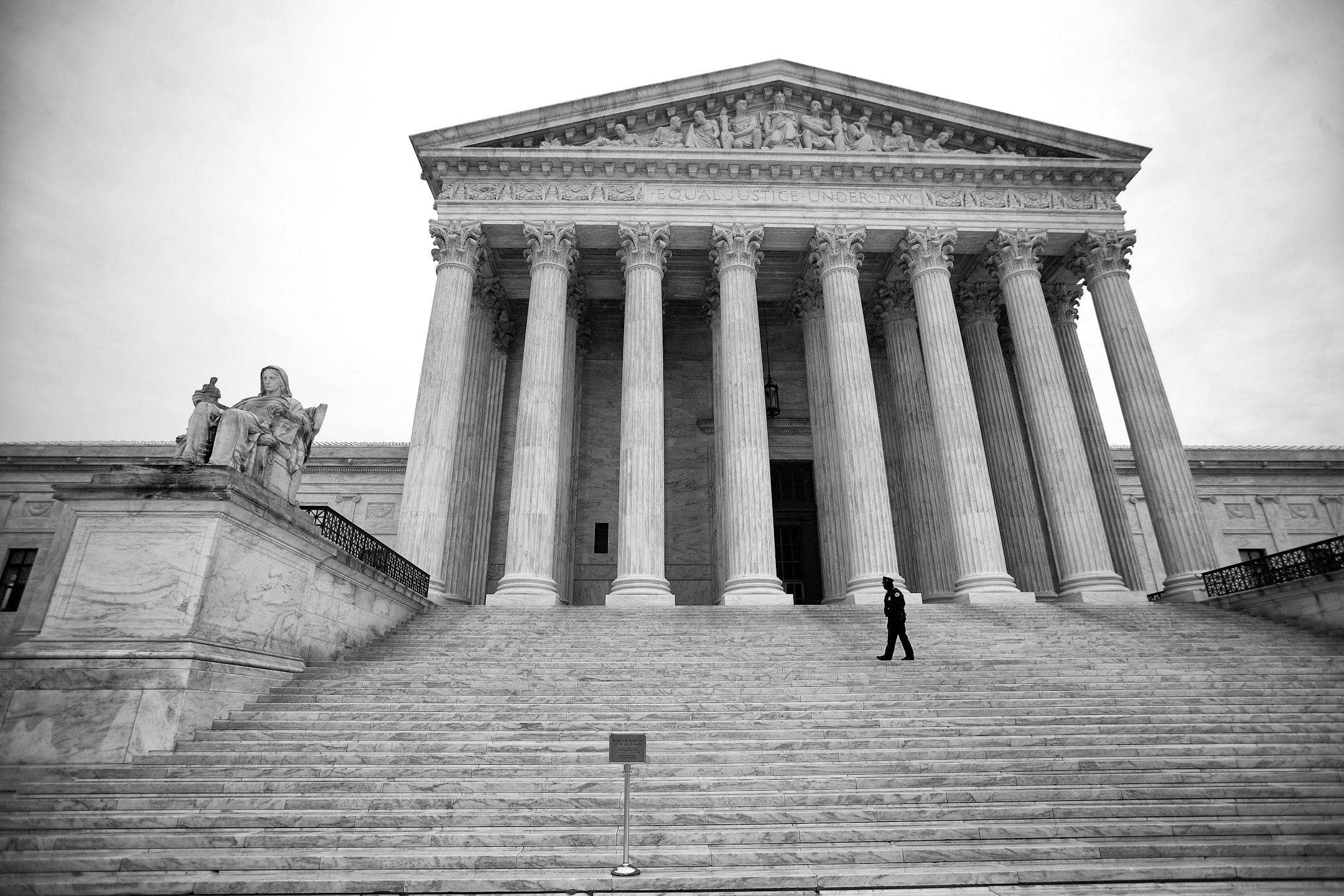
There's no free speech in front of the U.S. Supreme Court — or so says the U.S. Court of Appeals for the D.C. Circuit, which on Friday upheld a 1949 law that says you can't assemble or display signs on the plaza in front of the courthouse.
The decision contradicted a 2002 ruling by the same court that allowed free speech on the grounds of the U.S. Capitol, just across the street from the court. It rested on a combination of architectural analysis and insistence that judges and courts should be more insulated from the public than politicians and legislators.
With all due respect to the D.C. Circuit, architecture is beside the point. What's sometimes called the second highest court in the land was being much too deferential to the highest. The Supreme Court frequently decides high-profile, politicized cases with no single correct legal answer. It stands for free speech. Limiting speech on the plaza is not just a legal mistake. It's a symbolic one.
The court analyzed the law in two steps. First, it asked whether the plaza in front of the court is a traditional public forum or a nonpublic forum. In a different case, the Supreme Court itself had held that the sidewalk in front of the plaza is a public forum. And the district court that ruled in this case had extended this logic to the plaza.
The appeals court on Friday said the plaza wasn't a public forum. It emphasized that the plaza forms an integrated architectural whole with the steps and the courthouse building as designed by Cass Gilbert. The opinion even quoted a statement by Justice Stephen Breyer to the effect that the building's plan "leads visitors along a carefully choreographed, climbing path that ultimately leads to the courtroom itself."
Today, for security reasons, visitors actually can't use the front door to the court, which would lead them from the plaza to the courtroom. But that really doesn't matter. The point is that architectural coherence isn't a good measure of whether a space is public.
A case in point is the grounds of the Capitol, designed by Frederick Law Olmsted, probably the most important landscape architect in U.S. history. They're also designed to be integrated with the Capitol. Yet in the 2002 case Lederman vs. U.S., the D.C. Circuit ruled that the Capitol grounds constituted a public forum and struck down no-demonstration zones there.
The court distinguished the Capitol grounds from the Supreme Court plaza just across First Street by citing a statement made by the Supreme Court this past April in a case called Williams-Yulee vs. Florida Bar to the effect that "judges are not politicians."


