

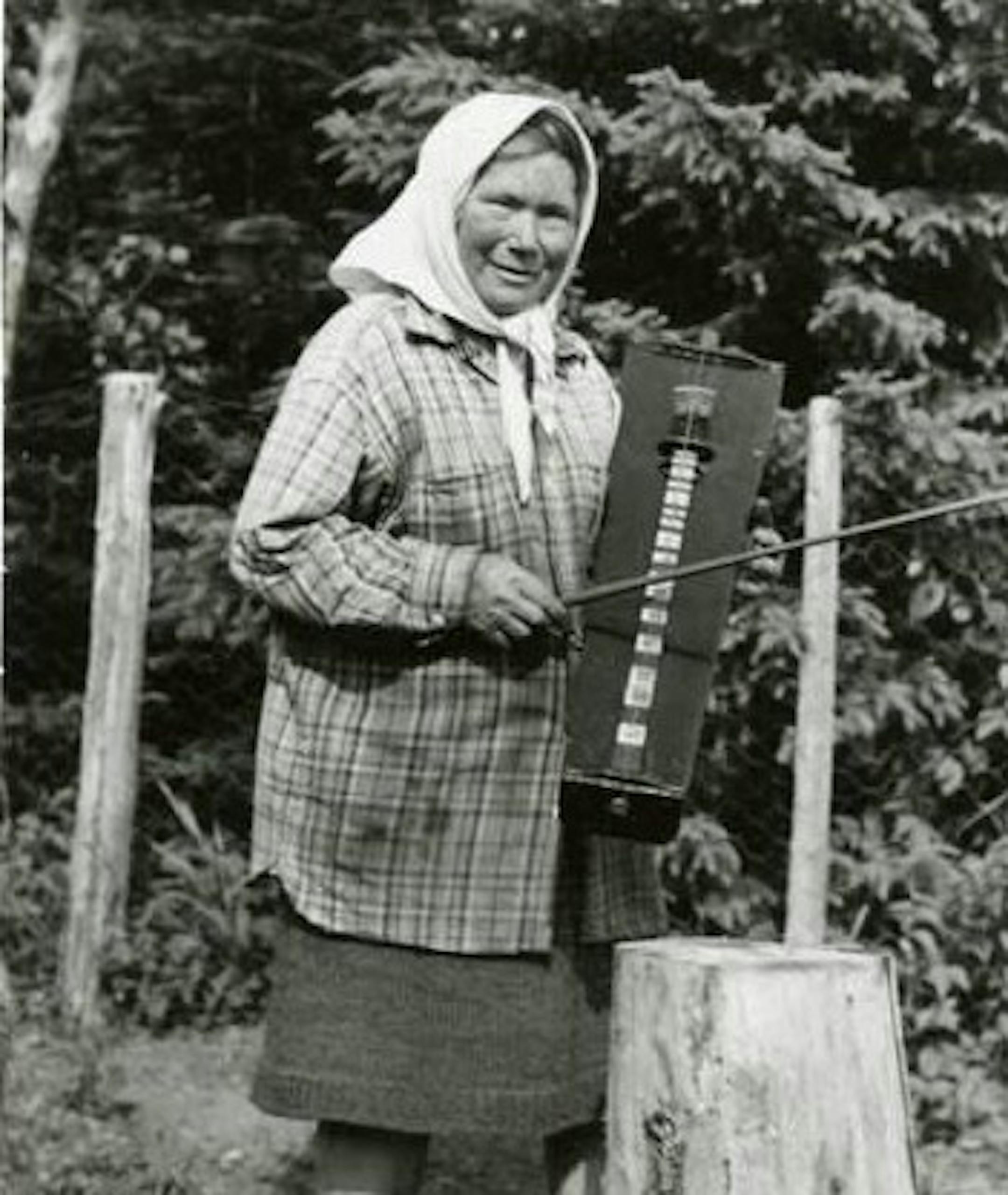
The Finns have a word for her: sisu, which translates roughly to mean strong will, determination or perseverance.
For more than 50 years, from 1928 into the 1980s, Finnish émigré Lydia Torry made her year-round home on Kubel Island — one of the countless rocky outcrops dotting the lakes way Up North along the Canadian border in what became Voyageurs National Park.
Unschooled, she taught herself English by scouring her decades-thick collection of National Geographic magazines. She moved moss and dirt to somehow grow potatoes, carrots and rutabaga from her rocky garden. Standing 4-feet-10, she typically wore a dress and tennis shoes — crocheting bedspreads, curtains, you name it.
"It's simply amazing that she could live self-sufficiently that way for all those years," said Karen Keenan, 75, whose late husband, Jim, got to know Torry as a fishing guide in the area back in the 1950s.
Catherine Crawford, the collections manager at Voyageurs National Park, said: "Lydia had sisu and the way she lived and survived on her island has become a story of fascination."
Born to a poor farming family on Dec. 5, 1891, Lydia Kotiranda sailed from Finland as a young woman in the 1920s — joining her brother on his way to the mines near Virginia, Minn. She spent some time in New York, Wisconsin and Minneapolis, where a friend convinced her to write letters to a bachelor fisherman named Emil Torry, who lived on Kubel Island.
Exchanging letters for a year, Emil finally invited Lydia to Kubel Island on Lake Namakan (an Ojibwe word for sturgeon), where he worked as a commercial fisherman. She instantly felt connected to the rocky islands and pine-rimmed lakes.
"It almost looked like my old country," she said in a 1976 oral history when she was 84. "He asked me if I really liked this all, and then I said, 'Yes, I guess I like this.' " They were married in 1928 and had no children.


