

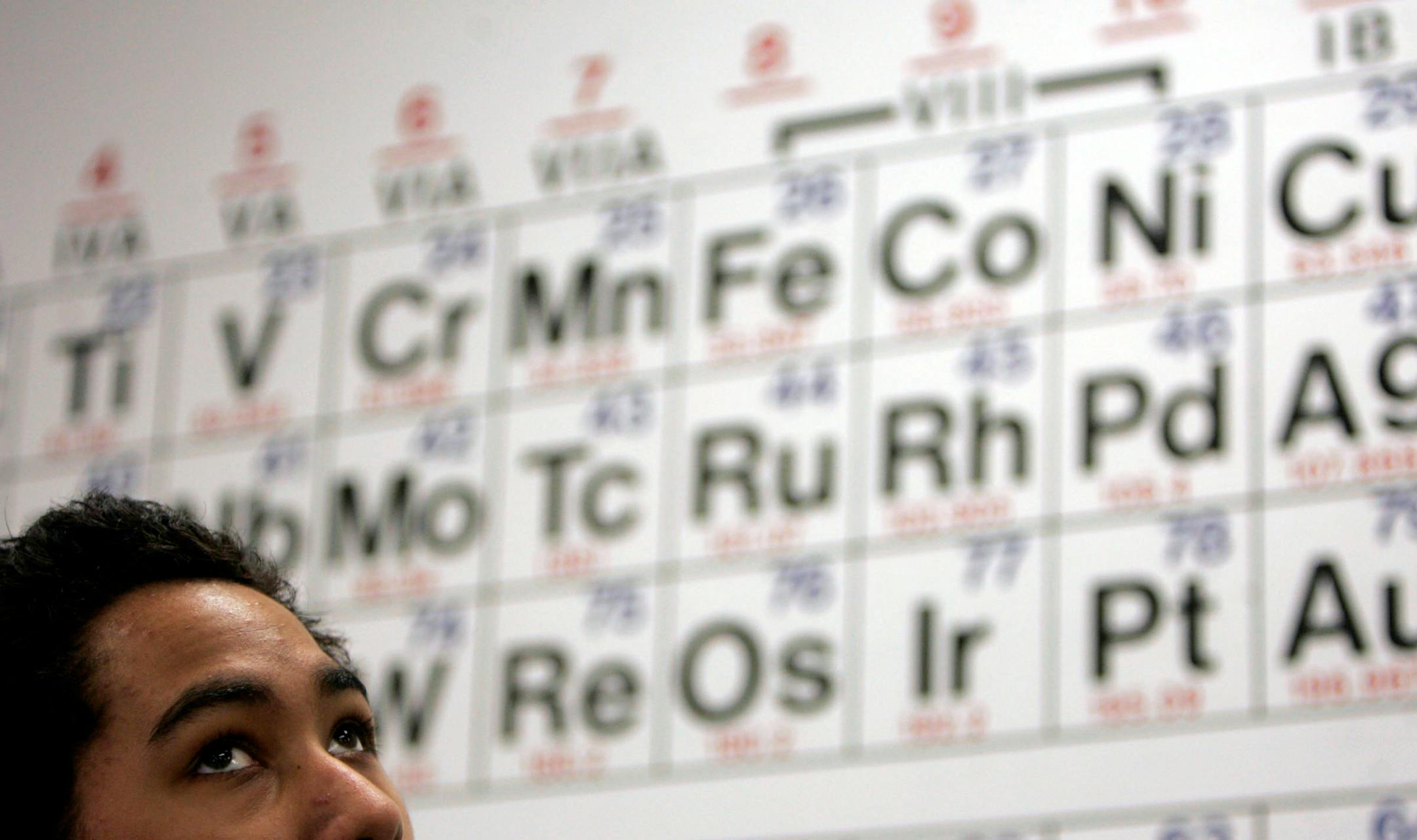
Jordan Richardson rubs his fingertips against the face of his watch, packs a specialized laptop into his shoulder bag, grabs his white cane, inches toward the edge of his seat and waits for the bell.
"I'm like a cheetah," he tells a visitor. "Hope you can keep up."
An electronic bell chimes and Jordan bursts into the cramped halls of Blaine High School, walking briskly through a sea of humanity that refuses to part like the Red Sea as he approaches -- even though everyone in the school knows Jordan is blind.
Undaunted by the crush of bodies rushing in every direction, he whisks up the stairs to his chemistry class, where the grand experiment is about to resume. Jordan, a 17-year-old junior, is among the few selected students nationally who hope to prove that blind students, with the aid of new computer technology, will be able to conduct chemistry experiments independently.
Or maybe the experiment is Jordan himself. The first blind student ever at Blaine High School, Jordan has Braille textbooks and is allowed to listen to computer programs through earphones while other students break into groups. Otherwise, this National Honor Society student, who dreams of going to college at Oxford, asks for few special privileges.
"Do you have my number? Want me to write it down for you?" Amanda Norskog, a senior, asks Jordan, who volunteers to help at a school-sponsored garage sale.
Jordan was told he had less than 5 percent vision -- legally blind -- when he was a preschooler. Both eyes continue to deteriorate and Jordan's mother says he is expected to lose all vision before he's done with college. Jordan can see blurred images, mostly peripherally, but is literally nose-to-white-board trying to read classroom instructions.
Amanda knows Jordan is blind, but anyone who gets to know him immediately realizes that Jordan sees the big picture. Jordan is an acknowledged student leader, a Student Council member, a trombone player in the school band who plays second fiddle to no one.


